
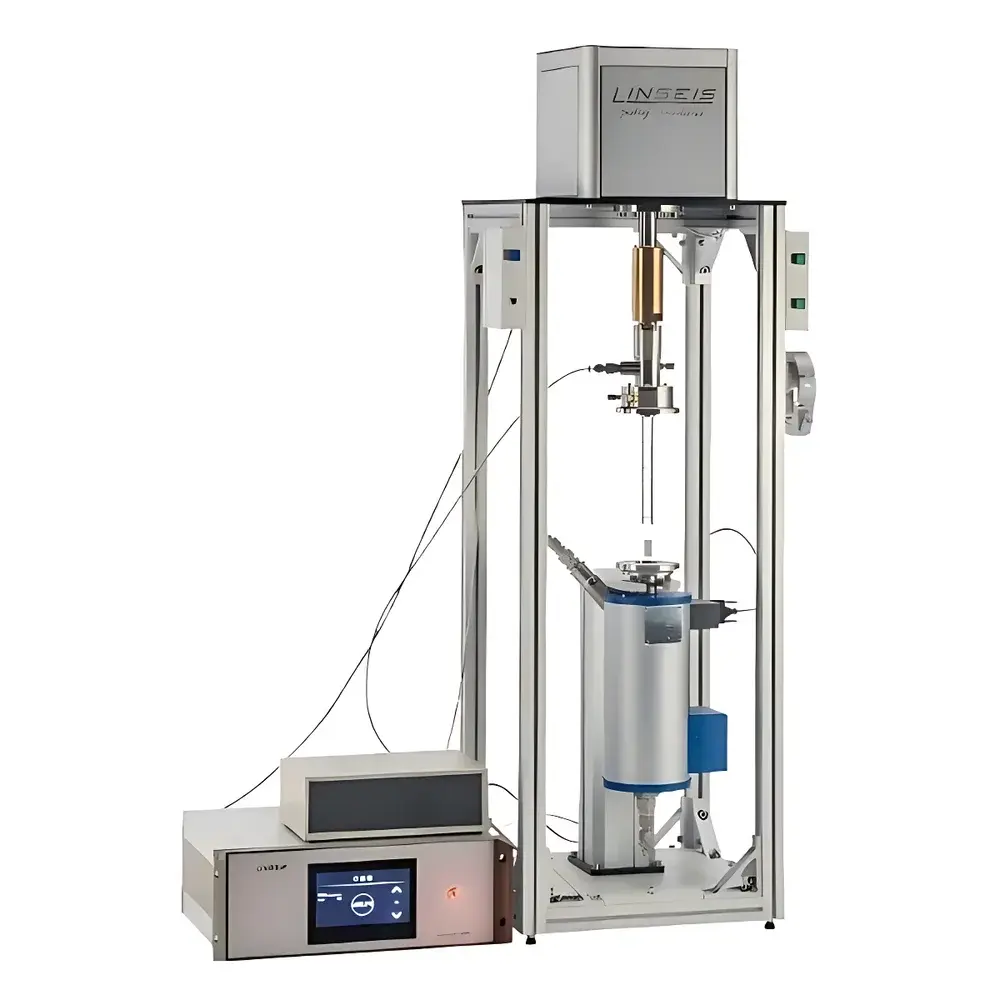
LINSEIS TGA L87 MSB Magnetic Suspension Balance
| Brand | LINSEIS |
|---|---|
| Origin | Germany |
| Model | TGA L87 MSB |
| Temperature Range | –196 to 2400 °C |
| Balance Sensitivity | 1 µg |
| Maximum Sample Mass | 10 g (standard balance) |
| Measurement Environment | Ultra-High Vacuum (UHV) to 150 bar (metal version) |
| Gas Analysis Compatibility | Mass Spectrometry (MS) and FTIR coupling supported |
Overview
The LINSEIS TGA L87 MSB Magnetic Suspension Balance is a high-precision thermogravimetric analyzer engineered for extreme-condition mass measurement under controlled thermal, pressure, and chemical environments. Unlike conventional microbalances integrated directly into furnace chambers, this system employs active magnetic suspension to decouple the weighing mechanism from hostile process conditions. Its core principle relies on closed-loop electromagnetic force compensation: a permanent magnet (suspended element) interacts with a controllable electromagnet mounted on a precision analytical balance. A position-sensitive optical or inductive sensor continuously monitors vertical displacement of the suspended magnet; feedback is processed by a PID controller that dynamically adjusts electromagnetic current to maintain equilibrium—effectively transducing sample weight into a stable, contactless force signal. This architecture enables true in-situ gravimetric analysis across an unprecedented temperature span—from cryogenic liquid nitrogen temperatures (–196 °C) to ultra-high-temperature ceramic processing (2400 °C)—while preserving long-term calibration stability and minimizing thermal drift.
Key Features
- True contactless mass sensing via active magnetic suspension, eliminating mechanical linkages and thermal conduction paths to the balance
- Dual-platform configuration: metal-cell variant rated for UHV to 150 bar and –196–2400 °C; glass-cell variant optimized for aggressive corrosives up to 900 °C and 1.3 bar
- 1 µg resolution with 10 g maximum load capacity (standard balance), validated over full operational temperature range
- Hermetically sealed glass cell option with fused-in sensor cores and magnet assemblies, enabling compatibility with HF, molten salts, and halogenated media
- Modular gas interface supporting real-time coupling to quadrupole mass spectrometers (QMS) and Fourier-transform infrared (FTIR) spectrometers for evolved gas analysis (EGA)
- Integrated PID-controlled levitation system with sub-micron positional stability and <0.1% linearity deviation across dynamic load range
Sample Compatibility & Compliance
The TGA L87 MSB accommodates solid, powder, and pelletized samples—including reactive metals, refractory oxides, catalysts, polymers, and biomass derivatives—within chemically inert or actively purged atmospheres. Metal cells feature customizable internal coatings (e.g., alumina, yttria-stabilized zirconia, or Hastelloy C-276 cladding) to resist oxidation, carburization, or acid corrosion at elevated pressures. Glass cells meet ASTM E1131 and ISO 11358 standards for thermal stability verification and are routinely deployed in GLP-compliant laboratories conducting USP residual solvent studies or EPA Method 8270D thermal desorption validation. All configurations support audit-trail-enabled operation per FDA 21 CFR Part 11 when paired with LINSEIS ThermoSoft™ v6.x software.
Software & Data Management
Control and data acquisition are managed through LINSEIS ThermoSoft™, a Windows-based platform compliant with IEC 62443-3-3 for industrial cybersecurity. The software provides synchronized multi-channel recording (mass, temperature, pressure, gas signals), automated baseline correction using reference-run subtraction, and derivative thermogravimetry (DTG) with adjustable smoothing kernels. Raw data files (.ltd) are stored with embedded metadata including instrument ID, calibration certificate traceability, operator credentials, and environmental timestamps. Export formats include ASCII, CSV, and universal .tdms (NI LabVIEW-compatible). Optional modules enable ISO 17025-aligned uncertainty propagation modeling and automated report generation aligned with ASTM E1868 guidelines.
Applications
This system serves advanced research and industrial QA/QC workflows requiring quantitative mass change under non-ambient conditions. Key use cases include: catalytic coke burn-off kinetics under simulated regenerator conditions (0–150 bar air/O2); hydrogen absorption/desorption isotherms in metal hydrides (–196 to 600 °C, 1–100 bar H2); thermal decomposition pathways of energetic materials under inert purge; density determination via Archimedean buoyancy in supercritical CO2; oxidation resistance evaluation of SiC/Si3N4 composites at >1800 °C; and long-duration stability testing of proton-exchange membranes under humidified H2/air cycling. It is widely referenced in peer-reviewed literature for coal char gasification modeling (Fuel Processing Technology), nuclear fuel cladding corrosion (Journal of Nuclear Materials), and MOF-based hydrogen storage certification (International Journal of Hydrogen Energy).
FAQ
How does magnetic suspension improve accuracy compared to conventional quartz spring balances?
Magnetic suspension eliminates thermal expansion-induced artifacts in mechanical linkages and avoids convective interference from hot gases—resulting in superior baseline stability and reproducibility below ±2 µg over 100-hour runs.
Can the system operate under reducing atmospheres such as pure H₂ at high temperature?
Yes—the metal-cell version supports fully reducing, oxidizing, or inert atmospheres up to 150 bar, with optional H₂-compatible seals and furnace insulation.
Is density measurement possible without additional hardware?
Yes—Archimedean density mode is built into ThermoSoft™; users input known reference volume and fluid density to compute sample density directly from buoyant mass shifts.
What maintenance intervals are recommended for the suspension control electronics?
The PID controller and position sensor require no routine calibration; annual verification against NIST-traceable weights and certified temperature references is advised per ISO/IEC 17025.
Are custom cell geometries available for proprietary reactor integration?
Yes—LINSEIS offers OEM engineering services for flange-matched cells, differential pressure ports, and fiber-optic temperature feedthroughs under NDAs.



