
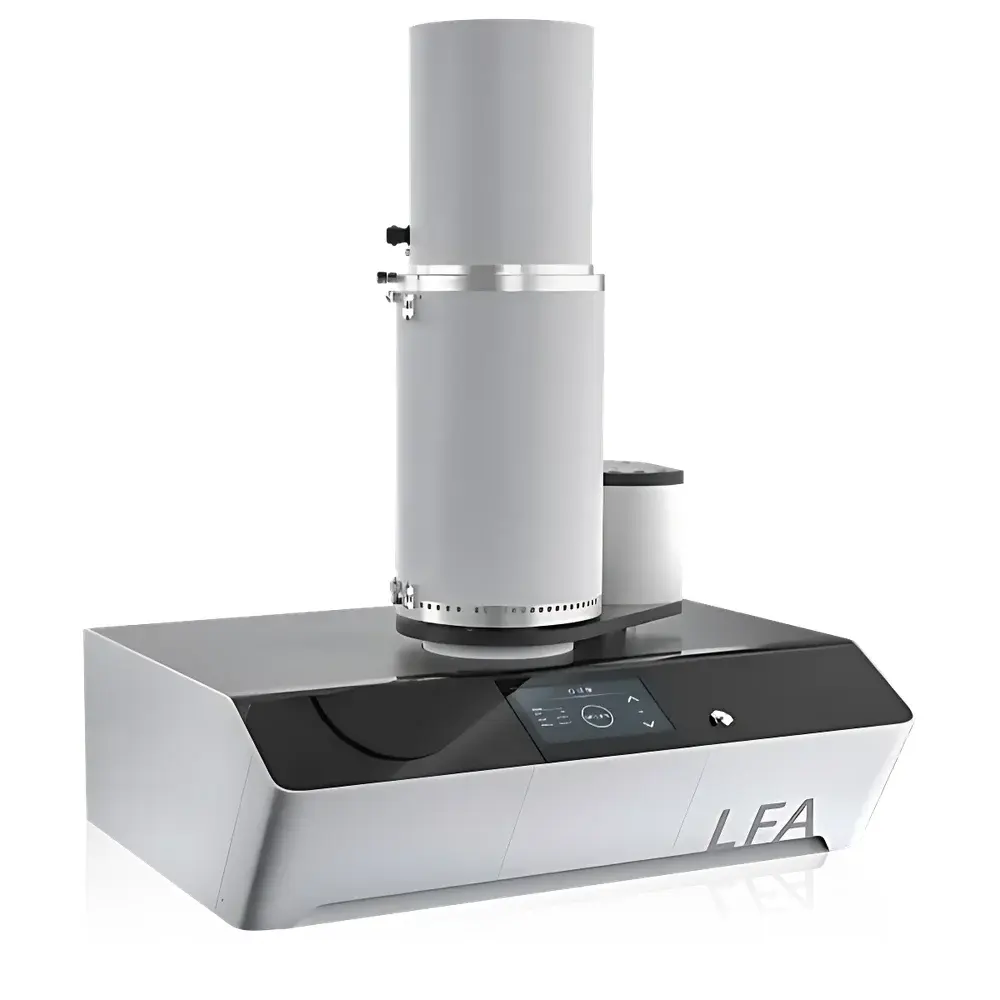
LINSEIS LFA L52 Laser Flash Analyzer
| Brand | LINSEIS |
|---|---|
| Origin | Germany |
| Model | LFA L52 |
| Measurement Principle | Laser Flash Analysis (LFA) |
| Thermal Conductivity Range | 0.1–4000 W/(m·K) |
| Thermal Diffusivity Range | 0.01–2000 mm²/s |
| Temperature Range | −125 °C to 2800 °C |
| Sample Forms | Solid, Powder, Liquid |
| Sample Geometry | Circular (Ø 6, 10, 12.7, 25.4 mm), Square (10×10 mm, 20×20 mm) |
| Sample Thickness | 0.1–6 mm |
| Pulse Source | User-replaceable Nd:YAG laser |
| Detection | Non-contact IR detection (InSb or MCT detector) |
| Data Acquisition Rate | 2 MHz |
| Atmosphere | Inert or reducing |
| Auto-sampler Options | 3-, 6-, or 18-position |
| Furnace Options | Multiple modular furnaces (e.g., cryo, graphite, SiC, high-temp metal) |
| Heating Rate | 0.01–100 °C/min (furnace-dependent) |
| Compliance | ASTM E1461, ISO 22007-4, DIN 30905 |
Overview
The LINSEIS LFA L52 Laser Flash Analyzer is a high-precision, modular thermal property measurement system engineered for the determination of thermal diffusivity (α), specific heat capacity (cp), and derived thermal conductivity (λ = α · ρ · cp) across an exceptionally broad temperature range—from cryogenic conditions at −125 °C up to ultra-high temperatures of 2800 °C. Based on the standardized laser flash method (ASTM E1461, ISO 22007-4, DIN 30905), the instrument delivers quantitative thermal transport data by applying a short, controlled energy pulse—delivered via a user-replaceable Nd:YAG laser—to the rear surface of a sample. The resulting transient temperature rise on the front surface is captured with sub-millisecond temporal resolution using a high-speed infrared detector (InSb or MCT). Thermal diffusivity is calculated by fitting the measured temperature-time profile to analytical solutions of the heat conduction equation under defined boundary conditions, enabling rigorous, model-based analysis without assumptions about absolute emissivity or contact resistance.
Key Features
- Modular furnace architecture supporting interchangeable heating modules—including liquid nitrogen-cooled cryo-furnaces, graphite resistance furnaces (up to 3000 °C), SiC elements (up to 1600 °C), and high-stability metal furnaces—enabling seamless adaptation to application-specific thermal regimes.
- Multi-sample automation capability with configurable auto-samplers (3-, 6-, or 18-position), permitting unattended sequential analysis while maintaining inter-sample thermal equilibrium and atmospheric consistency.
- High-fidelity non-contact detection system operating at 2 MHz sampling frequency, ensuring accurate capture of early-time thermal wave propagation critical for thin or highly conductive samples.
- Optimized optical path design featuring adjustable iris aperture and focused collimation optics to maximize signal-to-noise ratio and minimize edge effects during pulse irradiation and IR thermography.
- Thermal chamber compatible with inert (Ar, He, N2) or reducing (H2/Ar, CO) atmospheres, essential for oxidation-sensitive materials such as refractory metals, carbides, and advanced ceramics.
- Robust mechanical design with precision-machined sample holders and low-drift furnace control, delivering long-term measurement stability and repeatability better than ±1% over repeated runs—as demonstrated in interlaboratory validation studies on Pyroceram® reference material up to 1250 °C.
Sample Compatibility & Compliance
The LFA L52 accommodates diverse physical forms: dense solids (metals, ceramics, composites), pressed powders, sintered compacts, thin discs, and selected liquids (in sealed, optically transparent crucibles). Sample geometry flexibility includes circular specimens (6–25.4 mm diameter) and square formats (10×10 mm, 20×20 mm), with thicknesses ranging from 0.1 mm to 6 mm. For optimal accuracy, minimum recommended thickness is ≥200 µm for high-conductivity metals (e.g., Ag, Cu); deviations below this threshold reflect intrinsic size effects rather than instrument limitation—highlighting the need for complementary techniques (e.g., thin-film LFA or time-domain thermoreflectance) when characterizing nanoscale layers. All operational protocols align with GLP-compliant workflows, and software supports audit trails, electronic signatures, and 21 CFR Part 11–ready data integrity features upon configuration.
Software & Data Management
Control and analysis are executed through LINSEIS ThermoSoft®, a Windows-based platform offering real-time visualization, multi-curve overlay, automated baseline correction, and customizable model selection (e.g., Cowan, Degenerate, or numerical finite-difference solvers). Raw detector signals are stored in vendor-neutral binary format with full metadata (pulse energy, ambient pressure, furnace setpoint, atmosphere composition, sample ID). Export options include CSV, ASCII, and XML for integration into LIMS or statistical process control environments. Calibration routines support certified reference materials (e.g., NIST SRM 736, Pyroceram®, graphite standards), with traceability documented per ISO/IEC 17025 requirements. Batch processing tools enable post-hoc recalculation across datasets using updated thermal property libraries or revised density inputs.
Applications
- Characterization of aerospace-grade superalloys and CMCs (ceramic matrix composites) under simulated service temperatures up to 2800 °C.
- Quality control of battery electrode materials (LiCoO2, Si-anodes, solid electrolytes) where thermal management directly impacts safety and cycle life.
- Development of nuclear fuel cladding (Zr-alloys, SiC/SiC composites) requiring validated thermal diffusivity data across fast-neutron irradiation temperature windows.
- Thermal property mapping of gradient materials (e.g., functionally graded thermal barrier coatings) via spatially resolved LFA measurements on sectioned cross-sections.
- Validation of computational thermophysics models (e.g., molecular dynamics, phonon transport simulations) using benchmark datasets acquired under tightly controlled thermal and atmospheric conditions.
FAQ
What standards does the LFA L52 comply with?
The system conforms to ASTM E1461 (Standard Test Method for Thermal Diffusivity of Solids), ISO 22007-4 (Plastics — Determination of Thermal Conductivity and Thermal Diffusivity — Part 4: Laser Flash Method), and DIN 30905 (Thermal Analysis — Laser Flash Method).
Can the LFA L52 measure liquids?
Yes—liquids may be analyzed in hermetically sealed, IR-transparent crucibles (e.g., sapphire or quartz) under inert atmosphere; viscosity and vapor pressure constraints apply.
Is density required for thermal conductivity calculation?
Yes—thermal conductivity λ is derived from λ = α × ρ × cp; therefore, independent density (ρ) and specific heat (cp) measurements—or literature values with documented uncertainty—are necessary inputs.
How is calibration verified?
Calibration is performed using certified reference materials traceable to national metrology institutes (e.g., NIST, PTB); routine verification employs Pyroceram® or graphite standards with published thermal diffusivity tables.
Does the system support GMP/GLP documentation?
When configured with optional software modules, ThermoSoft® provides electronic signature capability, change history logging, and audit trail generation compliant with FDA 21 CFR Part 11 and EU Annex 11 requirements.



