
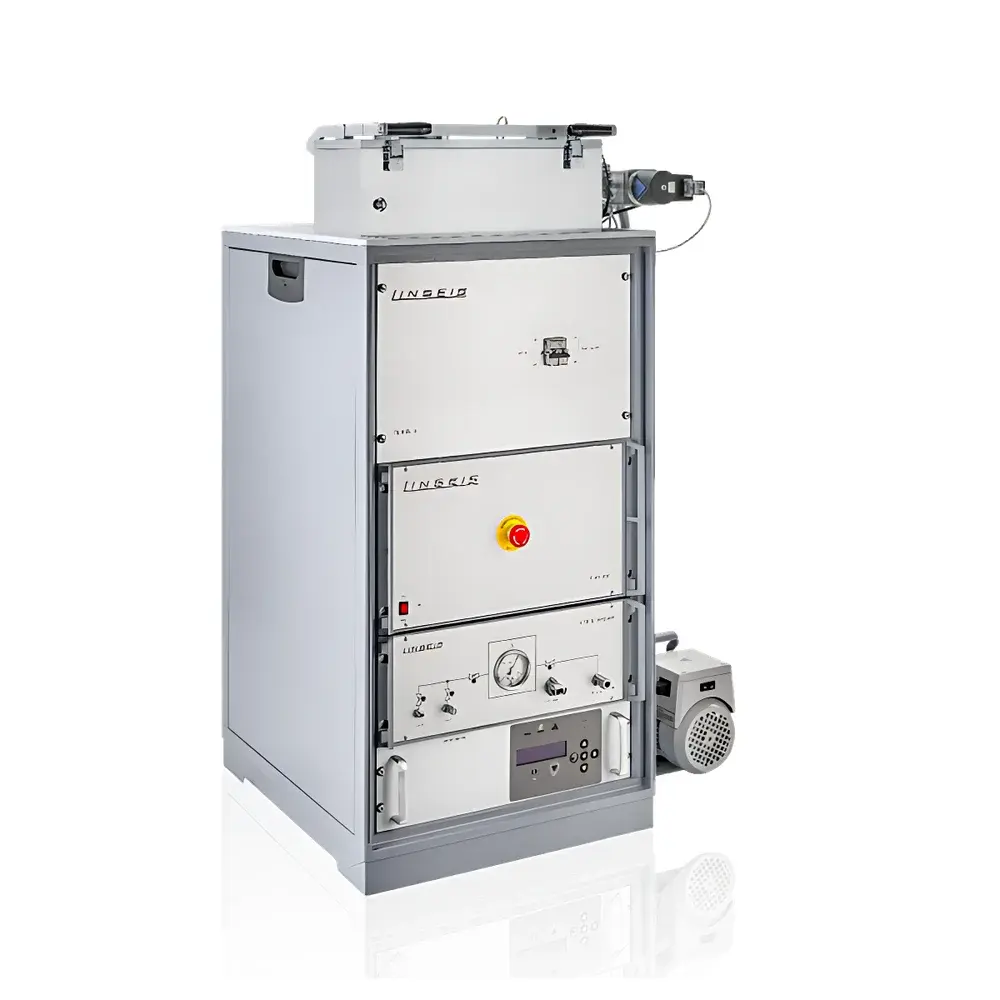
LINSEIS DIL L78 RITA Quenching & Phase-Transformation Dilatometer
| Brand | LINSEIS |
|---|---|
| Origin | Germany |
| Model | DIL L78 RITA |
| Temperature Range | −150 °C to 1600 °C |
| Heating/Cooling Rate | up to 2500 °C/s (induction furnace, hollow cylindrical sample) |
| Sample Geometry | Hollow cylinder, OD 3.5 mm / ID 3 mm / L 10 mm |
| Measurement Range | ±1.2 mm |
| Resolution | 5 nm |
| Data Acquisition Rate | up to 1 kHz |
| Compliance | ASTM A1033 |
Overview
The LINSEIS DIL L78 RITA is a high-speed, induction-heated dilatometer engineered for precise in-situ dimensional analysis of metallic materials during rapid thermal transients—particularly phase transformations induced by controlled heating, isothermal holding, and quenching. Operating on the principle of contact-based linear displacement measurement via high-resolution capacitive or optical sensing, the system captures nanoscale length changes (±1.2 mm range, 5 nm resolution) synchronized with temperature profiles across an exceptional thermal domain (−150 °C to 1600 °C). Its core application lies in generating time–temperature–transformation (TTT), continuous cooling transformation (CCT), and continuous heating transformation (CHT) diagrams—critical thermodynamic maps used in metallurgical process design, heat treatment optimization, and alloy development. The integrated induction furnace enables ultra-rapid thermal cycling (≤2500 °C/s heating/cooling), replicating industrial quenching conditions in water, oil, or inert gas environments while maintaining traceable temperature control via up to three spot-welded thermocouples directly on the sample surface.
Key Features
- Induction-based furnace architecture delivering heating and cooling rates up to 2500 °C/s—validated for hollow cylindrical specimens (OD 3.5 mm / ID 3 mm / L 10 mm)
- Nanometric displacement resolution of 5 nm (optionally upgradeable to 1 nm) with full-scale measurement range of ±1.2 mm in quench mode
- Simultaneous acquisition of temperature, length change, and optional force signals at up to 1 kHz sampling frequency
- 24-bit analog-to-digital conversion ensuring high dynamic range and low-noise signal integrity
- Modular configuration supporting optional compression/stress–strain modules (up to 22 kN axial load, true strain range −0.02 to 1.2)
- Compliance with ASTM A1033 for standardized determination of transformation kinetics in ferrous alloys
Sample Compatibility & Compliance
The DIL L78 RITA is optimized for metallic samples—especially steels, titanium alloys, and nickel-based superalloys—where solid-state phase transitions (e.g., austenite → ferrite, martensite, bainite) induce measurable volumetric and linear expansion anomalies. The standard hollow cylindrical geometry minimizes thermal lag and ensures uniform induction coupling. All measurements adhere to internationally recognized metrological frameworks: temperature calibration follows ITS-90 traceability; dimensional data acquisition meets ISO/IEC 17025 requirements for laboratory competence; and software workflows support audit-ready documentation aligned with GLP and GMP environments. The system is routinely deployed in R&D labs and quality assurance departments subject to FDA 21 CFR Part 11 compliance mandates, with full electronic signature and change-tracking capabilities available via LINSEIS ThermoSoft™.
Software & Data Management
Control and analysis are performed using LINSEIS ThermoSoft™—a modular, Windows-based platform offering real-time visualization, automated event detection (e.g., onset of martensitic start Ms, austenite finish Af), and multi-curve overlay functionality. The software computes coefficient of thermal expansion (CTE), derivative-based transformation temperatures, and constructs TTT/CCT/CHT diagrams using built-in kinetic models (e.g., Johnson–Mehl–Avrami). Raw data files (.tdt) are stored in ASCII format with embedded metadata (time stamp, setpoint, PID parameters, sensor IDs), enabling seamless import into MATLAB, Python (NumPy/Pandas), or statistical analysis suites. Audit trails record all user actions, parameter modifications, and calibration events—fully compliant with 21 CFR Part 11 when configured with role-based access control and digital signatures.
Applications
- Determination of critical transformation temperatures (Ac1, Ac3, Ms, Mf) in carbon and alloy steels under industrially relevant cooling conditions
- Quantification of thermal expansion anisotropy and CTE hysteresis across phase boundaries
- Validation of thermomechanical processing simulations (e.g., Thermo-Calc®, JMatPro®)
- Development and qualification of new hardenable steels, tool steels, and precipitation-hardening alloys
- In-process monitoring of microstructural evolution during interrupted quenching, tempering, or aging cycles
- Correlation of dilatometric response with ex-situ characterization (XRD, SEM/EBSD, hardness mapping)
FAQ
What sample geometries are supported beyond the standard hollow cylinder?
Standard configuration uses a 3.5 mm OD × 3 mm ID × 10 mm L hollow cylinder; solid rods (up to 6 mm diameter), thin foils, and custom-machined geometries can be accommodated with optional fixtures.
Can the DIL L78 RITA perform simultaneous dilatometry and mechanical testing?
Yes—when equipped with the optional DIL L78/RITA Q/D/T configuration, it supports uniaxial compression and tension tests with force control, stroke control, or true strain rate control, enabling coupled thermo-mechanical analysis.
How is temperature calibrated during ultra-fast heating/cooling?
Calibration employs NIST-traceable Type K or S thermocouples welded directly to the sample surface; dual-point verification (ice point and fixed-point reference metals) ensures accuracy within ±1.5 °C across the full operating range.
Is the system suitable for non-ferrous alloys such as aluminum or titanium?
Yes—the instrument’s broad temperature range and sensitivity to subtle expansion anomalies make it applicable to Al–Si eutectics, Ti–6Al–4V α/β transitions, and Ni–Cr–Fe precipitation sequences, though transformation kinetics differ from ferrous systems.
What level of data security and regulatory compliance does the software provide?
ThermoSoft™ supports 21 CFR Part 11 compliance through electronic signatures, user authentication, immutable audit logs, and encrypted database storage—certified for use in regulated pharmaceutical and aerospace QA/QC environments.



