
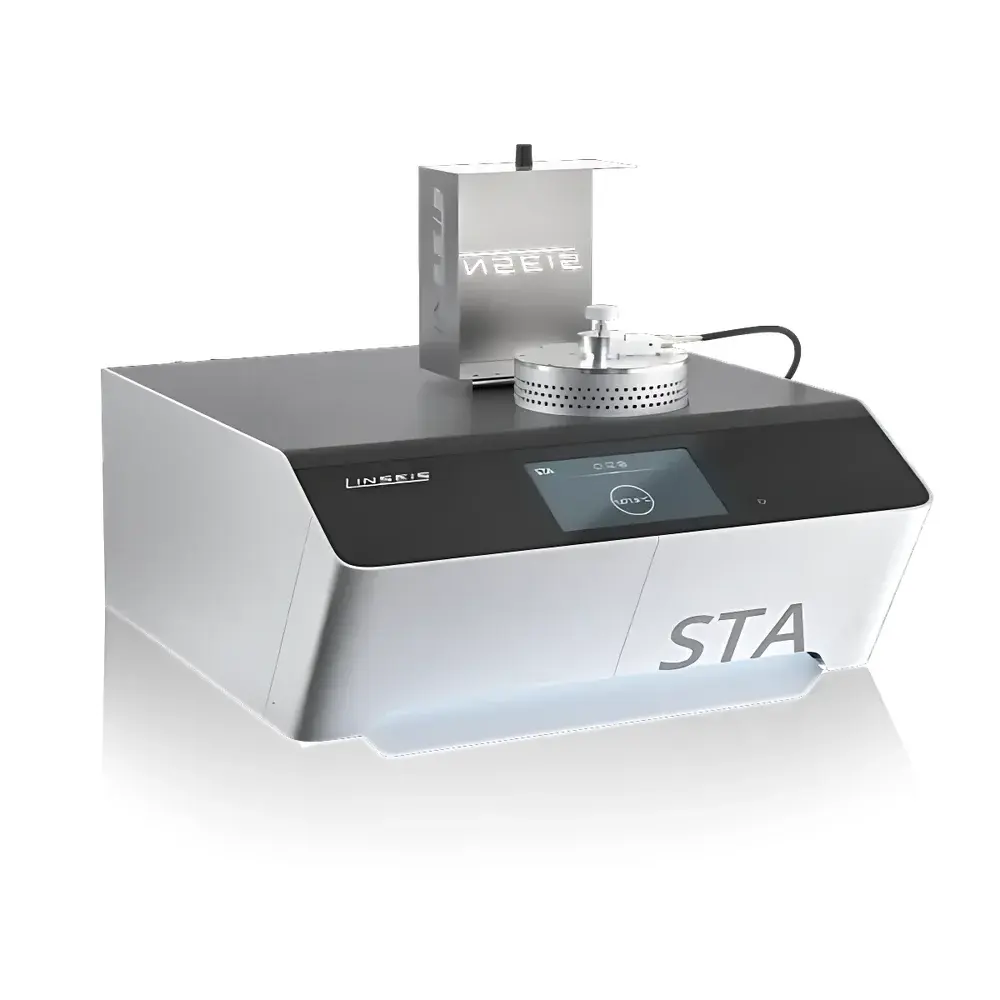
LINSEIS STA L82 Simultaneous Thermal Analyzer
| Brand | LINSEIS |
|---|---|
| Origin | Germany |
| Model | STA L82 |
| Temperature Range | RT to 1000 °C |
| Heating Rate | 0.01–100 K/min |
| Temperature Stability | ±0.001 °C |
| Maximum Sample Mass | 25 mg / 2500 mg |
| TG Resolution | 0.1 µg |
| DSC Sensitivity | ~4–17.6 µW |
| DTA Resolution | 0.03 nV |
| Vacuum Capability | 10⁻² mbar (≤800 °C) |
| Atmosphere Control | Inert, oxidative, reducing, humidified, or vacuum |
| Optional Autosampler | 42- or 90-position |
| Sensor Types | E/K/S thermocouples |
| Measurement Modes | TG, TG-DTA, TG-DSC, TG-DSC (Cp) |
Overview
The LINSEIS STA L82 Simultaneous Thermal Analyzer is an integrated high-precision instrument engineered for concurrent thermogravimetric analysis (TGA) and differential thermal analysis (DTA) or differential scanning calorimetry (DSC) under tightly controlled atmospheric and thermal conditions. Based on the principle of simultaneous mass loss and heat flow measurement, the STA L82 enables unambiguous correlation between endo-/exothermic events and mass change kinetics—critical for deconvoluting overlapping transitions in complex materials. Its furnace architecture features active overtemperature suppression and digital PID temperature control, ensuring thermal stability of ±0.001 °C across its full operating range from ambient to 1000 °C. Designed and manufactured in Germany, the system complies with fundamental metrological requirements for traceable thermal characterization in R&D laboratories and quality control environments governed by ISO/IEC 17025, ASTM E1131, ASTM E1641, and ISO 11358 standards.
Key Features
- Simultaneous acquisition of TG, DTA, and DSC signals using a single sample pan and identical thermal history—eliminating inter-run variability inherent in sequential measurements.
- HiRes heating rate modulation: dynamically adjusts ramp rate in real time upon detection of mass change onset (e.g., decomposition, desorption), enabling enhanced resolution of adjacent thermal events without manual intervention.
- Integrated atmosphere management: fully programmable gas switching (N₂, O₂, Ar, synthetic air), humidity control via integrated water vapor generator, and vacuum operation down to 10⁻² mbar (up to 800 °C).
- Corrosion-resistant DTA sensor option with electromagnetic shielding—suitable for aggressive atmospheres containing halogens, sulfur compounds, or acidic vapors.
- High-resolution microbalance with 0.1 µg readability and automatic tare compensation; supports both open and sealed crucibles (alumina, platinum, gold, quartz).
- Modular sensor configuration: interchangeable E-, K-, or S-type thermocouple assemblies calibrated per IEC 60584; DSC mode includes optional Cp (specific heat) determination via quasi-isothermal step-heating protocol.
Sample Compatibility & Compliance
The STA L82 accommodates solid, powder, granular, and thin-film samples up to 2500 mg (standard configuration) or 5 g (optional high-capacity module). It supports quantitative analysis of polymers, pharmaceuticals, catalysts, battery electrode materials, ceramics, composites, and biological matrices—including moisture-sensitive or volatile organics. All hardware and firmware components are designed to meet CE marking requirements. Data acquisition and reporting modules support audit trails, electronic signatures, and user access levels compliant with FDA 21 CFR Part 11 when used with validated software configurations. Calibration procedures follow ISO 13320 (particle size) and ISO 11357 (DSC) traceability chains; mass calibration uses NIST-traceable weights, temperature calibration employs certified reference materials (e.g., In, Sn, Zn, Al, Ag).
Software & Data Management
ThermoSoft® v8.5 (included) provides intuitive workflow-driven operation—from method creation and real-time monitoring to multi-peak deconvolution and kinetic modeling (e.g., Kissinger, Ozawa-Flynn-Wall, Friedman). Raw data files (.tda, .tdt) are stored in ASCII-compatible format for third-party processing (OriginLab, MATLAB, Python SciPy). The software supports GLP/GMP-compliant documentation: each measurement record includes instrument ID, operator credentials, environmental logs (pressure, gas flow rates), calibration timestamps, and checksum-verified raw signal archives. Optional modules include automated baseline correction, reaction onset detection (tangent intersection, derivative maximum), and ASTM E698 activation energy calculation.
Applications
- Decomposition profiling of elastomers: quantification of bound water (9.3 wt%), pyrolytic volatiles (36.0 wt%), and oxidative combustion residue (14.3 wt%)—with residual ash content (40.4 wt%) identified via post-run XRD cross-validation.
- Pharmaceutical solid-state characterization: detection of polymorphic transitions, eutectic melting (ASA at 140 °C), and multi-stage thermal degradation pathways—enabling excipient compatibility screening and stability-indicating assay development.
- Battery cathode material analysis: in-situ oxidation state evolution during heating under O₂/N₂ gradients; correlation of oxygen release (TG) with exothermic peaks (DSC) informs safety margin assessment per UN 38.3 thermal abuse protocols.
- Catalyst thermal stability testing: monitoring of metal-support interactions, phase segregation, and sintering onset temperatures under simulated regeneration conditions (air → N₂ → H₂ cycling).
- Composite filler dispersion analysis: differentiation of polymer matrix degradation from nanofiller decomposition via synchronized mass loss and enthalpy signatures.
FAQ
What types of crucibles are compatible with the STA L82?
Standard options include alumina, platinum, gold, and quartz crucibles; custom geometries (e.g., pressed-powder pans, wire-loop holders) are supported upon request.
Can the STA L82 perform specific heat (Cp) measurements?
Yes—using the optional TG-DSC Cp module and quasi-isothermal step-heating protocol per ISO 11357-4, with accuracy ±3% against certified reference materials.
Is remote operation supported?
The system integrates with standard Ethernet TCP/IP networks; remote monitoring and method queuing are enabled via ThermoSoft® WebConnect (licensed separately).
How is temperature calibration verified?
Calibration is performed using five certified reference metals (In, Sn, Pb, Zn, Al) per ASTM E967; deviation limits are ±0.1 °C at all points across the range.
Does the autosampler maintain inert atmosphere during loading?
Yes—the 90-position autosampler features a glove-box-integrated transfer chamber with continuous purge gas flow, preserving sample integrity for air-sensitive materials.



