
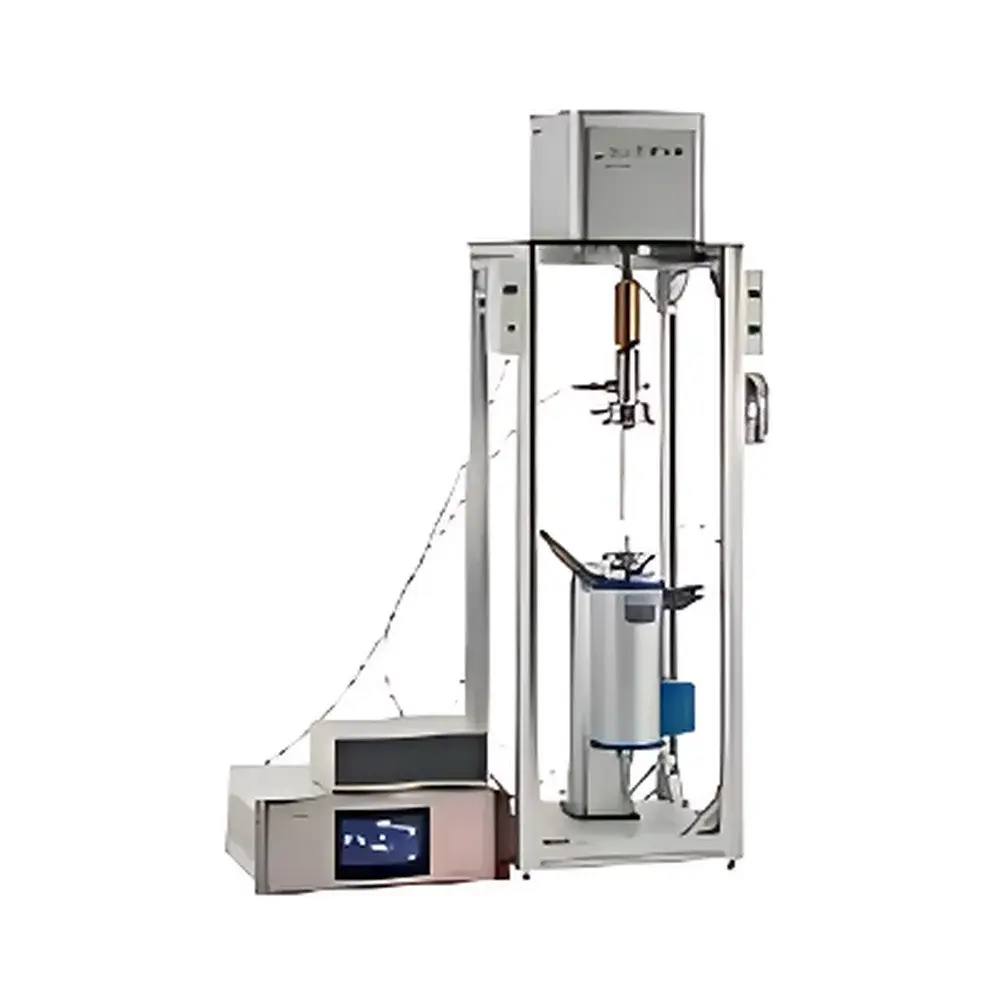
LINSEIS STA L87 MSB Magnetic Suspension Balance
| Brand | LINSEIS |
|---|---|
| Origin | Germany |
| Model | STA L87 MSB |
| Temperature Range | –196 to 2400 °C |
| Max. Sample Mass | 10 g (standard balance) |
| Resolution | 1 µg |
| Pressure Range | UHV to 150 bar (metal version) |
| Measurement Principle | Magnetic suspension coupling with PID-controlled electromagnetic levitation |
| Compliance Options | ASTM E1131, ISO 11358, USP <731>, GLP/GMP-ready data logging |
Overview
The LINSEIS STA L87 MSB Magnetic Suspension Balance is a high-precision simultaneous thermal analyzer engineered for thermogravimetric analysis (TGA) and differential thermal analysis (DTA) under extreme environmental conditions. Unlike conventional microbalances constrained by furnace proximity or mechanical linkage limitations, the STA L87 MSB employs a contactless magnetic suspension coupling system—comprising a permanent magnet (suspended element), an electromagnet (fixed on the analytical balance), a high-resolution position sensor, and a real-time PID control unit. This architecture decouples the sensitive weighing mechanism from the measurement chamber, enabling stable mass detection across cryogenic (–196 °C) to ultra-high-temperature (2400 °C) regimes, under ultrahigh vacuum (UHV), elevated pressures (up to 150 bar), and aggressive chemical environments—including halogenated, acidic, or oxidizing atmospheres. The instrument operates on the principle of active magnetic levitation: the suspended magnet’s vertical position is continuously monitored; deviations trigger proportional electromagnetic force adjustments to maintain equilibrium—ensuring sub-microgram resolution (1 µg) independent of thermal drift or mechanical stress.
Key Features
- Contactless magnetic suspension coupling isolates the precision balance from thermal, mechanical, and chemical stresses—eliminating thermal convection artifacts and mechanical hysteresis.
- Dual-chamber modularity: interchangeable metal and glass measurement cells optimized for distinct operational envelopes—metal version for high-pressure/high-temperature applications (–196 to 2400 °C, UHV to 150 bar); glass version for highly corrosive media (up to 900 °C, ≤1.3 bar), with all critical components hermetically sealed in borosilicate glass.
- Integrated density determination capability via Archimedean buoyancy method—enabled by precise mass measurement of reference bodies in calibrated fluids across temperature and pressure gradients.
- Real-time PID-controlled levitation stability ensures long-term baseline reproducibility (<0.1 µg/h drift under isothermal conditions) and robust signal-to-noise ratio even during rapid heating ramps (up to 100 K/min).
- Gas evolution interface compatible with quadrupole mass spectrometry (MS) and Fourier-transform infrared spectroscopy (FTIR) for evolved gas analysis (EGA), supporting reaction pathway identification and kinetic modeling.
- Modular furnace design with segmented heating zones enables precise axial temperature profiling and minimizes thermal gradients across the sample zone.
Sample Compatibility & Compliance
The STA L87 MSB accommodates solid, powdered, and granular samples up to 10 g (standard configuration), with crucible options including Pt, Al₂O₃, SiC, and custom-coated variants for reactive systems. Metal-cell configurations support in-situ studies of catalytic oxidation, coal gasification, hydrogen storage materials, and molten salt corrosion—validated per ASTM E1131 (TGA standard test method) and ISO 11358 (polymer thermal degradation). Glass-cell operation complies with USP for pharmaceutical excipient stability testing under humidified or solvent-saturated atmospheres. All data acquisition meets GLP and GMP requirements, with full 21 CFR Part 11–compliant audit trails, electronic signatures, and secure user-role management available via optional software modules.
Software & Data Management
Control and analysis are executed via LINSEIS ThermoSoft™ v6.x—a Windows-based platform supporting multi-instrument synchronization, automated method sequencing, and real-time derivative calculation (DTG). Raw mass and temperature signals are acquired at 10 Hz with 24-bit ADC resolution. Integrated kinetic analysis tools include Ozawa-Flynn-Wall, Kissinger, and Friedman models for activation energy extraction. Export formats include ASCII, CSV, and universal .tdf (thermal data format) for third-party integration with MATLAB®, OriginLab®, or Thermo-Calc®. Data integrity safeguards include automatic backup, cyclic redundancy checksums, and time-stamped metadata embedding (operator ID, calibration status, ambient conditions).
Applications
- Materials science: Oxidation kinetics of refractory metals, sintering behavior of ceramic precursors, decomposition pathways of MOFs and battery cathode materials.
- Energy research: Thermal stability of hydrogen storage alloys, coke reactivity in blast furnaces, ash fusion behavior during biomass co-firing.
- Chemical process engineering: Catalyst deactivation mechanisms under simulated flue gas, polymer pyrolysis for circular economy feedstock recovery.
- Environmental analytics: Heavy metal volatility during waste incineration, sorbent regeneration cycles in flue gas desulfurization.
- Pharmaceutical development: Hydrate/dehydrate transitions, excipient–API interaction screening under controlled humidity/pressure.
- Fuel cell R&D: Proton exchange membrane (PEM) durability under thermal cycling and low-humidity conditions.
FAQ
How does magnetic suspension eliminate thermal drift in TGA measurements?
Thermal expansion and convection currents near conventional balances introduce spurious mass signals. The STA L87 MSB physically separates the balance from the furnace—only magnetic fields transmit force—removing conductive/convective coupling and enabling true isothermal baseline stability.
Can the glass-cell version be used for hydrofluoric acid (HF) exposure?
Yes—the glass measurement cell uses fused quartz components where specified; standard borosilicate versions resist most mineral acids except HF. Custom quartz cells with HF-compatible seals and coatings are available upon request.
Is calibration traceable to national standards?
All factory calibrations are performed using NIST-traceable weights and certified reference materials (e.g., Ni, Cu, Al₂O₃), with full uncertainty budgets documented per ISO/IEC 17025 guidelines.
What safety interlocks prevent overheating or overpressure events?
Hardware-level dual-redundant temperature limiters, pressure relief valves (ASME-certified for metal cells), and real-time PID saturation monitoring trigger immediate shutdown and purge sequences if preset thresholds are exceeded.
Does the system support dynamic atmosphere switching during a single run?
Yes—integrated mass flow controllers (MFCs) with up to four gas channels allow programmable gas composition changes (e.g., N₂ → O₂ → CO₂) synchronized with temperature ramps, with pressure compensation enabled.



