
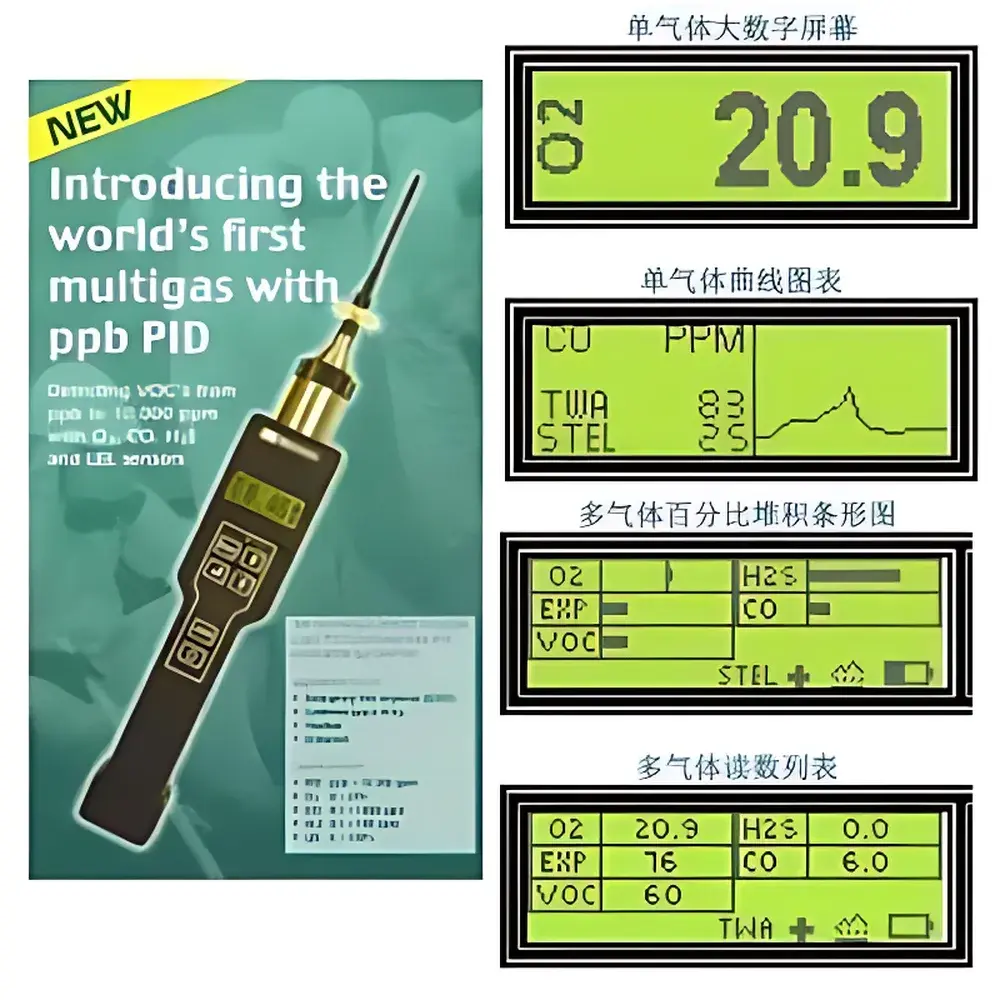
YL6-5000EX & YL6-6000EX Series Handheld Photoionization Detectors (PID) for Volatile Organic Compounds
| Origin | Imported |
|---|---|
| Manufacturer Type | Authorized Distributor |
| Model Series | YL6-5000EX (RC/DC variants), YL6-6000EX |
| Ionization Energy Options | 8.4 eV, 10.2 eV, 10.6 eV, 11.7 eV |
| Detection Limit | 0.1 ppb (for benzene-equivalent VOCs) |
| Measurement Range | 1–999 ppb |
| Display Units | ppm, ppb, mg/m³ |
| Data Storage Capacity | 20,000 measurement points |
| Certifications | BASEEFA EEx ia IIC T4, CENELEC EN 50020 |
| Intrinsic Safety Compliance | ATEX Directive 2014/34/EU, IECEx Scheme |
| Alarm Functions | STEL (15-min), TWA (8-hr), user-defined thresholds |
| Communication | Infrared (IR) port |
| Weight | < 0.8 kg (typical) |
| Battery Options | Rechargeable Li-ion (RC) or AA alkaline (DC) |
Overview
The YL6-5000EX and YL6-6000EX Series are intrinsically safe, handheld photoionization detectors engineered for real-time, quantitative detection of volatile organic compounds (VOCs) in complex industrial and environmental settings. Based on the principle of ultraviolet photoionization—where VOC molecules are ionized by high-energy UV photons emitted from a sealed lamp—the instrument generates a current proportional to analyte concentration. This non-destructive, broad-spectrum detection method enables rapid screening across >250 VOCs—including benzene, toluene, styrene, formaldehyde, acetone, xylene, isobutene, and chlorinated solvents—without requiring carrier gas or consumables. Designed for operation in Zone 0/1 hazardous areas, the series complies with stringent intrinsic safety standards (BASEEFA EEx ia IIC T4, CENELEC EN 50020), making it suitable for use in petrochemical refineries, confined-space entry, emergency response, and indoor air quality (IAQ) assessments where explosion risk is present.
Key Features
- Intrinsically safe design certified to ATEX 2014/34/EU and IECEx for continuous use in explosive atmospheres (Gas Group IIC, Temperature Class T4)
- Interchangeable PID lamps (8.4 eV, 10.2 eV, 10.6 eV, 11.7 eV) enabling selective detection and interference mitigation—e.g., 10.6 eV for broad-spectrum VOC screening; 11.7 eV for low-ionization-potential compounds like H₂S or NH₃
- Auto-ranging measurement with dual-scale display (ppb/ppm/mg/m³) and automatic zero compensation via background subtraction
- Integrated STEL (Short-Term Exposure Limit) and TWA (Time-Weighted Average) calculation algorithms compliant with OSHA and ACGIH exposure guidelines
- 20,000-point internal data logger with timestamp, GPS-tagged (optional), and IR-based download capability
- Ergonomic vertical grip housing with backlit LCD, IP65-rated enclosure, and operating temperature range of –10 °C to +50 °C
- Real-time audible and visual alarms with programmable threshold levels and alarm history logging
Sample Compatibility & Compliance
The YL6 series detects VOCs with ionization potentials below the selected lamp energy, offering compatibility with hydrocarbons (e.g., hexane, octane), aromatics (benzene, toluene), oxygenates (MEK, ethanol), halogenated compounds (dichloromethane), and select inorganics (ammonia, hydrogen sulfide). It is not intended for permanent gases (N₂, O₂, CO₂), methane, or highly polar compounds with strong adsorption tendencies unless paired with heated sampling accessories. Regulatory alignment includes support for workplace exposure monitoring per ISO 16000-22 (indoor air), ASTM D5197 (ambient VOC analysis), and EPA Method TO-15/TO-17 workflows when used as a screening tool. Device firmware and data handling architecture support audit-ready records aligned with GLP/GMP documentation requirements, including user authentication logs and calibration traceability.
Software & Data Management
The ISLPC desktop software provides full configuration control, spectral library management, calibration validation, and report generation (PDF/CSV). Data export supports integration with LIMS platforms and regulatory submission formats (e.g., EPA Form R, OSHA 300 logs). The IR interface enables secure, cable-free synchronization without compromising intrinsic safety integrity. Firmware updates preserve calibration coefficients and user-defined gas groups. All stored measurements include sensor ID, lamp voltage, ambient temperature/humidity (via optional probe), and operator ID—ensuring full traceability under FDA 21 CFR Part 11-compliant environments when deployed with electronic signature modules.
Applications
- Industrial hygiene monitoring during maintenance, painting, or solvent handling operations
- Leak detection in pipelines, storage tanks, railcars, ISO containers, and marine cargo holds
- Post-remediation verification at brownfield sites and landfill perimeter monitoring
- Fire investigation support through residual accelerant identification (e.g., gasoline, kerosene markers)
- Confined space entry pre-screening per OSHA 1910.146 and NFPA 350
- Indoor air quality audits in offices, schools, hospitals, and newly constructed buildings
- Fumigation monitoring for phosphine, methyl bromide, or sulfuryl fluoride in grain, timber, and tobacco facilities
- Emergency response triage during chemical spills, transportation incidents, or illicit lab detection
FAQ
What VOCs can the YL6-5000EX detect?
It detects over 250 VOCs with ionization potentials below the installed lamp’s photon energy—including benzene, toluene, formaldehyde, acetone, styrene, and chlorinated solvents—but cannot quantify methane or permanent gases.
Is calibration required before each use?
Zero calibration is performed automatically on startup; span calibration using certified standard gas (e.g., 100 ppm isobutylene) is recommended before critical measurements or after lamp replacement.
Can the device operate in explosive atmospheres?
Yes—certified to EEx ia IIC T4 per CENELEC EN 50020, permitting safe use in Zone 0 (continuous hazard) environments.
How is data transferred from the instrument?
Via infrared (IR) communication to the ISLPC software; no physical connection is needed, preserving intrinsic safety integrity.
What accessories extend its functionality?
Available options include telescopic sampling probes (5 m / 10 m PTFE tubing), lamp cleaning kits, 8.4/10.2/11.7 eV lamp modules, rugged carry cases, and optional temperature/humidity sensors.







