
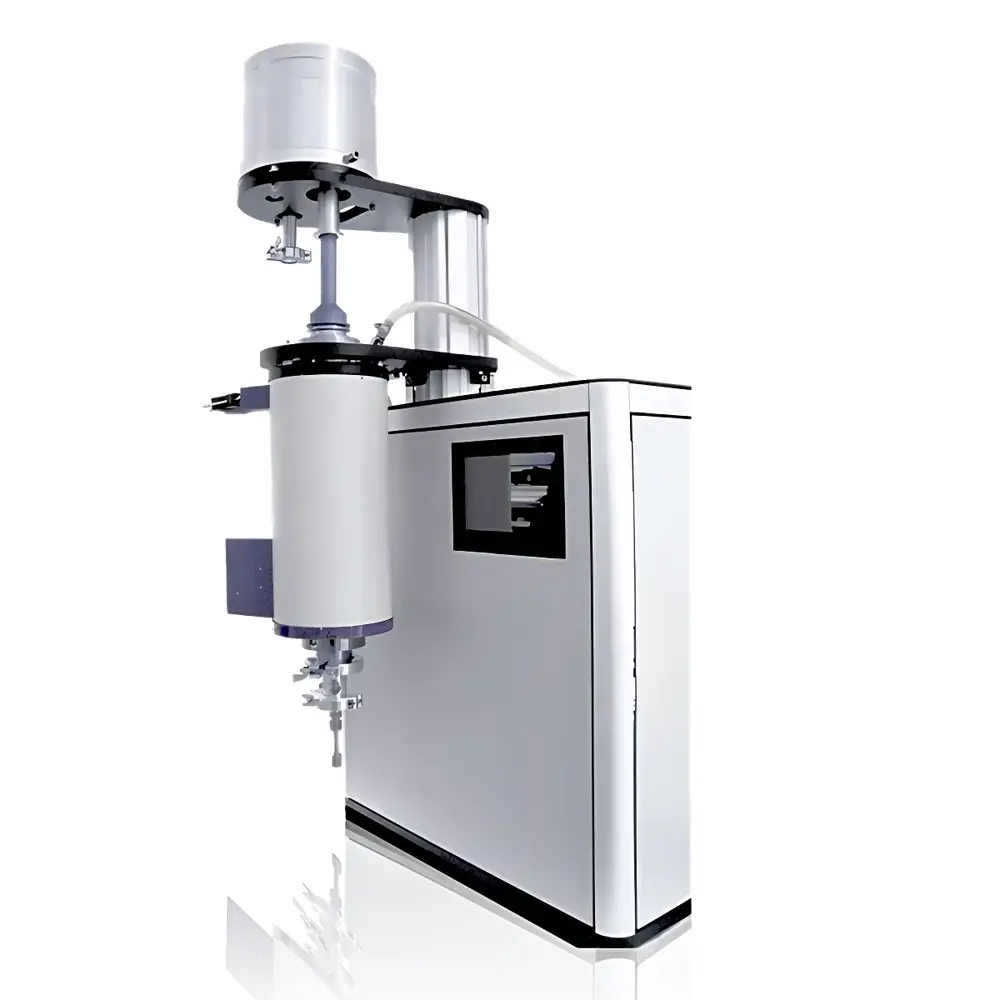
LINSEIS STA/TGA L86 Suspended Microbalance Thermogravimetric Analyzer
| Brand | LINSEIS |
|---|---|
| Origin | Germany |
| Model | STA/TGA L86 |
| Instrument Type | Universal Simultaneous Thermal Analyzer |
| Temperature Range | −150 °C to 2400 °C |
| Balance Sensitivity | 0.01 µg |
| Maximum Sample Capacity | 35 g / ±20000 mg |
| Vacuum Capability | 10⁻² mbar (pump-dependent) |
| Pressure Range (optional) | up to 5 bar |
| Heating Rate | 0.01–100 K/min |
| TG Resolution Options | 0.01 µg / 0.02 µg / 0.1 µg |
| DSC Sensor Types | E, K, S, B, C (C = DTA-only) |
| DSC Resolution | 0.3–1.2 µW |
| DTA Resolution | 0.03 nV |
| DTA Sensitivity | 1.5 µV/mW |
| DTA Range | ±250 µV / ±2500 µV |
Overview
The LINSEIS STA/TGA L86 is a high-precision simultaneous thermal analyzer engineered for rigorous research and industrial quality control environments. It integrates thermogravimetric analysis (TGA), differential thermal analysis (DTA), and differential scanning calorimetry (DSC) into a single modular platform—enabling true simultaneous measurement of mass change and thermal effects under precisely controlled temperature programs. Its suspended microbalance architecture eliminates mechanical coupling between the furnace and weighing system, ensuring exceptional long-term stability and minimizing drift during extended high-temperature experiments (up to 2400 °C). The system operates on the principle of electromagnetic force compensation, delivering sub-microgram resolution (down to 0.01 µg) across its full dynamic range (±20,000 mg), while maintaining linearity and reproducibility under inert, oxidative, reducing, or corrosive atmospheres—including vacuum (10⁻² mbar) and pressurized conditions (up to 5 bar, optional). Designed in accordance with ISO 11358, ASTM E1131, and ASTM E1641 standards, the STA/TGA L86 supports GLP-compliant workflows through hardware-level calibration traceability and audit-ready data logging.
Key Features
- Suspended high-resolution microbalance with active drift compensation and automatic tare functionality
- Modular furnace system supporting interchangeable sensor configurations (DSC, DTA, TMA-compatible)
- Triple-range TG resolution selection (0.01 µg / 0.02 µg / 0.1 µg) optimized for ultra-trace decomposition studies or high-mass industrial samples
- Corrosion-resistant DTA sensor with triple-thermocouple configuration for enhanced signal-to-noise ratio and baseline stability
- Programmable gas control module enabling precise switching between up to four gases (e.g., N₂, O₂, Ar, CO₂) with mass flow regulation
- Integrated vacuum interface compatible with turbomolecular and rotary vane pumps for low-background volatile analysis
- High-fidelity temperature control with 0.001 °C setpoint accuracy and ramp rates from 0.01 to 100 K/min
Sample Compatibility & Compliance
The STA/TGA L86 accommodates diverse sample geometries—from powders and granules to thin films, fibers, and bulk ceramics—using standard alumina, platinum, or graphite crucibles (including hermetic and vented variants). Its corrosion-resistant sensor housing and chemically inert furnace lining permit direct analysis of halogenated polymers, sulfidic ores, catalysts, and battery electrode materials without cross-contamination. The system meets essential regulatory requirements for pharmaceutical and materials testing: it supports 21 CFR Part 11-compliant electronic signatures via optional software modules, provides full audit trails for instrument parameters and calibration events, and conforms to ISO/IEC 17025 documentation practices. All thermal sensors are factory-calibrated against NIST-traceable reference materials (e.g., indium, zinc, alumina), with recalibration certificates available per ICH Q5C guidelines.
Software & Data Management
ThermoSoft® v8.2 (included) delivers intuitive experiment setup, real-time multi-channel visualization (TG, DSC/DTA, derivative curves), and automated peak deconvolution using Savitzky-Golay smoothing and tangent intersection algorithms. Raw data is stored in vendor-neutral ASCII and HDF5 formats, enabling seamless integration with MATLAB®, Python-based analysis pipelines (e.g., SciPy, PyMca), or LIMS platforms via OPC UA or RESTful API. Batch processing supports up to 99 sequential runs with conditional logic (e.g., pause on mass loss >5%, trigger EGA coupling upon exotherm detection). All measurement metadata—including atmosphere composition, pressure logs, and balance diagnostics—is embedded in each dataset, satisfying ALCOA+ data integrity principles.
Applications
The STA/TGA L86 serves as a core characterization tool across advanced materials development and regulatory science. In cementitious systems, it quantifies dehydration, carbonate decomposition, and sulfate stability in gypsum–quartz mortars under simulated service conditions (e.g., cyclic humidity/temperature), directly informing ASTM C150 and EN 197-1 compliance assessments. In energy storage, it evaluates SEI formation kinetics in Li-ion anodes, cathode structural degradation at elevated temperatures, and binder thermal stability in solid-state electrolytes. Additional use cases include polymer degradation profiling (ASTM D3850), catalytic coke burn-off quantification, ash content determination in coal and biomass (ISO 1171), and kinetic modeling of solid-state reactions using Ozawa-Flynn-Wall and Kissinger methods.
FAQ
What types of atmospheres can be used with the STA/TGA L86?
Nitrogen, oxygen, argon, helium, air, hydrogen, carbon dioxide, and custom gas mixtures are supported; vacuum operation down to 10⁻² mbar is standard.
Is the system suitable for analyzing reactive or corrosive samples?
Yes—the DTA sensor features a shielded design with ceramic insulation and optional platinum-rhodium thermocouples, enabling stable measurements in halogen-rich or sulfur-containing environments.
How is calibration performed and documented?
Automatic zero-point and span calibration routines are executed before each run; full calibration reports—including temperature, mass, and enthalpy verification—are generated and timestamped in accordance with ISO/IEC 17025 Annex A.
Can the STA/TGA L86 be coupled with evolved gas analysis (EGA) systems?
Yes—it includes a dedicated heated transfer line (up to 300 °C) and standardized flange interface for direct coupling to FTIR, MS, or GC-MS units per ASTM E2550 guidelines.
What is the typical maintenance interval for the suspended microbalance?
No routine mechanical maintenance is required; the electromagnetic force compensation system is solid-state and sealed. Annual performance verification using certified reference materials is recommended for ISO 17025 accreditation.



