
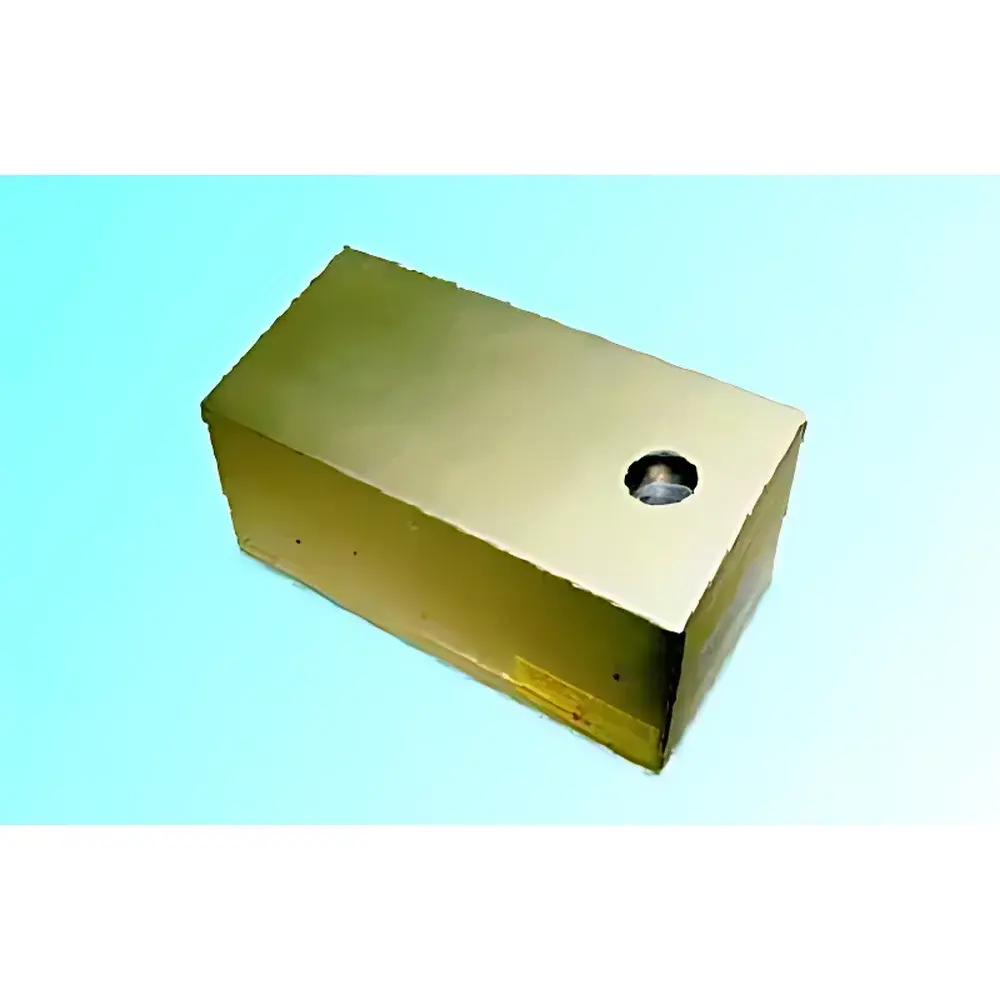
MicroFocus X-ray Generator Integrated Module
| Origin | Beijing |
|---|---|
| Manufacturer Type | Distributor |
| Origin Category | Domestic |
| Price | Upon Request |
| Anode Voltage | 10–80 kV |
| Focal Spot Sizes | 50 µm, 100 µm, 200 µm, 500 µm, 1 mm |
| Tube Current | 30–350 µA |
| Max Power Output | 10–24 W |
| Radiation Beam Angle | 20°, 28°, or 30° |
| Exit Window Material | Glass or Beryllium |
| Operation Mode | Continuous |
| Dimensions | 279 mm × 101 mm × 101 mm |
| Leakage Dose Rate | <5 µSv/hr at 5 cm |
| Input Power | 24 VDC, max 1.2 A |
| Operating Temperature | 0–40 °C |
| Humidity Range | 30–90 % RH |
| Safety Protections | Overvoltage, Overcurrent, Short-Circuit |
Overview
The MicroFocus X-ray Generator Integrated Module is a compact, self-contained X-ray source engineered for precision non-destructive testing (NDT), micro-CT system integration, and laboratory-scale X-ray imaging applications. Based on thermionic emission principles, it employs a sealed microfocus X-ray tube with a tungsten or molybdenum target anode, operated under high vacuum conditions. The module integrates the X-ray tube, high-voltage (HV) power supply, and filament current regulator into a single mechanically rigid enclosure—eliminating external cabling complexity and minimizing electromagnetic interference. Its design supports stable operation across the full 10–80 kV anode voltage range and 30–350 µA tube current, enabling tunable photon energy spectra and flux density for optimized contrast-to-noise ratio in high-resolution radiography. The selectable focal spot sizes—from 50 µm to 1 mm—allow users to balance spatial resolution against usable photon flux, making the module suitable for both high-magnification micro-imaging and broader-field industrial inspection.
Key Features
- Fully integrated architecture: X-ray tube, HV generator (±0.1% voltage regulation), and filament driver co-located within a single aluminum alloy housing with thermal management fins.
- External analog/digital control interface (0–10 V or RS-485) for real-time adjustment of anode voltage and tube current—enabling closed-loop exposure parameter synchronization with detector acquisition timing.
- Onboard monitoring circuitry provides isolated analog outputs for continuous readout of actual anode voltage, tube current, and filament temperature—supporting traceable process documentation per ISO/IEC 17025 requirements.
- Low-dose radiation design: Effective shielding reduces leakage dose to <5 µSv/hr at 5 cm from any surface, compliant with IEC 61331-1 for Class I diagnostic X-ray equipment.
- 24 VDC input with integrated overvoltage, overcurrent, and short-circuit protection—designed for compatibility with industrial PLC-controlled power distribution systems and battery-backed backup configurations.
- Remote enable/disable functionality via TTL-level signal, supporting interlocked safety circuits required under EN 62471 and ANSI Z535.4 for embedded radiation sources.
- Operational robustness: Rated for continuous duty cycle within ambient conditions of 0–40 °C and 30–90 % relative humidity (non-condensing), with conformal coating on PCBs for long-term reliability in controlled lab or cleanroom environments.
Sample Compatibility & Compliance
This module is compatible with standard X-ray detectors—including flat-panel imagers (amorphous silicon or CMOS-based), scintillator-coupled CCD/CMOS sensors, and direct-conversion photon-counting detectors—provided appropriate geometric magnification and source-to-detector distance are maintained. It meets mechanical and electrical interface standards for OEM integration into automated inspection platforms and benchtop CT systems. Regulatory compliance includes adherence to IEC 61000-6-3 (EMC emissions), IEC 61000-6-2 (immunity), and RoHS 2011/65/EU. While not certified as a medical device, its performance parameters align with ASTM E2737 (Standard Practice for Digital Radiographic Testing) and ISO 17636-2 (Non-destructive testing of welds — Radiographic testing — Part 2: X- and gamma-ray techniques with digital detectors) when deployed in industrial QA/QC workflows.
Software & Data Management
The module supports integration with third-party control software via industry-standard protocols including Modbus RTU over RS-485 or analog voltage control. No proprietary SDK is required; configuration and monitoring data (e.g., accumulated tube-on time, thermal history, fault logs) can be logged through host PC applications using open communication registers. For GLP/GMP-aligned environments, integration with SCADA or MES platforms enables audit-trail generation for exposure parameters, consistent with FDA 21 CFR Part 11 requirements when paired with electronic signature-capable software layers. Firmware updates are performed via UART bootloader, ensuring field-upgradability without hardware modification.
Applications
- High-resolution micro-CT scanning of electronic components, additive-manufactured metal parts, and composite materials.
- In-line NDT for solder joint integrity assessment, wire bond inspection, and PCB void detection.
- Academic and R&D use in synchrotron beamline pre-characterization, X-ray phase-contrast feasibility studies, and calibration source development.
- Portable or mobile X-ray inspection systems where size, weight, and low-power DC operation are critical constraints.
- Custom X-ray fluorescence (XRF) excitation sources for benchtop elemental analysis instrumentation.
FAQ
Is this module suitable for medical imaging applications?
No—it is designed and tested exclusively for industrial and research-grade non-medical imaging. It does not meet regulatory requirements for clinical diagnostic use under FDA 21 CFR Part 1020 or EU MDR Annex I.
Can the focal spot size be changed dynamically during operation?
No. Focal spot size is determined by the physical geometry of the installed X-ray tube and must be selected at time of order. Multiple modules with different spots may be mounted on a common platform for flexible setup reconfiguration.
What cooling method is recommended for extended continuous operation?
Passive convection cooling suffices up to 15 W output. For sustained operation above 18 W, forced-air cooling (≥2 CFM airflow across heatsink fins) is advised to maintain junction temperatures within specification limits.
Does the module include radiation shielding for full-system integration?
The module itself incorporates internal lead-equivalent shielding; however, final system-level shielding must be validated per local radiation safety regulations (e.g., NRC 10 CFR 35 or national equivalent) and is the responsibility of the integrator.



