
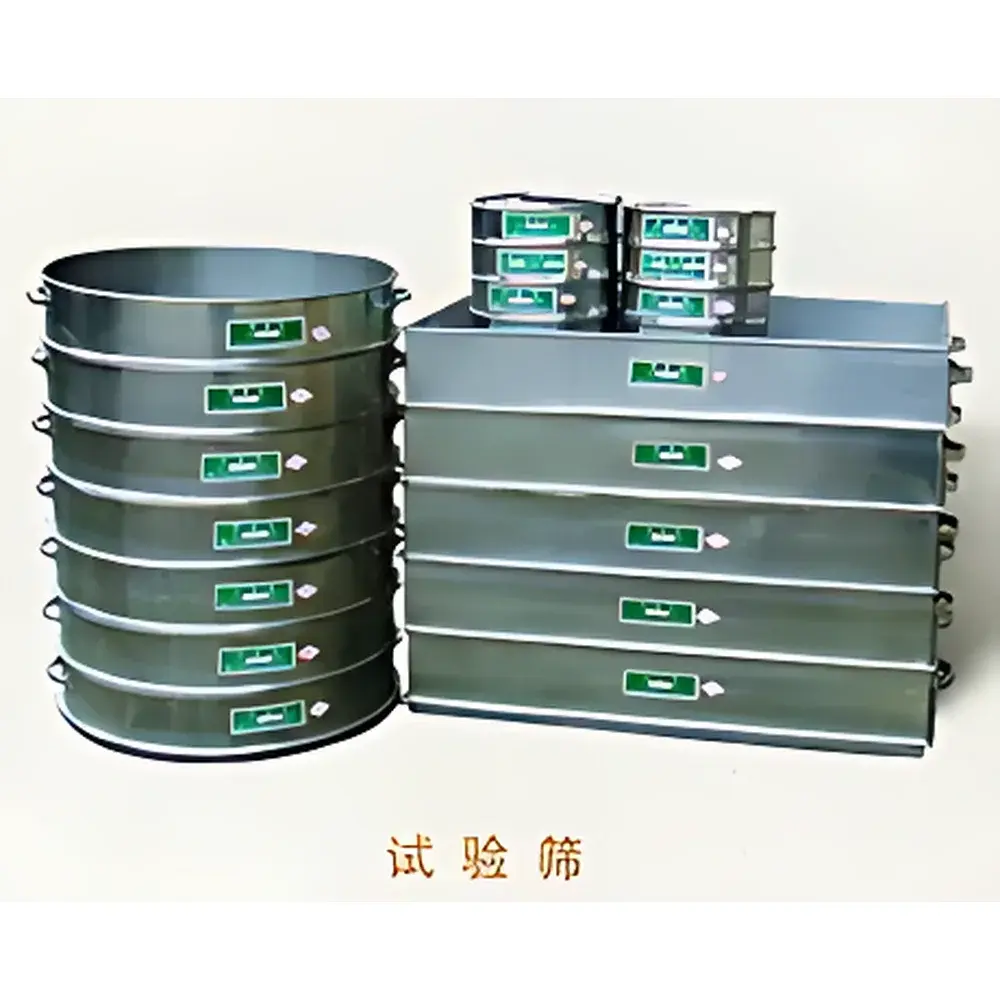
Brookfield Standard Test Sieves
No specifications available.
Overview
Brookfield Standard Test Sieves are precision-engineered laboratory sieves designed for reliable particle size analysis and sample preparation in accordance with internationally recognized standards including ASTM E11, ISO 3310-1, and USP <786>. These sieves operate on the principle of mechanical sieving—where particles are separated based on their ability to pass through apertures of defined geometry (square or circular) under controlled agitation. The fundamental purpose is to isolate oversized or undersized fractions from bulk granular materials, enabling subsequent crushing, grinding, or homogenization steps to achieve target particle size distributions. This process is critical in raw material qualification, quality control of powders, and ensuring statistical representativeness during sample reduction (e.g., coning and quartering), thereby minimizing sampling bias and improving analytical reproducibility across metallurgical, pharmaceutical, mineralogical, and construction materials laboratories.
Key Features
- Multiple standardized diameters and heights—including Φ200 × 50 mm (standard ASTM/ISO configuration), Φ300 × 60 mm, Φ450 × 100 mm, and rectangular 700 × 500 × 150 mm formats—to accommodate diverse sample volumes and screening protocols.
- Aperture range spanning 6.0 mm down to 45 µm (0.045 mm) for Φ200 mm standard sieves; extended ranges up to 150 mm (coarse fractionation) and down to 200 µm (0.2 mm) for larger-format manual sieves—supporting applications from aggregate grading to fine pharmaceutical powder classification.
- Construction from high-grade stainless steel (AISI 304 or equivalent) for corrosion resistance, dimensional stability, and compliance with GMP/GLP environments; select models feature dual-layer stainless mesh for enhanced durability and reduced mesh deformation under repeated loading.
- Both square and circular aperture options available—square openings provide higher throughput for irregularly shaped particles, while circular apertures align with legacy specifications and certain regulatory test methods.
- Robust frame design with precision-ground seating surfaces ensures stackability and leak-free sealing when used with mechanical sieve shakers or hand-sieving assemblies.
Sample Compatibility & Compliance
These test sieves are validated for use with dry, free-flowing granular solids including ores, cement clinker, crushed stone, activated carbon, excipients, catalysts, and ceramic powders. They are not intended for wet sieving or highly cohesive, electrostatic, or fibrous materials without prior conditioning (e.g., drying, anti-static treatment). All standard Φ200 mm sieves meet the dimensional tolerances and mesh calibration requirements specified in ISO 3310-1:2016 and ASTM E11–22. Calibration certificates traceable to NIST or national metrology institutes are available upon request for audit-ready documentation. For regulated industries, sieves may be integrated into validated sieving workflows compliant with FDA 21 CFR Part 11 (when paired with electronic shakers and audit-trail-capable software) and ICH Q5A/Q5C guidelines for particulate characterization.
Software & Data Management
While the sieves themselves are passive mechanical components, they are fully compatible with Brookfield’s automated sieve shaker platforms (e.g., SV-100 Series), which include embedded firmware supporting programmable amplitude, time, and motion profiles (horizontal orbital, vertical tapping, or gyratory). Data export via USB or Ethernet enables integration into LIMS or ELN systems. All shaker-generated reports include timestamped sieve stack configuration, duration, amplitude setting, and operator ID—supporting full traceability per GLP and ISO/IEC 17025 requirements. Manual sieving records should be documented in controlled notebooks or electronic forms with defined fields for sieve ID, aperture size, sample mass, and fraction weights.
Applications
- Particle size distribution (PSD) determination in QC labs for incoming raw materials and finished products.
- Validation of milling and grinding efficiency in R&D and production settings.
- Preparation of representative subsamples for elemental analysis (XRF, ICP-OES), moisture content testing, or bulk density measurement.
- Aggregate gradation analysis per ASTM C136/C136M for concrete and asphalt mix design.
- Pharmaceutical blend uniformity assessment and granule sizing prior to tableting or capsule filling.
- Mineral processing optimization—e.g., classifying crushed ore before flotation or leaching stages.
FAQ
What standards do these sieves comply with?
ASTM E11, ISO 3310-1, and USP <786> for aperture tolerance, frame dimensions, and material specifications.
Can I use these sieves with automated shakers?
Yes—they are dimensionally compatible with all major mechanical sieve shakers meeting ASTM D6913 and ISO 2591-1 mounting interfaces.
How often should test sieves be recalibrated?
Annual calibration is recommended; more frequent verification is required if subjected to abrasive samples or mechanical impact.
Are calibration certificates included?
Certificates are optional and provided upon request, with traceability to accredited national standards bodies.
Do you offer custom aperture sizes or non-standard diameters?
Custom fabrication is available for OEM or high-volume industrial applications—contact engineering support for dimensional and material specifications.
Related Products



