
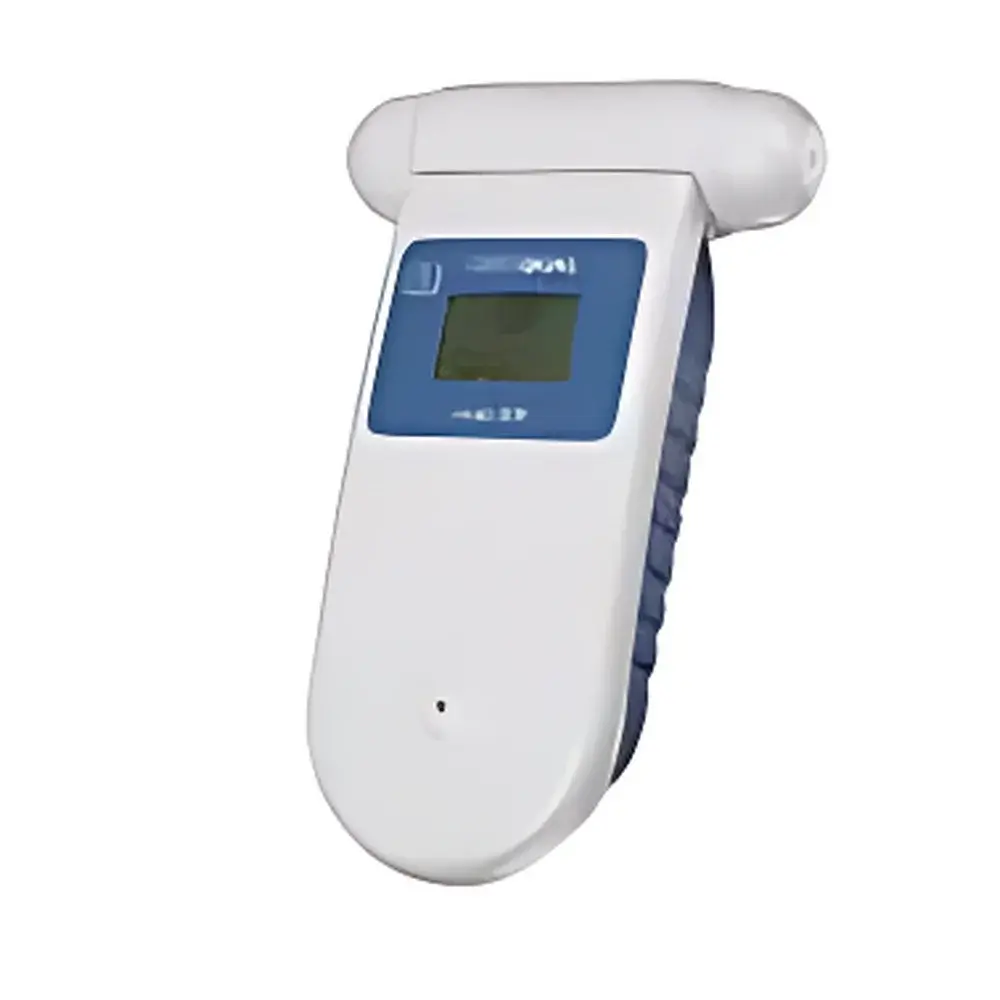
GSS 200 Portable & Fixed-Mount Ammonia (NH₃) Gas Detector
| Origin | Imported |
|---|---|
| Manufacturer Type | Authorized Distributor |
| Measurement Range | 0–1000 ppm NH₃ |
| Accuracy | ±5 ppm (0–100 ppm), ±10% FS (100–1000 ppm) |
| T90 Response Time | <60 s |
| Sensing Principle | Metal Oxide Semiconductor (MOS) |
| Operating Temperature | −20°C to +60°C |
| Operating Humidity | 5–95% RH (non-condensing) |
| Power Supply | 12 VDC, 800 mA |
| Battery Options | 9.6 V Ni-Cd (940 mAh) or 9.6 V Ni-MH (2100 mAh) |
| Enclosure Rating | IP20 / NEMA 1 |
| Dimensions (w/ probe) | 195 × 122 × 54 mm |
| Weight (w/ probe & battery) | <460 g |
| Compliance | FCC Part 15 |
| EN 50082-1 | 1997 |
| EN 50081-1 | 1992 |
Overview
The GSS 200 Ammonia (NH₃) Gas Detector is a dual-mode environmental monitoring instrument engineered for reliable, real-time detection of ammonia vapor in both portable and fixed-installation configurations. It employs a calibrated metal oxide semiconductor (MOS) sensing element—specifically optimized for NH₃ selectivity and stability across industrial, agricultural, wastewater treatment, and laboratory settings. Unlike electrochemical or catalytic bead sensors, the MOS platform offers extended operational life under intermittent exposure conditions and exhibits minimal drift when deployed in ambient air with variable humidity and temperature profiles. The device operates on a diffusion-based sampling principle, requiring no external pump or sample conditioning system. Its measurement range spans 0–1000 ppm NH₃, covering occupational exposure limits (e.g., OSHA PEL = 50 ppm, ACGIH TLV = 25 ppm) as well as higher-concentration process leak scenarios. All signal processing, temperature compensation, and linearization algorithms are embedded within the host unit firmware, ensuring consistent output regardless of probe orientation or ambient thermal gradients.
Key Features
- Modular architecture: Single host unit accepts interchangeable gas-specific sensor probes—enabling field reconfiguration without hardware replacement.
- Dual deployment flexibility: Functions as a handheld survey instrument or, when mounted in an optional FRP (fiberglass-reinforced polymer) enclosure, transitions seamlessly into a wall- or pole-mounted fixed monitor.
- Extended probe-to-host separation: Sensor head and display/control unit can be physically decoupled up to 14 meters via shielded twisted-pair cabling—ideal for confined-space entry or hazardous-area remote monitoring.
- Intuitive human interface: Backlit LCD displays real-time NH₃ concentration (ppm), battery status, sensor health indicator, and operational mode—all legible under low-light conditions.
- Energy-efficient operation: Configurable standby mode reduces power draw during non-monitoring intervals; battery runtime exceeds 12 hours (Ni-MH) under typical duty cycles.
- Ruggedized mechanical design: Compact housing (195 × 122 × 54 mm) weighs less than 460 g with probe and battery installed, meeting IP20 and NEMA 1 ingress protection standards for indoor use.
Sample Compatibility & Compliance
The GSS 200 is validated for continuous operation in ambient air containing trace to moderate concentrations of ammonia, including environments with elevated humidity (5–95% RH, non-condensing) and wide thermal variation (−20°C to +60°C). It is not intended for use in explosive atmospheres (ATEX/IECEx zones) or corrosive gas mixtures containing chlorine, hydrogen sulfide, or high-level sulfur oxides, which may accelerate MOS sensor degradation. Regulatory compliance includes adherence to electromagnetic compatibility (EMC) requirements per EN 50082-1:1997 and emissions limits per EN 50081-1:1992. FCC Part 15 Class B certification confirms suitability for commercial and light-industrial facilities. While not certified to ISO 10156 or EN 45544-1 for safety-critical personnel protection, it meets functional performance benchmarks for general-purpose area monitoring per OSHA 29 CFR 1910.120 and EPA Method TO-15 guidance for ambient NH₃ screening.
Software & Data Management
The GSS 200 operates autonomously without proprietary software dependencies. Analog 4–20 mA and digital RS-485 Modbus RTU outputs are available via optional interface modules for integration into SCADA, DCS, or building management systems (BMS). Data logging capability is not built-in; however, third-party PLCs or edge gateways can capture time-stamped concentration values at user-defined intervals. No onboard storage or cloud connectivity is provided—aligning with industrial cybersecurity best practices for air quality instrumentation deployed in regulated infrastructure. Audit trails, calibration history, and alarm event logs must be maintained externally per site-specific GLP or ISO 17025 documentation protocols.
Applications
- Wastewater treatment plants: Monitoring NH₃ off-gas from anaerobic digesters, sludge dewatering areas, and headworks ventilation ducts.
- Agricultural facilities: Spot-checking barns, poultry houses, and manure storage pits for compliance with livestock air quality guidelines.
- Refrigeration systems: Leak detection around ammonia-based industrial chillers and cold storage infrastructure.
- Laboratory fume hoods and chemical synthesis workspaces: Verifying local exhaust effectiveness during NH₃ handling procedures.
- Indoor air quality (IAQ) assessments: Mapping spatial NH₃ gradients in urban schools, hospitals, and elderly care facilities where cleaning agents or biological decay contribute to indoor emissions.
FAQ
Is the GSS 200 suitable for personal protective equipment (PPE) integration or worker-worn applications?
No—it is designed for area monitoring, not personal exposure assessment. For wearable dosimetry, refer to OSHA-compliant direct-reading personal monitors with pump-assisted sampling.
Can the MOS sensor be recalibrated in the field?
Yes, zero and span calibration is supported using certified NH₃ calibration gas (e.g., 50 ppm in air) and a dedicated calibration adapter kit. Full calibration requires access to the sensor’s internal adjustment potentiometers or firmware menu.
Does the device support alarm relay outputs?
Not natively. Relay functionality requires an external I/O module interfaced via RS-485 or analog output scaling to a programmable logic controller.
What is the expected service life of the NH₃ sensor under normal operating conditions?
Typical MOS sensor lifespan is 24–36 months when operated continuously within specification; performance verification via bump testing is recommended every 30 days in critical applications.
Is firmware upgrade capability available?
Firmware updates are performed only by authorized service centers using JTAG or UART diagnostics tools—not end-user accessible.







