
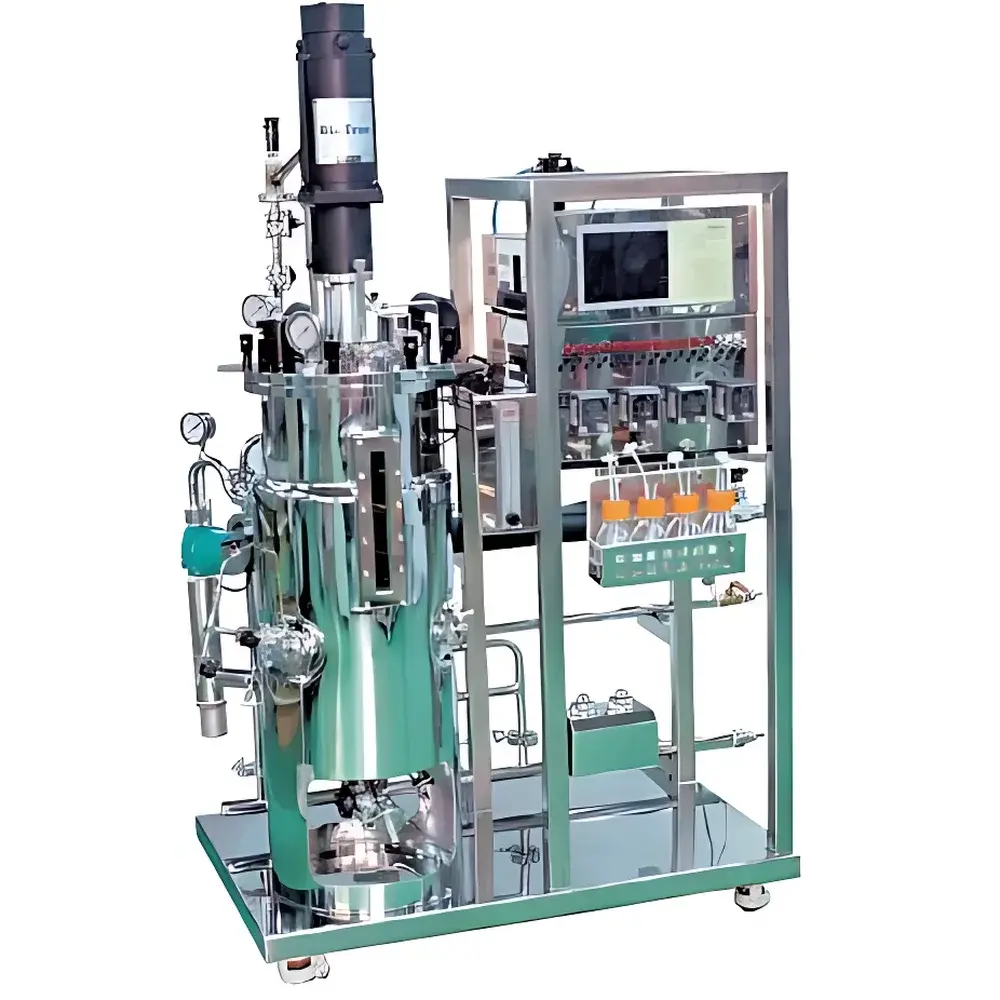
BioS Series Production-Scale Bioreactor Systems (50L–2000L)
| Origin | South Korea |
|---|---|
| Manufacturer Type | Authorized Distributor |
| Origin Category | Imported |
| Model Range | BioS 50L–2000L |
| Pricing | Upon Request |
Overview
The BioS Series Production-Scale Bioreactor Systems are fully integrated, stainless-steel (SUS316L) stirred-tank bioreactors engineered for robust, reproducible, and scalable microbial and mammalian cell culture processes. Designed in accordance with current Good Manufacturing Practice (cGMP) principles and aligned with ISO 13485 and ASME BPE-2023 standards for biopharmaceutical equipment, these systems employ conventional aerated, agitated tank architecture based on Rushton turbine or marine impeller hydrodynamics, coupled with precise control of critical process parameters—including temperature, pH, dissolved oxygen (DO), pressure, foam, and feed addition—via a centralized microprocessor-based control platform. The BioS platform supports both batch and fed-batch operation modes across working volumes from 50 L to 2000 L, making it suitable for upstream process development, pilot-scale manufacturing, and clinical-grade production of therapeutic proteins, vaccines, and recombinant enzymes.
Key Features
- Fully jacketed cylindrical vessel constructed from electropolished SUS316L stainless steel, rated for design pressure up to 3.0 bar(g) and maximum operating pressure of 2.0 bar(g)
- Top-mounted, direct-coupled AC motor drive (0.75 kW, 220 V, 50/60 Hz) with digital color LCD speed controller and real-time RPM display
- Integrated sterile air supply system featuring dual-stage filtration: pre-filter + 0.01 µm PTFE membrane filter housed in SUS316L cartridge housing (Sartorius certified)
- Multi-parameter digital control modules—each equipped with color LCD interface—dedicated to pH, DO, temperature, foam, pressure, and airflow regulation
- Automated sterilization-in-place (SIP) functionality with programmable cycle configuration, including hold time, ramp rate, and temperature validation logging
- Modular DAQS (Data Acquisition System) software enabling real-time graphical monitoring, timestamped parameter logging, export to MS Excel (.csv), and optional thermal printer integration
- Condenser and exhaust gas handling subsystem including SUS316L heat exchanger, coalescing filter, and disposable hydrophobic air filter elements
- Sanitary sampling port and bottom discharge valve with CIP-compatible geometry and zero dead-leg design per ASME BPE guidelines
Sample Compatibility & Compliance
The BioS bioreactors support cultivation of bacteria (e.g., E. coli, Bacillus spp.), yeasts (Saccharomyces cerevisiae, Pichia pastoris), filamentous fungi, and anchorage-dependent or suspension-adapted mammalian cells (CHO, HEK293). All wetted surfaces comply with USP Class VI biocompatibility requirements. System architecture adheres to FDA 21 CFR Part 11-compliant data integrity provisions when DAQS software is configured with audit trail, electronic signature, and role-based access controls. Full documentation packages—including FAT/SAT protocols, IQ/OQ templates, and material traceability records—are available upon request to support regulatory submissions under ICH Q5D, Q5A(R2), and EMA Annex 1 frameworks.
Software & Data Management
The embedded DAQS software operates on an 8.5-inch industrial-grade color LCD HMI with touch-enabled navigation. It provides synchronized acquisition of ≥12 analog/digital inputs (pH, DO, T, P, RPM, airflow, level, feed weight, etc.) at configurable sampling intervals (1–60 sec). All data are stored locally on non-volatile memory with automatic backup to external USB media. Export formats include CSV and XML; time-series plots support overlay analysis and trend annotation. Optional GMP-compliant mode enables electronic signature capture, change history tracking, and ALCOA+ compliant record retention for ≥30 years per internal policy. Integration with third-party MES/SCADA platforms is supported via Modbus TCP and OPC UA protocols.
Applications
- Process development and scale-up studies for monoclonal antibody and biosimilar manufacturing
- Clinical trial material (CTM) production under cGMP conditions
- Enzyme and specialty metabolite fermentation for industrial biocatalysis
- Vaccine antigen production using viral vector or protein subunit platforms
- Stability and comparability studies across multiple bioreactor scales (50 L → 2000 L)
- Training and technology transfer for contract development and manufacturing organizations (CDMOs)
FAQ
What regulatory standards does the BioS bioreactor meet?
The system complies with ASME BPE-2023 surface finish and weld criteria, ISO 13485 for medical device manufacturing, and supports implementation of FDA 21 CFR Part 11 and EU Annex 1 requirements through optional software configurations.
Is remote monitoring supported?
Yes—via optional Ethernet connectivity and secure web-based HMI interface compatible with modern IT infrastructure and firewall policies.
Can the system be validated for GMP use?
Absolutely. Comprehensive IQ/OQ documentation packages, calibration certificates for all sensors, and FAT/SAT execution support are provided by authorized service partners.
What maintenance intervals are recommended for the filtration system?
Sterile air filters require replacement after each SIP cycle or per manufacturer’s lifetime specification (typically 50–100 cycles); condenser and exhaust filters are replaced based on differential pressure monitoring and scheduled preventive maintenance.
Is customization available for specific process requirements?
Yes—custom configurations include alternative impeller types, additional feed ports, integrated mass flow controllers, off-gas analyzers (O₂/CO₂), and PAT-ready sensor interfaces (e.g., Raman, NIR).
Related Products




