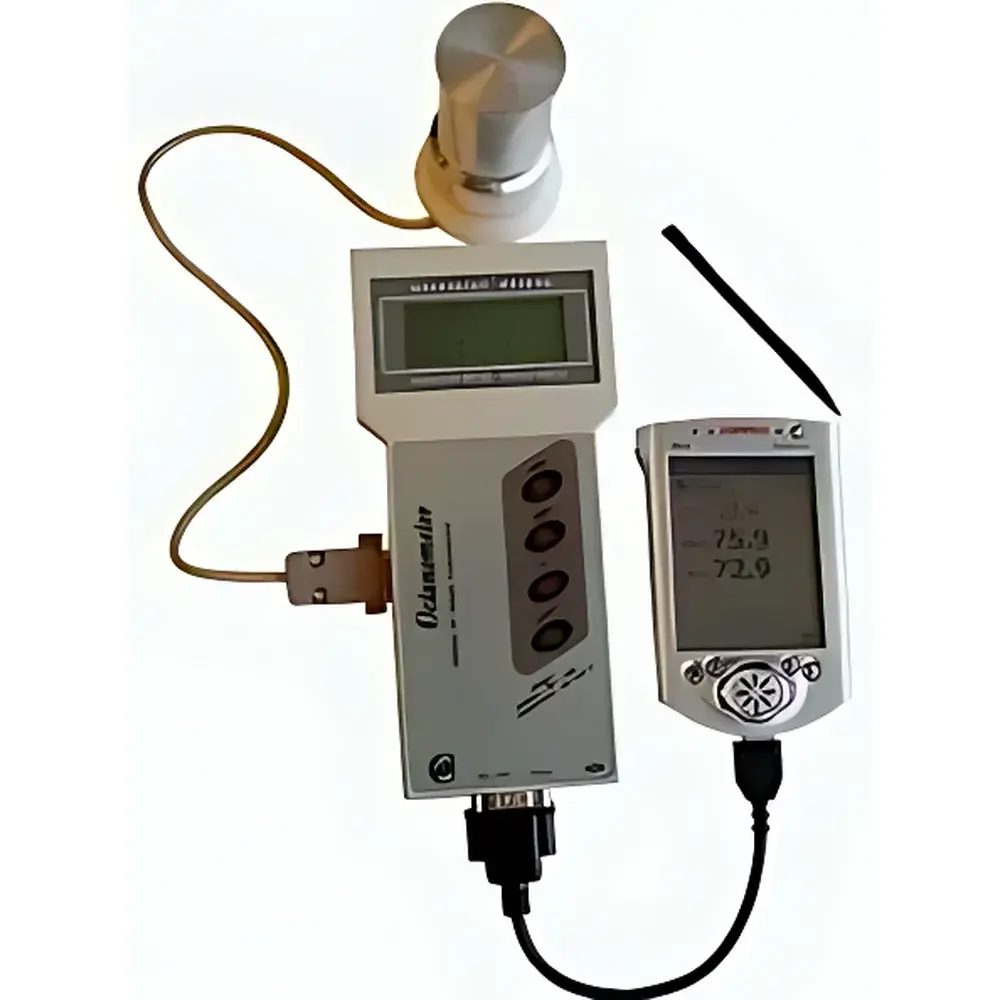
SHATOX-2212 Portable Octane Number and Cetane Number Analyzer
| Origin | Imported |
|---|---|
| Manufacturer Type | Authorized Distributor |
| Model | SHATOX-2212 |
| Measurement Range (Octane) | 40–120 (±0.5) |
| Measurement Range (Cetane) | 20–100 (±1) |
| Sample Measurement Time | <10 s |
| Display | LCD digital readout |
| Operating Temperature | −10 °C to +40 °C |
| Relative Humidity | 30–80% RH |
| Atmospheric Pressure | 64–106 kPa |
| Power Supply | 6 V DC adapter or AA batteries |
| Current Consumption | 30 mA |
| Battery Life | Up to 100 h |
| Dimensions (Sensor) | 60 × 100 mm |
| Dimensions (Main Unit) | 80 × 150 × 30 mm |
| Weight | 0.7 kg |
| Data Export Format | .txt and .xls |
| Interface | RS-232 |
Overview
The SHATOX-2212 Portable Octane Number and Cetane Number Analyzer is a field-deployable, electromagnetic property-based instrument engineered for rapid, non-destructive assessment of gasoline anti-knock quality (expressed as Research Octane Number, RON, and Motor Octane Number, MON) and diesel ignition quality (Cetane Number, CN). Unlike traditional ASTM D2699/D2700 (RON/MON) or ASTM D613 (CN) test methods—which require full-scale engine-based laboratories—the SHATOX-2212 employs dielectric permittivity and magnetic susceptibility correlation models calibrated against reference fuel standards. This physical principle enables direct in-situ measurement of hydrocarbon composition effects on combustion behavior without sample dilution, distillation, or combustion chamber instrumentation. The analyzer operates under ambient environmental constraints typical of refinery perimeters, fuel terminals, transportation depots, and mobile QA/QC units—supporting real-time verification of blending accuracy, adulteration detection, and regulatory compliance pre-delivery.
Key Features
- True dual-parameter capability: simultaneous or independent determination of octane number (40–120, ±0.5) and cetane number (20–100, ±1) in a single handheld platform
- Sub-10-second measurement cycle per sample, enabling high-throughput screening during loading/unloading operations or pipeline transfer points
- Integrated temperature sensor for real-time compensation of fuel thermal expansion effects on electromagnetic response
- Optional pour point estimation for diesel samples via correlated thermal transition analysis
- Compact ergonomic design (80 × 150 × 30 mm; 0.7 kg) with IP54-rated enclosure for dust and splash resistance in industrial environments
- Dual power architecture: supports continuous operation via 6 V DC adapter or extended field use with standard AA alkaline cells (100 h typical runtime)
- RS-232 serial interface compliant with legacy lab infrastructure and embedded Pocket PC calibration systems (Microsoft Pocket PC 2000/2002)
Sample Compatibility & Compliance
The SHATOX-2212 is validated for use with all conventional gasoline formulations—including unleaded, oxygenated (MTBE, ethanol-blended), and reformulated fuels—as well as straight-run, hydrotreated, and biodiesel-blended diesel fuels (up to B20). It does not require solvent extraction, phase separation, or pre-conditioning. Calibration traceability follows ISO/IEC 17025 guidelines through primary reference materials certified by NIST-traceable sources. While not a replacement for referee engine testing per ASTM D2699, D2700, or D613, the instrument meets ASTM D7713 (Standard Practice for Field Screening of Gasoline Octane Number Using Electromagnetic Sensors) and supports internal quality control workflows aligned with API RP 2550 and EN 228/EN 590 specifications. Its operational parameters comply with IEC 61000-6-2 (immunity) and IEC 61000-6-3 (emissions) for industrial electromagnetic environments.
Software & Data Management
The analyzer ships with embedded firmware and companion software for Windows Mobile (Pocket PC 2000/2002) and desktop Windows platforms. All calibration routines—including multi-point linear and polynomial regression—are executed locally on the connected PDA or PC via RS-232. Measurement data are timestamped and stored in non-volatile memory with automatic export to .txt (tab-delimited) or .xls (Excel-compatible) formats—enabling direct ingestion into LIMS, ERP, or statistical process control (SPC) systems. Audit trails include operator ID, calibration date/version, ambient conditions, and raw sensor output values. Software supports GLP-compliant data integrity features including user-access levels, electronic signatures (via external authentication), and immutable log files—facilitating alignment with FDA 21 CFR Part 11 requirements where applicable.
Applications
- On-site verification of gasoline blending ratios at refineries and terminals prior to shipment
- Rapid screening of suspect fuel deliveries at service stations or fleet depots
- Field support for customs and regulatory agencies conducting fuel quality surveillance
- Mobile laboratory integration for emergency response teams assessing post-contamination fuel integrity
- Process troubleshooting during catalytic reformer or hydrotreater unit startups
- Educational demonstration of fuel property–composition relationships in petroleum engineering curricula
FAQ
Does the SHATOX-2212 require periodic recalibration using certified reference fuels?
Yes—calibration must be performed at least once per shift when used in regulated environments, using ASTM-certified primary reference fuels (e.g., Chevron RON/MON standards or PTB cetane references).
Can the instrument measure ethanol content independently of octane number?
No—it infers octane enhancement from combined dielectric and magnetic responses; standalone ethanol quantification requires complementary NIR or GC analysis.
Is the device suitable for measuring marine diesel (DMA/DMB) or aviation turbine fuel (Jet A-1)?
It is validated for road diesel (EN 590) and common blends; Jet A-1 and marine distillates fall outside its calibration matrix due to aromatic and naphthene content deviations.
What is the minimum sample volume required for a valid measurement?
A stable 5 mL volume fully immersed in the sensor cavity is sufficient; no flow cell or pumping system is needed.
Does the analyzer meet explosion-proof certification for use in Zone 1 hazardous areas?
No—it carries no ATEX, IECEx, or UL HazLoc certification; operation is restricted to non-classified locations per NFPA 30 and API RP 2510.