
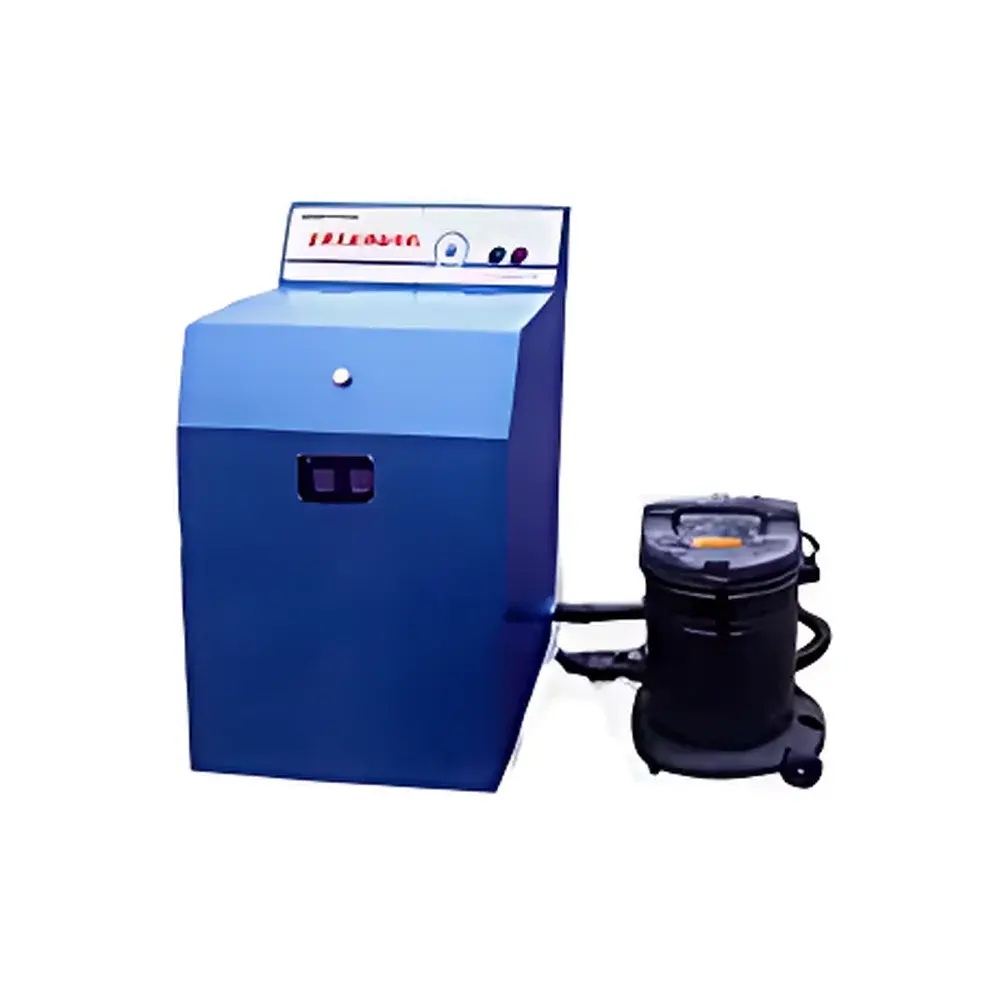
KER-1.2.3/100A Series Sealed Sample Pulverizer
| Origin | China |
|---|---|
| Manufacturer Type | Authorized Distributor |
| Model | KER-1/100A, KER-2/100A, KER-3/100A |
| Feed Capacity | 150 g (per bowl), 2×150 g, or 3×150 g |
| Max Feed Size | ≤20 mm |
| Output Particle Size | 800–200 mesh |
| Processing Time | <2 min (KER-1/100A, KER-2/100A), <3 min (KER-3/100A) |
| Bowl Material | High-Manganese Steel |
| Motor Power | 1.1 kW (KER-1/100A), 1.5 kW (KER-2/100A & KER-3/100A) |
| Voltage | 3-phase 380 V AC |
| Weight | 180–200 kg |
| Dimensions (L×W×H) | 500×500×730 mm |
| Control System | Fully Enclosed Automatic Controller |
| Grinding Mechanism | Impact and Abrasion |
| Operation Mode | Dry or Wet |
| Sealing | Hermetic Bowl Closure & Dust-Tight Enclosure |
Overview
The KER-1.2.3/100A Series Sealed Sample Pulverizer is an industrial-grade laboratory pulverizing system engineered for rapid, reproducible size reduction of hard and brittle inorganic materials—including metallic alloys, ores, ceramics, slag, and refractory minerals. Operating on the principle of high-energy impact and controlled abrasion within a hermetically sealed grinding chamber, this instrument eliminates cross-contamination and sample loss—critical requirements for geochemical analysis, metallurgical assay, cement quality control, and regulatory-compliant sample preparation (e.g., ASTM D346, ISO 18283, USP ). Unlike open-bowl grinders, its fully enclosed architecture prevents airborne particulate dispersion, ensuring operator safety and compliance with OSHA PEL and EU Directive 2004/37/EC on carcinogens and mutagens. The system is not equipped with an integrated industrial dust collector; however, its intrinsic sealing design minimizes fugitive emissions to levels compatible with standard fume hood integration or local exhaust ventilation (LEV) systems.
Key Features
- Triple-configurable bowl capacity: single-bowl (KER-1/100A), dual-bowl (KER-2/100A), or triple-bowl (KER-3/100A) operation—enabling parallel processing while maintaining identical grinding kinetics across all channels.
- Hermetic bowl closure mechanism with precision-machined high-manganese steel liners (HB ≥ 180), delivering exceptional wear resistance and consistent particle size distribution (PSD) over extended service life.
- Fully enclosed automatic control unit with IP54-rated housing, safeguarding electronics from abrasive dust ingress and supporting long-term reliability in high-particulate environments.
- Dual-mode capability: validated for both dry grinding (standard mode) and wet grinding (with compatible liquid media), without modification—preserving sample integrity for subsequent XRF, ICP-OES, or XRD analysis.
- Low-noise, vibration-damped base structure and dynamically balanced rotor assembly ensure stable operation at rated speed (typical operating RPM: 960–1440, depending on motor configuration), reducing mechanical fatigue and ambient lab disturbance.
- Compliance-ready design: meets CE machinery directive (2006/42/EC) structural safety requirements and supports GLP documentation through traceable batch processing logs (when paired with optional external data acquisition interfaces).
Sample Compatibility & Compliance
The KER series accommodates feed materials with Mohs hardness up to 7.5 (e.g., quartz, hematite, bauxite, stainless steel chips) and compressive strength ≤200 MPa. Samples must be pre-crushed to ≤20 mm prior to loading. Final output spans 800–200 mesh (18–74 µm), suitable for homogenization prior to fusion bead preparation (ISO 12677), acid digestion (EPA Method 3050B), or direct press-and-analyze workflows. All models conform to ISO 14001 environmental management prerequisites for closed-loop sample handling and satisfy baseline occupational hygiene benchmarks per ACGIH TLV® guidelines for respirable crystalline silica exposure during routine operation.
Software & Data Management
While the KER-1.2.3/100A operates via embedded microcontroller-based timing and cycle logic (no onboard PC or GUI), it features standardized 4–20 mA analog output and RS-485 Modbus RTU interface for integration into centralized laboratory information management systems (LIMS) or supervisory control and data acquisition (SCADA) platforms. Optional external programmable logic controller (PLC) modules enable audit-trail logging of start/stop timestamps, total operational hours, and bowl-specific cycle counts—supporting FDA 21 CFR Part 11 compliance when deployed in regulated pharmaceutical or contract testing laboratories.
Applications
- Preparation of representative sub-samples for X-ray fluorescence (XRF) spectrometry in mining exploration and grade control.
- Routine pulverization of cement clinker and fly ash per ASTM C114 and EN 196-2 protocols.
- Homogenization of geological core samples prior to multi-element ICP-MS analysis.
- Production of fine powders for thermal analysis (TGA/DSC) and BET surface area measurement.
- Quality assurance grinding of recycled metal scrap prior to spectrographic sorting or alloy verification.
FAQ
Is the KER-1.2.3/100A compliant with ISO/IEC 17025 accreditation requirements for sample preparation?
Yes—the sealed architecture, documented repeatability (RSD <3% for d50 across 10 consecutive runs), and compatibility with traceable calibration standards support method validation under ISO/IEC 17025 Clause 7.2.2.
Can the system be used for cryogenic grinding?
No—this model is not designed for liquid nitrogen cooling or sub-ambient operation. Ambient-temperature dry/wet grinding only.
What maintenance intervals are recommended for the high-manganese steel bowls?
Visual inspection every 200 operating hours; liner replacement advised after 1,500–2,000 hours of cumulative use under typical mineral feed conditions.
Does the unit include vibration isolation mounts?
Standard configuration includes elastomeric anti-vibration feet; optional active damping mounts are available upon request for sensitive instrumentation environments.
Is electrical certification provided for North American markets (UL/cUL)?
CE marking is standard; UL/cUL listing requires factory-installed modifications and third-party evaluation—available as a custom order with lead-time extension.



