
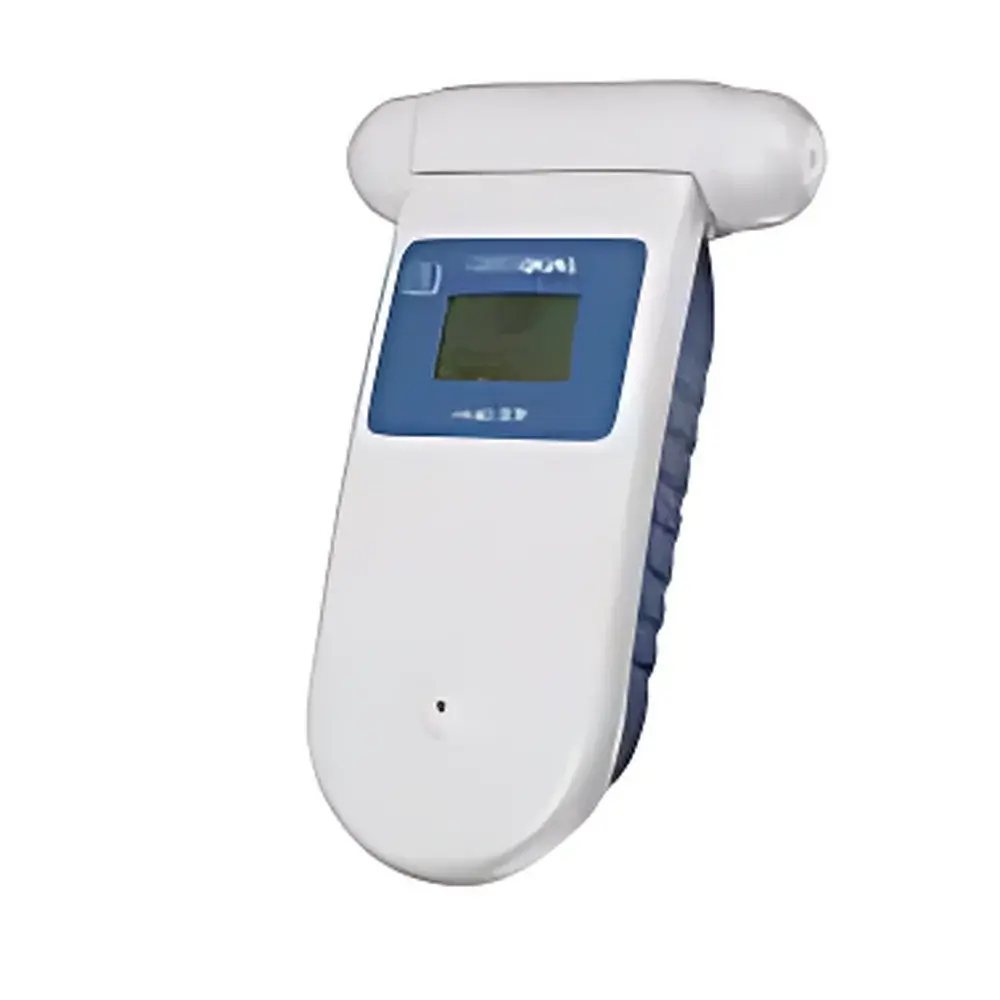
Ozone (O₃) Gas Detector – Portable & Fixed-Mount Model 200
| Origin | Imported |
|---|---|
| Manufacturer Type | Authorized Distributor |
| Measurement Principle | Metal Oxide Semiconductor (MOS) Sensor |
| Detection Range | 0.000–50.00 ppm (multi-range selectable) |
| Accuracy | ±0.005 ppm (0–0.100 ppm), ±10% (0.100–2.00 ppm), ±15% (2.00–20.00 ppm), ±20% (20.00–50.00 ppm) |
| Resolution | 1 ppb (low-range), 0.01 ppm (mid/high-range) |
| T90 Response Time | <10 s (leak range) to <70 s (ultra-low range) |
| Operating Temp | −5°C to +50°C |
| Operating Humidity | ≤95% RH (non-condensing) |
| Power | 12 VDC, 800 mA |
| Rechargeable Options | 9.4 V Ni-Cd (940 mAh) or 9.6 V Ni-MH (2100 mAh) |
| Enclosure Rating | IP20 / NEMA 1 |
| Dimensions | 195 × 122 × 54 mm (with probe) |
| Weight | <460 g (with probe and battery) |
| Compliance | FCC Part 15, EN 50082-1:1997, EN 50081-1:1992 |
Overview
The Ozone (O₃) Gas Detector – Portable & Fixed-Mount Model 200 is a dual-mode environmental monitoring instrument engineered for reliable, real-time detection of ozone across four calibrated concentration ranges: ultra-low (0.000–0.150 ppm), low (0.000–0.500 ppm), medium (0.50–20.00 ppm), and leak-level (0.00–50.00 ppm). It employs a temperature-compensated metal oxide semiconductor (MOS) sensing element—specifically optimized for O₃ selectivity in ambient air matrices—delivering high reproducibility under variable humidity and thermal conditions. Unlike electrochemical or UV absorption analyzers, this MOS-based platform offers rapid deployment, minimal maintenance, and intrinsic suitability for field verification, occupational hygiene screening, and ozone generator commissioning. The device operates without consumables or zero-gas calibration requirements, making it appropriate for both short-term spot checks and semi-permanent installation when fitted with optional FRP (fiberglass-reinforced polymer) mounting hardware.
Key Features
- Modular architecture: Single base unit accepts interchangeable gas sensor probes—enabling future expansion to NO₂, Cl₂, SO₂, or VOC configurations without hardware replacement.
- Multi-range auto-scaling display: Large backlit LCD dynamically adjusts resolution and units (ppm or ppb) based on active measurement range, ensuring readability across trace and industrial exposure levels.
- Extended probe-to-host separation: Up to 14 meters of shielded cable support enables remote sampling in confined spaces, ducts, or hazardous zones while maintaining operator safety.
- Dual power flexibility: Operates from external 12 VDC supply or internal rechargeable battery packs—Ni-Cd (940 mAh) for standard duty or high-capacity Ni-MH (2100 mAh) for extended logging campaigns.
- Intelligent diagnostics: Real-time status indicators report battery charge level, sensor health, signal saturation, and thermal drift compensation status—critical for GLP-aligned field documentation.
- Low-power standby mode: Reduces current draw to <15 mA during idle periods, extending operational uptime between charges without compromising wake-up latency.
Sample Compatibility & Compliance
The Model 200 is validated for continuous monitoring of ozone in ambient air, indoor workplace environments, and near-point emission sources such as UV ozone generators, water treatment off-gas streams, and sterilization chambers. Its MOS sensor exhibits minimal cross-sensitivity to common interferents including NO, CO, and hydrocarbons below 50 ppm—verified per EN 14625:2012 Annex B protocols. While not certified to ISO 16000-23 or EPA Method TO-11A for regulatory compliance reporting, the instrument meets essential electromagnetic compatibility (EMC) and safety requirements per FCC Part 15 Subpart B and European harmonized standards EN 50082-1:1997 (immunity) and EN 50081-1:1992 (emissions). For applications requiring audit-trail capability or data integrity assurance, optional firmware upgrade supports time-stamped CSV export via USB and configurable alarm thresholds with latching behavior.
Software & Data Management
Data acquisition occurs at 1 Hz sampling rate with onboard non-volatile memory storing up to 32,000 timestamped records (date/time, concentration, temperature, battery voltage). Export is performed via micro-USB interface using vendor-supplied Windows-compatible desktop utility that generates compliant .csv files suitable for integration into LIMS or Excel-based trend analysis. No proprietary cloud service is required; all configuration—including range selection, alarm setpoints (high/low), backlight timeout, and unit preference—is managed locally through intuitive menu navigation. The firmware supports firmware-over-the-air (FOTA) updates via USB, enabling future enhancements to calibration algorithms or communication protocols without hardware modification.
Applications
- Occupational health & safety: Routine O₃ exposure assessment in laboratories, printing facilities, and HVAC maintenance zones where UV lamps or corona discharge devices operate.
- Water & wastewater treatment: Monitoring residual ozone in contact chambers and off-gas vents prior to catalytic destruction units.
- Pharmaceutical cleanroom validation: Spot-checking ozone residuals after decontamination cycles to verify decay below ISO 14644-1 Class 5 limits (≤0.05 ppm).
- Industrial hygiene surveys: Mapping spatial ozone gradients around industrial ozone generators used in surface oxidation or odor control systems.
- Educational & research use: Teaching gas sensor fundamentals, calibration curve generation, and response kinetics in environmental engineering labs.
FAQ
Is this instrument suitable for regulatory compliance reporting under OSHA PEL or EU Directive 2004/101/EC?
No. The Model 200 is intended for indicative monitoring and process verification—not legal metrology. For enforcement-grade data, reference-grade UV photometers meeting ISO 13964:2021 are required.
Can the sensor be recalibrated in the field?
Yes. Zero calibration is performed using ambient air (O₃-free nitrogen optional); span adjustment requires certified ozone gas standard (e.g., 0.100 ppm ±2% NIST-traceable). Procedure is guided via on-screen prompts.
What is the expected service life of the MOS sensor under continuous operation?
Typical functional lifespan is 24–36 months in environments with average ozone exposure <1 ppm and humidity <80% RH. Performance degradation is indicated by increasing baseline drift or reduced T90 response speed.
Does the device support analog output (4–20 mA) or Modbus RTU?
Not natively. Analog output requires optional signal conditioner module (sold separately); Modbus RTU is available via third-party RS485 gateway interfacing to the USB data stream.
How is temperature compensation implemented?
An integrated thermistor continuously measures sensor head temperature; compensation coefficients are applied per factory characterization curves stored in EEPROM—no user intervention required.
Related Products







