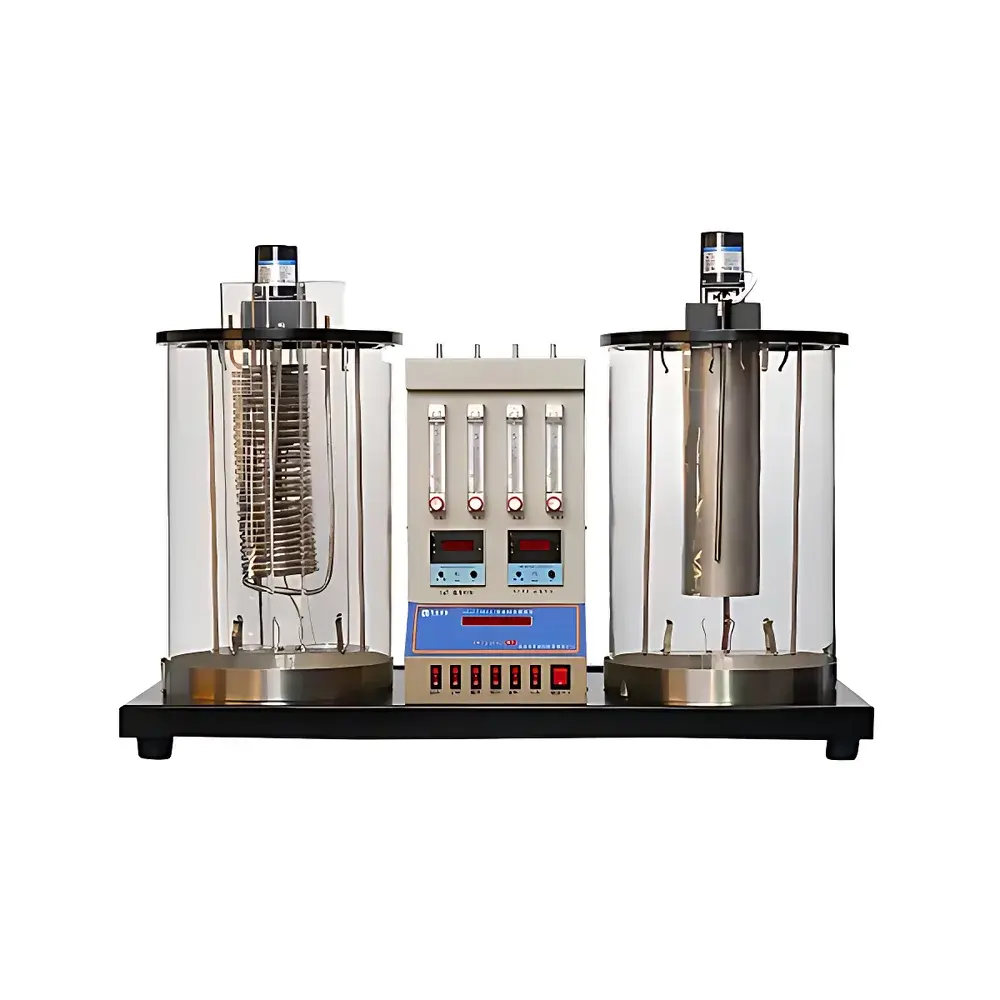
Spectra Invent HX-FC1850 Foam Characteristic Analyzer
| Brand | Spectra Invent (Chinainvent) |
|---|---|
| Origin | Beijing, China |
| Manufacturer Type | Authorized Distributor |
| Country of Manufacture | China |
| Model | HX-FC1850 |
| Price Range | USD 1,400 – 14,000 |
| Standard Compliance | GB/T 12579, ASTM D892 |
| Temperature Control | 24 °C (with optional immersion chiller) and 93.5 °C |
| Temperature Stability | ±0.5 °C |
| Heating Power | 2500 W (93.5 °C bath), 800 W (24 °C bath) |
| Temperature Sensor | PT100 Platinum Resistance Thermometer |
| Gas Diffusion Disc Diameter | 25.4 mm ± 0.02 mm |
| Air Permeability Rate | 3000–6000 mL/min at 2.4 kPa (250 mmH₂O) |
| Sample Cylinder | 1000 mL calibrated glass cylinder (ASTM-compliant) |
| Air Flow Control | Adjustable rotameter, 16–160 mL/min, with reference mark at 94 mL/min |
| Dimensions | 1000 mm × 340 mm × 740 mm |
| Weight | 46 kg |
Overview
The Spectra Invent HX-FC1850 Foam Characteristic Analyzer is a precision-engineered instrument designed to quantify the foaming behavior of industrial lubricants—including engine oils, gear oils, and hydraulic fluids—under standardized thermal and aerodynamic conditions. It operates on the principle of controlled air sparging through a calibrated porous diffusion disc into a defined volume of test oil, followed by quantitative measurement of foam height (foam tendency) and its decay over time (foam stability). The system adheres strictly to the physical test protocols outlined in GB/T 12579 and ASTM D892, ensuring data comparability across global laboratories and compliance with OEM and regulatory specifications for lubricant qualification.
Key Features
- Dual-temperature bath configuration supporting both low-temperature (24 °C, optionally enhanced with immersion chiller) and high-temperature (93.5 °C) test modes per ASTM D892 Method A and B;
- High-stability temperature control system with ±0.5 °C accuracy, utilizing PT100 platinum resistance sensors and independent heating elements (2500 W for 93.5 °C bath; 800 W for 24 °C bath);
- Integrated air supply management with precision-adjustable rotameter (16–160 mL/min range), featuring a factory-calibrated 94 mL/min reference line aligned with ASTM D892 requirements;
- Standardized 1000 mL borosilicate glass cylinder with etched volume markings, optimized for optical clarity and thermal inertia matching;
- 25.4 mm ± 0.02 mm sintered stainless-steel diffusion disc with certified air permeability (3000–6000 mL/min at 2.4 kPa), ensuring reproducible bubble generation kinetics;
- Modular, freestanding architecture with casters for lab mobility and ergonomic access to all controls and sample ports;
- Digital electronic timer with programmable start/stop functions synchronized to gas initiation and foam height recording intervals.
Sample Compatibility & Compliance
The HX-FC1850 is validated for use with mineral-based, synthetic, and semi-synthetic lubricants across viscosity grades from ISO VG 10 to VG 680. Its design conforms to the dimensional, thermal, and airflow specifications mandated by GB/T 12579 (Chinese National Standard) and ASTM D892 (Standard Test Method for Foaming Characteristics of Lubricating Oils). The instrument supports routine QC testing in accordance with ISO/IEC 17025-accredited laboratory practices and provides traceable documentation suitable for internal audit, supplier qualification, and OEM technical dossier submission. All wetted components are chemically resistant to hydrocarbon solvents and common additive packages.
Software & Data Management
While the base HX-FC1850 operates via standalone digital controls, optional PC-integrated software modules (available upon request) enable automated data logging, timestamped foam height capture at user-defined intervals (e.g., 0, 5, 10 min), and export to CSV or PDF formats. The software architecture supports audit trail functionality compliant with FDA 21 CFR Part 11 requirements when deployed in regulated environments, including electronic signature capability, user role-based access control, and immutable record retention. Raw data files retain full metadata: ambient conditions, operator ID, calibration status, and bath temperature history.
Applications
- Quality control of finished lubricants prior to release;
- Evaluation of antifoam additive efficacy during formulation development;
- Comparative analysis of foam performance across competing base stocks or additive packages;
- Root-cause investigation of field-reported foaming issues in hydraulic systems or gearboxes;
- Supporting ASTM D892 conformance reporting for API licensing and OEM approvals (e.g., GM, Ford, Caterpillar);
- Teaching and demonstration of interfacial rheology principles in university tribology and lubrication engineering labs.
FAQ
What standards does the HX-FC1850 fully support?
It is engineered and verified for strict adherence to ASTM D892 (Methods A and B) and GB/T 12579, including all specified bath temperatures, airflow rates, diffusion disc geometry, and timing sequences.
Can the instrument operate continuously at 93.5 °C without thermal drift?
Yes—the 2500 W heating element, combined with PID-controlled PT100 feedback and insulated bath construction, maintains ±0.5 °C stability over 60+ minute test cycles under load.
Is the 1000 mL cylinder supplied with NIST-traceable calibration?
The cylinder meets ASTM E542 dimensional tolerances and is calibrated to Class A volumetric accuracy; full traceable calibration certificates are available as an add-on service.
How is gas flow verified and maintained over time?
The rotameter is factory calibrated against a primary flow standard; users may perform periodic verification using a secondary electronic flow meter connected upstream of the diffusion disc.
Does the system require external compressed air or built-in air generation?
It requires a clean, oil-free, dry compressed air source (4–6 bar) connected via standard 6 mm push-to-connect fitting; no internal compressor is integrated.