
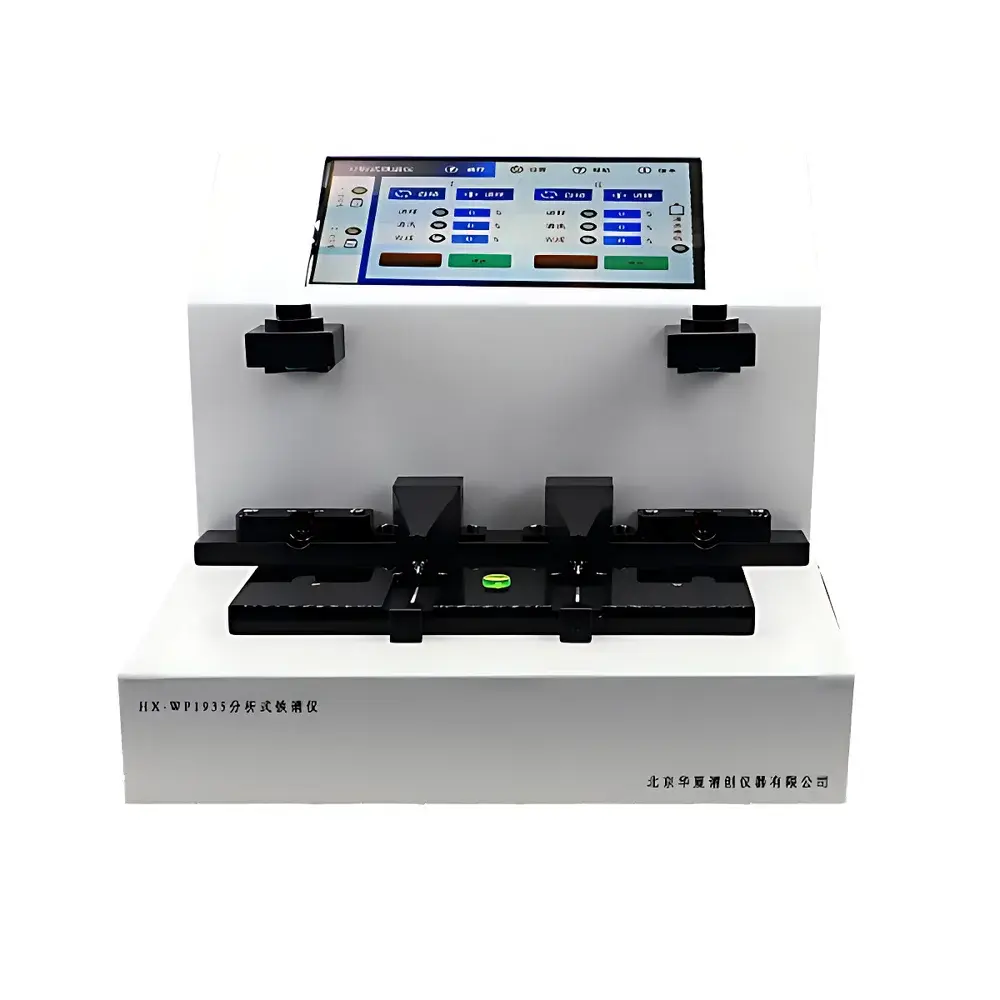
Spectra Invent HX-WP1935 Analytical Ferroscope
| Brand | Spectra Invent |
|---|---|
| Origin | Beijing, China |
| Manufacturer Type | Authorized Distributor |
| Country of Origin | China |
| Model | HX-WP1935 |
| Pricing | Upon Request |
| Compliance | ASTM D7690, ASTM D7684, SH/T 0573 |
| Display | 10.1-inch LCD touch screen |
| Power Supply | AC 220 V, 50 Hz |
| Particle Size Range | 0 µm to 800 µm |
| Sample Introduction | Pneumatic micro-pump auto-sampling |
| Cleaning Mode | Dual-mode (automatic + manual) |
| Magnetic Field | Max flux density 1.8 T (±0.1 T), max field gradient > 57,657 T/m |
Overview
The Spectra Invent HX-WP1935 Analytical Ferroscope is an engineered solution for quantitative and morphological analysis of ferrous wear particles suspended in lubricating oils. Based on the principle of high-gradient magnetic separation, the instrument deposits wear debris onto a glass substrate (ferrogram) under controlled fluidic and magnetic conditions—enabling particle classification by magnetic susceptibility, size, shape, and composition. This methodology forms the technical foundation of analytical ferrography, a standardized diagnostic technique widely adopted in predictive maintenance programs across aviation, power generation, marine propulsion, and heavy industrial machinery sectors. The HX-WP1935 conforms rigorously to ASTM D7690 (Standard Practice for Analysis of Wear Debris Using Analytical Ferrography), ASTM D7684 (Standard Test Method for Quantitative Determination of Wear Debris in Lubricants Using Analytical Ferrography), and SH/T 0573 (Chinese standard for wear particle analysis in used lubricating oils), ensuring methodological traceability and inter-laboratory comparability.
Key Features
- Automated dual-sample processing: Simultaneous preparation of two ferrograms in under 20 minutes, minimizing throughput latency in high-volume oil analysis labs.
- Robust magnetic architecture: Integrated permanent magnet assembly delivering a maximum magnetic flux density of 1.8 T (±0.1 T) and field gradient exceeding 57,657 T/m—optimized for effective separation of sub-micron to 800 µm ferromagnetic particles.
- Intelligent flow control: Adjustable pneumatic micro-pump system ensures consistent sample delivery rate, critical for reproducible particle deposition morphology and quantitative layer uniformity.
- Water-tolerant sample handling: Designed to maintain spectral integrity even in presence of trace water contamination (<5% v/v), eliminating pre-drying steps commonly required in alternative ferrographic systems.
- Transparent ferrogram substrate: Glass-based collection slides enable transmitted-light microscopy, facilitating rapid differentiation between ferrous metals (e.g., steel, cast iron), non-ferrous metals (e.g., copper, aluminum), and organic contaminants (e.g., varnish, soot).
- Integrated human-machine interface: 10.1-inch capacitive touch LCD display supports intuitive workflow navigation, real-time status monitoring, and parameter configuration without external PC dependency.
- Dual cleaning protocol: Onboard automated solvent rinse cycle complements manual cleaning mode for flexible maintenance under varying lab SOPs and regulatory audit requirements.
Sample Compatibility & Compliance
The HX-WP1935 accommodates standard viscosity ranges encountered in turbine oils, hydraulic fluids, gear oils, and engine lubricants (ISO VG 32–680). It accepts sample volumes of 1–3 mL per run and operates effectively with diluted or undiluted oil matrices. All operational protocols align with ISO/IEC 17025:2017 requirements for testing laboratories, supporting GLP-compliant documentation when paired with validated LIMS integration. The instrument’s adherence to ASTM D7690 and SH/T 0573 ensures compatibility with global OEM maintenance specifications—including those issued by Rolls-Royce, Siemens Energy, Caterpillar, and GE Power—and satisfies technical prerequisites for third-party certification under CNAS (China National Accreditation Service) and A2LA (American Association for Laboratory Accreditation).
Software & Data Management
While the HX-WP1935 operates as a standalone hardware platform, its ferrogram output is fully compatible with industry-standard ferrographic image analysis software suites (e.g., FerroSTAR™, FerroView™, and custom MATLAB- or Python-based particle recognition algorithms). Digital ferrograms can be exported in TIFF or PNG format at ≥300 dpi resolution, preserving morphological fidelity for downstream AI-assisted classification. Audit trails—including operator ID, timestamp, sample ID, magnetic field settings, flow rate, and cleaning cycle logs—are stored locally and exportable via USB interface. For regulated environments, optional firmware upgrades support 21 CFR Part 11-compliant electronic signatures and secure user role management (Administrator, Technician, Reviewer).
Applications
- Predictive maintenance of gas turbines and steam turbines through early detection of abnormal wear modes (e.g., sliding, fatigue, cutting, severe sliding).
- Root cause analysis of gearbox failures in wind turbine drivetrains using particle morphology correlation with failure mechanisms.
- Verification of filter efficiency and lubricant degradation in hydraulic systems operating under high-pressure, high-cycle conditions.
- Baseline wear characterization during equipment commissioning and post-overhaul validation.
- Supporting ISO 4406 and ISO 16232 cleanliness code reporting via integrated particle counting workflows.
- Research applications in tribology laboratories investigating wear kinetics under variable load, speed, and temperature regimes.
FAQ
What standards does the HX-WP1935 comply with?
ASTM D7690, ASTM D7684, and SH/T 0573 are fully supported in both hardware design and procedural validation.
Can the instrument process water-contaminated oil samples?
Yes—the magnetic separation mechanism remains stable with up to 5% (v/v) water content; no dehydration step is required prior to analysis.
Is the ferrogram substrate reusable?
No. Each analysis requires a new clean glass slide to ensure optical clarity and prevent cross-contamination.
How is calibration verified?
Calibration is performed using NIST-traceable magnetic field probes and certified reference particle suspensions (e.g., ASTM E2337 iron oxide dispersions). Annual verification is recommended.
Does the system support remote diagnostics?
Local USB data export is standard; Ethernet or Wi-Fi connectivity is available via optional communication module upgrade.





