
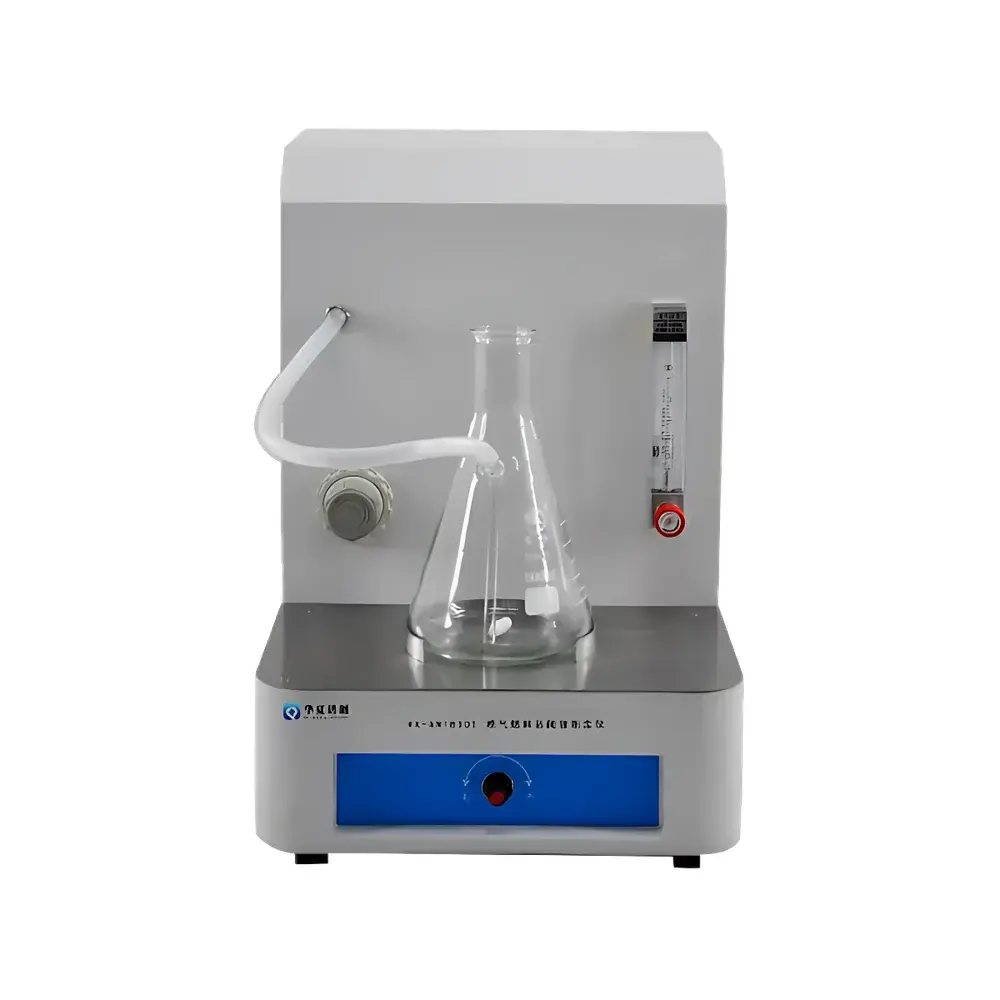
Spectra Invent HX-AN1830T Jet Fuel Total Acid Number (TAN) Analyzer
| Brand | Spectra Invent |
|---|---|
| Origin | Beijing, China |
| Manufacturer Type | Authorized Distributor |
| Country of Manufacture | China |
| Model | HX-AN1830T |
| Price Range | USD 1,400 – 14,000 |
| Measurement Range | 0.0001–0.100 mg KOH/g |
| Minimum Sample Mass | 100 ± 5 g |
| Nitrogen Flow Rate | 600–800 mL/min |
| Power Supply | AC 220 V, 50 Hz |
| Power Consumption | ≤100 W |
| Operating Temperature | 5–45 °C |
| Relative Humidity | ≤85 % RH |
Overview
The Spectra Invent HX-AN1830T Jet Fuel Total Acid Number (TAN) Analyzer is a dedicated potentiometric titration system engineered for precise, reproducible determination of total acid number in aviation turbine fuels—specifically in compliance with GB/T 12574, the Chinese national standard equivalent to ASTM D3242 and ISO 3682 for acid number measurement in hydrocarbon-based fuels. The instrument operates on the principle of non-aqueous potentiometric titration using alcoholic potassium hydroxide (KOH) as titrant, with automated endpoint detection via pH-sensitive electrode pair. Unlike colorimetric methods, this electrochemical approach eliminates subjective visual interpretation and delivers high repeatability (<0.001 mg KOH/g RSD under controlled conditions), essential for monitoring oxidative degradation in jet fuel during storage and distribution. Designed for routine QC laboratories in refineries, military fuel depots, and third-party testing facilities, the HX-AN1830T integrates gas-purged titration cell architecture to minimize CO₂ interference—a critical factor in low-acid-value matrices where ambient carbon dioxide can artificially elevate measured acidity.
Key Features
- Integrated benchtop design with fully enclosed titration chamber, minimizing operator exposure to solvents and titrants while ensuring consistent thermal and atmospheric conditions.
- Automated magnetic stirring mechanism with adjustable speed control (100–800 rpm), providing uniform mixing without mechanical seal wear or oil contamination risks associated with overhead stirrers.
- Dedicated nitrogen purge subsystem featuring a precision-built miniature glass rotameter calibrated for 600–800 mL/min flow range and an integrated pressure-regulating valve to maintain stable inert atmosphere throughout titration—critical for suppressing carbonate formation in low-TAN samples.
- Pre-aligned, temperature-compensated dual-junction pH electrode assembly optimized for non-aqueous media (e.g., isopropanol/toluene mixtures), with quick-release mounting for rapid calibration and cleaning.
- Embedded microprocessor controller with real-time titrant volume tracking, automatic endpoint recognition (first derivative dE/dV), and built-in drift compensation algorithm for extended stability during multi-sample runs.
Sample Compatibility & Compliance
The HX-AN1830T is validated for use with Jet A, Jet A-1, JP-5, and JP-8 fuels, as well as related distillate fractions meeting ASTM D1655 and DEF STAN 91-91 specifications. It supports sample introduction via calibrated volumetric flask or analytical balance (100 ± 5 g requirement ensures stoichiometric sufficiency for sub-mg-level detection). All operational parameters—including nitrogen flow rate, titrant concentration verification frequency, and electrode hydration protocol—are aligned with GB/T 12574 procedural requirements. While not certified to ISO/IEC 17025 out-of-the-box, the system supports GLP-compliant documentation when paired with external audit-ready lab notebooks or LIMS integration. Its electrical safety design conforms to GB 4793.1 (equivalent to IEC 61010-1) for laboratory electrical equipment.
Software & Data Management
The analyzer includes embedded firmware with local data storage (up to 500 test records) and USB 2.0 export capability for CSV-formatted reports containing sample ID, date/time stamp, titrant consumption, calculated TAN, electrode potential curve, and pass/fail flag against user-defined specification limits. No proprietary software installation is required; exported files are compatible with Microsoft Excel, LabWare LIMS, and Empower CDS platforms. Audit trail functionality—while not FDA 21 CFR Part 11 compliant by default—can be enabled through optional configuration that logs operator ID, parameter changes, and result modifications with timestamp and digital signature support (requires external authentication server).
Applications
- Monitoring acid buildup in stored jet fuel to assess oxidation stability and predict service life per MIL-STD-3004 and DEF STAN 91-091.
- Verifying conformance of refinery off-spec batches prior to blending or shipment.
- Supporting root-cause analysis of filter plugging incidents linked to organic acid-induced sludge formation.
- Calibration verification of field-deployable FTIR or NIR sensors used for rapid TAN screening.
- Research applications in fuel additive performance evaluation, including antioxidant efficacy under accelerated aging (ASTM D2274).
FAQ
What titrant concentration is recommended for optimal accuracy in the 0.0001–0.100 mg KOH/g range?
A standardized 0.01 mol/L alcoholic KOH solution is recommended, prepared and standardized per GB/T 12574 Annex A using potassium hydrogen phthalate reference material.
Can the HX-AN1830T be used for diesel or marine fuel TAN analysis?
While technically feasible, it is not validated for high-sulfur or biodiesel-blended fuels; method adaptation requires full re-validation per ISO 6618 and documented uncertainty assessment.
Is electrode recalibration required before each analysis?
No—daily two-point calibration (in blank solvent and standard acid solution) is sufficient; however, electrode response slope must remain within ±5 mV/pH unit of theoretical Nernstian value.
Does the system support automated sample changers?
Not natively; however, the USB interface and open CSV output format enable seamless integration with third-party autosamplers via custom scripting or PLC-triggered start commands.
What maintenance intervals are specified for the nitrogen flow control system?
The glass rotameter should be inspected quarterly for particulate accumulation; the pressure regulator diaphragm is rated for 10,000 cycles and requires replacement every 24 months under continuous operation.






