
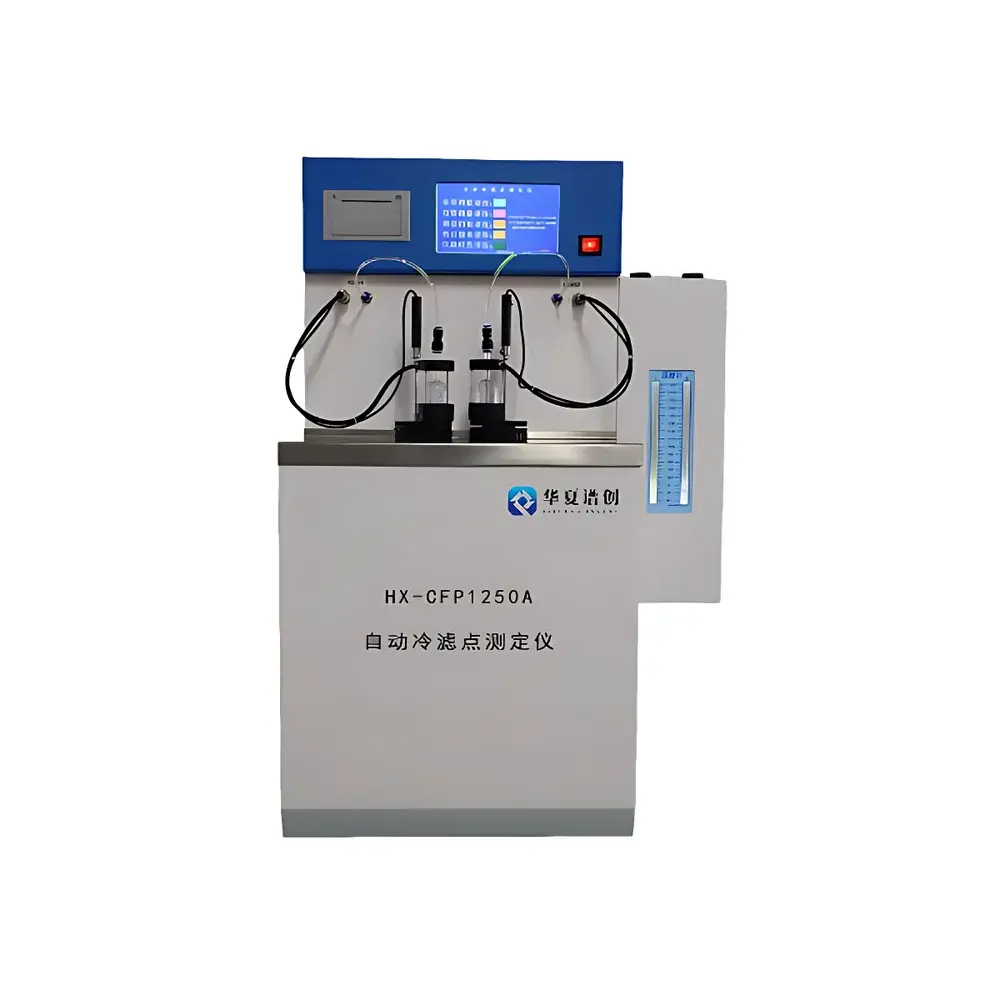
Spectra Invent HX-CFP1250A Automatic Cold Filter Plugging Point (CFPP) Analyzer
| Brand | Spectra Invent |
|---|---|
| Origin | Beijing, China |
| Model | HX-CFP1250A |
| Temperature Range | Ambient to –70 °C |
| Temperature Resolution | 0.1 °C |
| Pressure Range | 0–2 kPa (0–200 mmH₂O) |
| Pressure Resolution | 1 mmH₂O |
| Cooling Method | Compressor-based refrigeration |
| Bath Configuration | Single-bath dual-cell isothermal system |
| Temperature Sensor | PT100 platinum resistance thermometer |
| Timing Resolution | 1 s (60 s interval) |
| Power Supply | AC 220 V ±10%, 50 Hz |
| Power Consumption | <1500 W |
| Operating Environment | 5–45 °C, ≤85% RH |
| Dimensions (Main Unit) | 490 × 540 × 800 mm |
| Weight (Main Unit) | 50 kg |
| Compliance Standards | SH/T 0248, ASTM D6371 |
Overview
The Spectra Invent HX-CFP1250A Automatic Cold Filter Plugging Point (CFPP) Analyzer is a precision-engineered instrument designed for the standardized determination of the cold filter plugging point of distillate fuels—including diesel fuel, biodiesel blends, heating oil, and fuels containing flow improvers or other additive packages. CFPP is a critical low-temperature performance parameter defined as the lowest temperature at which a specified volume of fuel can pass through a standardized wire mesh filter within a prescribed time under controlled vacuum conditions. The HX-CFP1250A implements the fundamental thermodynamic and fluid dynamic principles outlined in SH/T 0248 (Chinese national standard) and ASTM D6371 (Standard Test Method for Determination of Cold Filter Plugging Point of Diesel and Domestic Heating Fuels), ensuring metrological traceability and interlaboratory reproducibility. Its operation relies on synchronized thermal control, regulated vacuum application, and high-fidelity timing—enabling unambiguous endpoint detection based on filtration kinetics rather than subjective visual assessment.
Key Features
- Compressor-based refrigeration system delivering stable, controllable cooling down to –70 °C with minimal thermal overshoot and drift.
- Integrated vacuum pump and electronic pressure regulation module maintaining suction pressure at user-defined setpoints (0–2 kPa) with ±1 mmH₂O repeatability.
- Intelligent differential temperature control algorithm that dynamically adjusts coolant bath temperature relative to sample temperature, enforcing linear and uniform cooling rates per ASTM D6371 requirements.
- Dual-cell isothermal bath architecture (single cold槽 with two independent sample cells) enabling parallel or sequential testing without cross-contamination or thermal interference.
- High-stability PT100 sensor array calibrated to NIST-traceable references, providing 0.1 °C resolution and long-term thermal accuracy across the full operating range.
- Microprocessor-controlled timing circuit with 1-second resolution and programmable 60-second filtration intervals, supporting precise endpoint validation per standard-defined criteria.
Sample Compatibility & Compliance
The HX-CFP1250A accommodates standard 45-mL fuel samples in accordance with ASTM D6371 and SH/T 0248 test protocols. It is validated for use with petroleum-derived diesel, ultra-low-sulfur diesel (ULSD), FAME biodiesel blends (B5–B20), hydrotreated vegetable oils (HVO), and kerosene-type heating fuels. The system supports fuels containing wax crystal modifiers, pour point depressants, and cold flow improvers—provided additives are homogeneously dispersed prior to analysis. All hardware components in contact with samples are chemically inert (borosilicate glass, PTFE, stainless steel 316), minimizing catalytic or adsorptive interference. The instrument meets mechanical and electrical safety requirements per IEC 61010-1 and is designed for routine operation in GLP-compliant laboratories; audit-ready data logs include timestamped temperature, pressure, and timing events—facilitating FDA 21 CFR Part 11 readiness when paired with compliant LIMS integration.
Software & Data Management
The embedded firmware provides real-time graphical display of temperature vs. time and pressure vs. time profiles during each test cycle. Results—including measured CFPP value, final filtration time, and pass/fail status against specification limits—are stored with ISO/IEC 17025-aligned metadata (operator ID, sample ID, calibration date, ambient conditions). Data export is supported via USB interface in CSV format for downstream statistical process control (SPC) or compliance reporting. Optional PC-based software (SpectraCFPP Suite v3.x) enables method templating, multi-instrument fleet monitoring, automated report generation (PDF/Excel), and electronic signature workflows aligned with ALCOA+ data integrity principles. All measurement records retain immutable timestamps and support full audit trail review per GLP and GMP documentation standards.
Applications
- Quality assurance of diesel fuel batches prior to distribution or blending.
- Formulation development and additive efficacy evaluation for cold flow improvement technologies.
- Refinery process optimization using CFPP as a key indicator of fractionation severity and wax content.
- Regulatory compliance testing for EN 590, GB 19147, and ASTM D975 specifications.
- Research into low-temperature behavior of alternative diesel fuels, including synthetic hydrocarbons and renewable diesel.
- Third-party certification laboratories requiring accredited CFPP testing capability per ISO/IEC 17025.
FAQ
What standards does the HX-CFP1250A fully comply with?
The instrument is designed and verified for conformance with SH/T 0248 and ASTM D6371, including all procedural, apparatus, and reporting requirements specified therein.
Can the system test fuels containing high concentrations of flow improvers?
Yes—provided the additive is fully dissolved and the sample is preconditioned per standard guidelines (e.g., ASTM D6371 Section 7.2); the dual-cell bath design minimizes thermal lag effects common in highly modified fuels.
Is external calibration required for pressure or temperature sensors?
The PT100 sensors and pressure transducers are factory-calibrated with certificate of calibration; annual verification using NIST-traceable reference standards is recommended for ISO/IEC 17025 accreditation.
Does the instrument support automated pass/fail decision logic based on specification limits?
Yes—user-defined specification thresholds can be programmed into test methods, triggering automatic result classification and flagging of out-of-specification outcomes.
What maintenance is required for the integrated vacuum system?
The diaphragm vacuum pump requires only periodic inspection of inlet filters and replacement of pump oil every 12 months under typical usage; no lubrication or alignment is needed.





