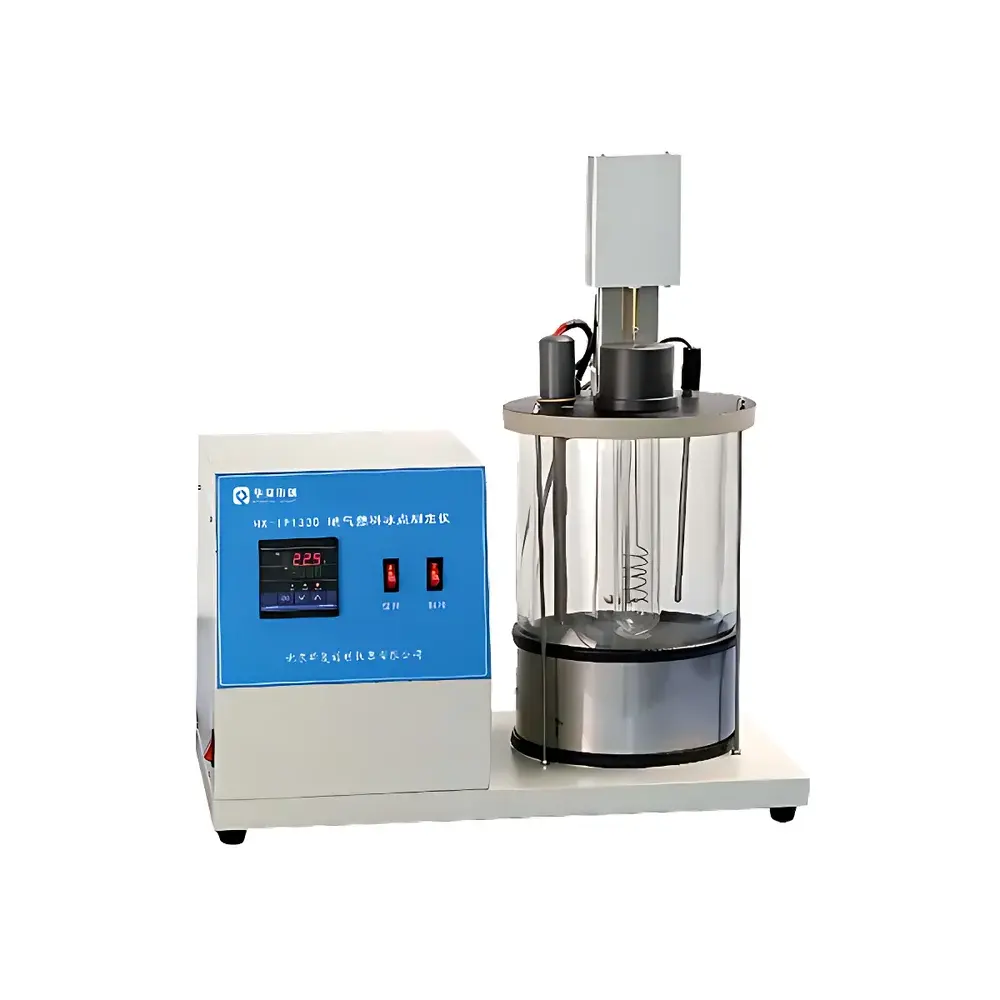
Spectra Invent HX-IP1330 Jet Fuel Freezing Point Analyzer
| Brand | Spectra Invent |
|---|---|
| Origin | Beijing, China |
| Manufacturer Type | Authorized Distributor |
| Country of Origin | China |
| Model | HX-IP1330 |
| Price Range | USD 1,400 – 14,000 |
| Power Consumption | 600 W (heating), 800 W (cooling) |
| Temperature Resolution | 0.1 °C |
| Cooling Range | −70 °C to ambient |
| Stirring Frequency (sample) | 60 rpm |
| Bath Agitation | 1200 rpm, 6 W motor |
| Ambient Operating Conditions | ≤30 °C, ≤85% RH |
| Power Supply | AC 220 V ±10%, 50 Hz |
| Overall Power Draw | <2000 W |
| Dimensions (H×W×D) | 650 × 400 × 530 mm |
Overview
The Spectra Invent HX-IP1330 Jet Fuel Freezing Point Analyzer is a precision laboratory instrument engineered for the standardized determination of the freezing point of aviation turbine fuels—primarily Jet A, Jet A-1, and JP-8—according to ASTM D2386, IP 16, ISO 3016, and GB/T 2430. The freezing point is defined as the highest temperature at which solid hydrocarbon crystals first disappear upon controlled warming of a previously cooled fuel sample. This thermodynamic transition is critical for flight safety, as crystallization in fuel lines or filters at low-altitude or high-altitude operating temperatures can impair engine performance or cause flow restriction. The HX-IP1330 implements a dual-phase thermal control strategy: rapid cryogenic cooling via a Danfoss (Secop) hermetic compressor, followed by precise, stepwise warming under continuous mechanical agitation. Its measurement principle relies on real-time optical detection of crystal dissolution coupled with high-fidelity temperature monitoring using calibrated platinum resistance sensors (Pt100), ensuring traceable, repeatable results aligned with international metrological requirements.
Key Features
- Integrated dual-stage thermal system: Secop compressor-based refrigeration (−70 °C minimum bath temperature) paired with 600 W resistive heating for accurate ramp control during crystal disappearance detection.
- Digital PID temperature regulation with 0.1 °C resolution and stability of ±0.2 °C over the full operational range.
- Automated dual-agitation architecture: sample stirring at 60 rpm ensures uniform nucleation and crystal dispersion; independent bath circulation at 1200 rpm maintains thermal homogeneity across the double-walled vacuum-jacketed observation chamber.
- Optically optimized double-layer vacuum glass bath enables unobstructed visual monitoring of crystal formation and melting without thermal distortion or condensation interference.
- Compliant sensor suite: factory-calibrated Pt100 temperature probes with NIST-traceable certification documentation supplied per unit.
- Robust mechanical design: all wetted components constructed from borosilicate glass and PTFE-lined stainless steel to prevent catalytic hydrocarbon degradation or contamination.
Sample Compatibility & Compliance
The HX-IP1330 is validated for use with undiluted aviation kerosene-type fuels meeting ASTM D1655 and DEF STAN 91-91 specifications. It accommodates standard 50 mL sample volumes in ASTM D2386-compliant U-tube test cells. Instrument validation includes documented IQ/OQ protocols supporting GLP and GMP environments. Data integrity complies with FDA 21 CFR Part 11 requirements when operated with optional audit-trail-enabled software (sold separately). The analyzer meets electromagnetic compatibility (EMC) per IEC 61326-1 and electrical safety per IEC 61010-1. All firmware and calibration routines adhere to ISO/IEC 17025:2017 clause 6.5.2 for measurement equipment management.
Software & Data Management
The HX-IP1330 operates in standalone mode with an embedded LCD interface for manual method execution. For automated reporting and regulatory compliance, it supports RS-232/USB connectivity to Spectra Invent’s optional LabLink™ Data Acquisition Suite (v4.2+). This software provides real-time curve logging (temperature vs. time), automatic freezing point identification via derivative thresholding, electronic signature capture, and CSV/PDF export with embedded metadata (operator ID, calibration status, environmental logs). Audit trails record all parameter changes, result modifications, and user logins—fully compliant with ALCOA+ data governance principles.
Applications
- Quality control laboratories in refineries and fuel blending facilities performing routine batch release testing per ASTM D2386.
- Airline maintenance organizations verifying fuel conformity prior to aircraft refueling operations.
- Third-party testing labs accredited to ISO/IEC 17025 conducting contract analysis for defense logistics agencies.
- Research institutions studying low-temperature phase behavior of alternative aviation fuels (SAF), including Fischer–Tropsch and hydroprocessed esters and fatty acids (HEFA).
- Regulatory inspection bodies performing surveillance testing under national civil aviation authority mandates.
FAQ
What standards does the HX-IP1330 fully support?
ASTM D2386, IP 16, ISO 3016, GB/T 2430, and DEF STAN 91-91 — with method parameters preloaded and user-adjustable within defined tolerances.
Is external calibration required before first use?
Yes. Each unit ships with a NIST-traceable calibration certificate for the primary Pt100 sensor. Users must perform initial verification using certified reference materials (e.g., n-decane, −29.7 °C) per ASTM D2386 Annex A1.
Can the instrument be integrated into a LIMS environment?
Yes — via ASCII-based serial output or LabLink™’s ODBC-compliant database connector, enabling direct ingestion into enterprise LIMS platforms such as Thermo Fisher SampleManager or LabVantage.
What maintenance intervals are recommended?
Compressor oil inspection every 12 months; vacuum bath integrity check every 24 months; temperature sensor recalibration annually or after 500 test cycles — whichever occurs first.
Does the system include built-in diagnostics?
Yes. Self-test routines verify thermal sensor continuity, compressor startup sequence, stirrer motor function, and power supply regulation during boot-up and between tests. Error codes are displayed with ISO-standardized troubleshooting guidance.