
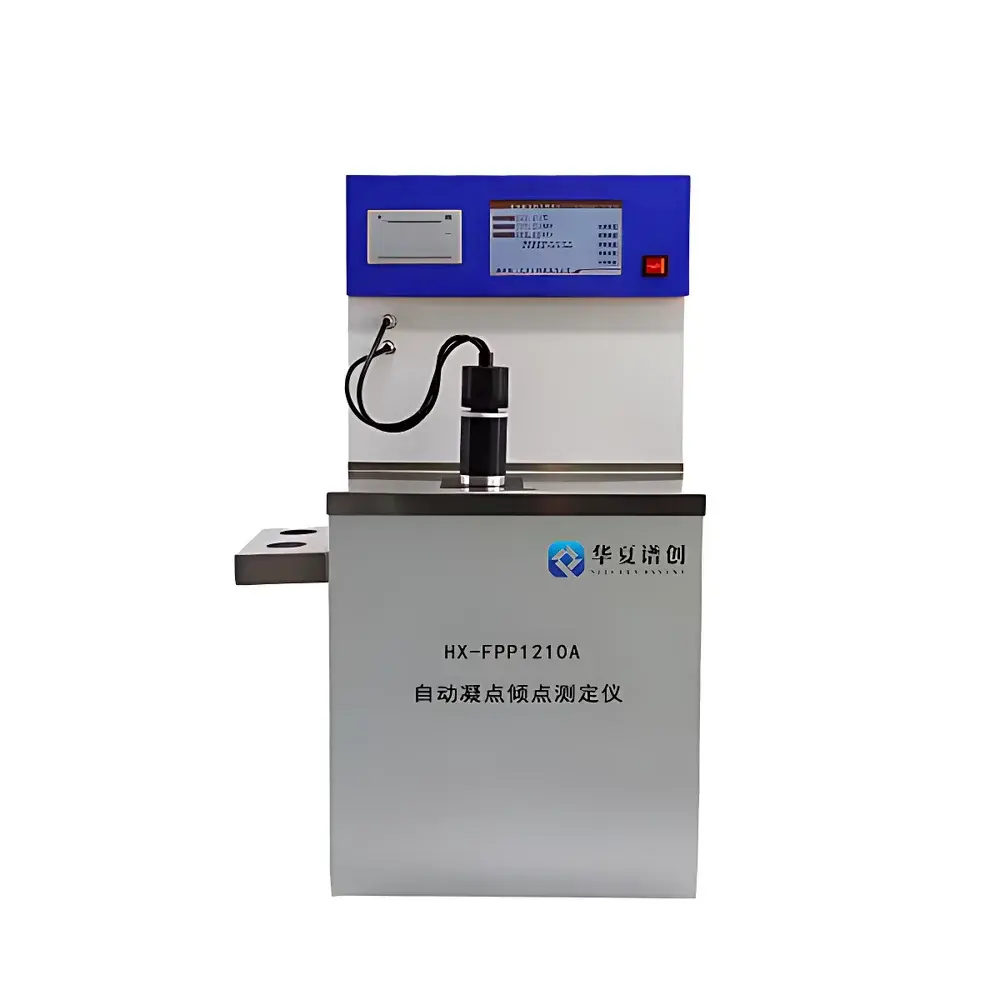
Spectra Invent HX-FPP1210A Automatic Cloud Point and Pour Point Tester
| Brand | Spectra Invent |
|---|---|
| Origin | Beijing, China |
| Manufacturer Type | Authorized Distributor |
| Country of Origin | China |
| Model | HX-FPP1210A |
| Power Consumption | <300 W |
| Titration Accuracy | 0.1 °C |
| Measurement Range | Ambient to –70 °C |
| Accuracy | ±1 °C |
| Resolution | 0.1 °C |
| Display | LCD Touchscreen |
| Printer | Thermal, 36-character Chinese/English output |
| Ambient Operating Temperature | 5–40 °C |
| Relative Humidity | ≤85% |
| Power Supply | AC 220 V ±10%, 50 Hz |
| Dimensions (W×D×H) | 400 × 570 × 830 mm |
| Weight | 66 kg |
Overview
The Spectra Invent HX-FPP1210A Automatic Cloud Point and Pour Point Tester is a precision-controlled thermal analysis instrument engineered for the standardized determination of cloud point (CP) and pour point (PP) in petroleum products and lubricants. It operates on the principle of controlled cooling and dynamic visual assessment—where cloud point is identified as the temperature at which wax crystals first become visible upon gradual cooling, and pour point is defined as the lowest temperature at which the sample exhibits flow under specified conditions following standardized tilt cycles. The system complies with internationally recognized test methods including ASTM D2386 (Standard Test Method for Cloud Point of Petroleum Products), ASTM D97 (Standard Test Method for Pour Point of Petroleum Products), GB/T 3535 (Chinese standard for pour point), and GB/T 510 (Chinese standard for cloud point). Its dual-zone Peltier-assisted thermoelectric cooling and resistive heating architecture enables precise temperature ramping from ambient down to –70 °C, supporting high-reproducibility testing across a broad spectrum of base oils, transformer fluids, diesel fuels, and dark-colored hydrocarbon samples—regardless of viscosity.
Key Features
- Integrated touchscreen LCD interface with intuitive navigation and multilingual (English/Chinese) menu support for seamless operation in international laboratories.
- Wide thermal operating range: programmable cooling to –70 °C and heating up to +50 °C, enabling compliance with both low-temperature pour point evaluation and elevated-temperature conditioning protocols.
- Fully automated tilt mechanism synchronized with temperature control—mechanically replicating the standardized 3-second, 45° tilt cycle per ASTM D97 and GB/T 510 requirements.
- Dual-mode testing: selectable “Rapid Mode” for preliminary screening (reduced dwell time per interval) and “Standard Mode” for full compliance with regulatory reporting requirements.
- Onboard diagnostic engine providing real-time fault detection—including refrigeration system status, sensor calibration drift alerts, and thermal bath uniformity warnings—with contextual guidance displayed directly on-screen.
- User-configurable cooling rate profiles and custom pass/fail criteria, supporting method development and internal SOP alignment without firmware modification.
- Thermal stability optimized via high-efficiency compressors and insulated cold chamber design, ensuring long-term operational reliability and minimal maintenance intervals.
Sample Compatibility & Compliance
The HX-FPP1210A accommodates standard ASTM D2386 and D97 sample volumes (typically 45 mL in specified glass test jars) and supports opaque, viscous, and heavily dyed petroleum derivatives—including insulating oils, residual fuel oils, marine distillates, and synthetic lubricants—without pre-dilution or filtration. All hardware and software functions are designed to meet the mechanical and procedural fidelity required by ISO/IEC 17025-accredited laboratories. Data integrity safeguards include timestamped result logging, non-erasable audit trails, and export-ready CSV reports compatible with LIMS integration. While not pre-certified for FDA 21 CFR Part 11, the system’s deterministic behavior, manual signature fields, and immutable record generation support GLP/GMP-aligned documentation practices when deployed with institutional procedural controls.
Software & Data Management
Instrument control and data acquisition are managed via embedded firmware with no external PC dependency. Each test generates a structured metadata file containing ambient conditions, cooling rate profile, detected transition temperatures, operator ID, and instrument serial number. Results are printed locally using the built-in thermal printer (36-character line width, Unicode-capable for bilingual labeling) and simultaneously stored in non-volatile memory (≥1,000 test records retained). Export options include USB flash drive transfer of raw temperature-vs.-time datasets and summary reports in plain-text or Excel-compatible formats. Optional firmware updates—distributed via secure download portal—maintain alignment with evolving ASTM and GB revisions, with version history and change logs accessible within the device UI.
Applications
This tester serves quality control and specification verification workflows in power generation (transformer oil condition monitoring), upstream and downstream petrochemical operations (crude assay validation, blending optimization), third-party inspection agencies (SGS, BV, CCIC), and academic research groups studying wax crystallization kinetics. Its robustness in handling high-viscosity and thermally unstable samples makes it particularly suitable for evaluating bio-based lubricants, cold-flow improver efficacy, and seasonal formulation adjustments. Routine use supports compliance with IEC 60296 (mineral insulating oils), API RP 14C (offshore fluid specifications), and national procurement standards for railway and aviation ground support fluids.
FAQ
Does the HX-FPP1210A require external calibration standards or reference oils?
No—built-in Pt100 temperature sensors are factory-calibrated against NIST-traceable references; however, periodic verification using certified reference materials (e.g., ASTM Standard Reference Material 2704) is recommended per ISO/IEC 17025 Clause 6.6.
Can the instrument store multiple user-defined test methods?
Yes—up to eight custom protocols can be saved, each with unique cooling rates, tilt frequency, hold times, and pass/fail thresholds.
Is remote monitoring or network connectivity supported?
Not natively; the system operates as a standalone unit. Integration with SCADA or LIMS requires optional RS-232 or USB-to-serial gateway hardware and middleware configuration.
What maintenance is required for the refrigeration system?
Annual inspection of condenser coils and refrigerant pressure levels is advised; compressor service life exceeds 15,000 operational hours under typical laboratory duty cycles.
How does the system ensure repeatability between operators?
By eliminating manual tilt timing and visual interpretation—temperature ramping, tilt actuation, and endpoint detection are fully automated and governed by fixed algorithmic logic per cited standards.





