
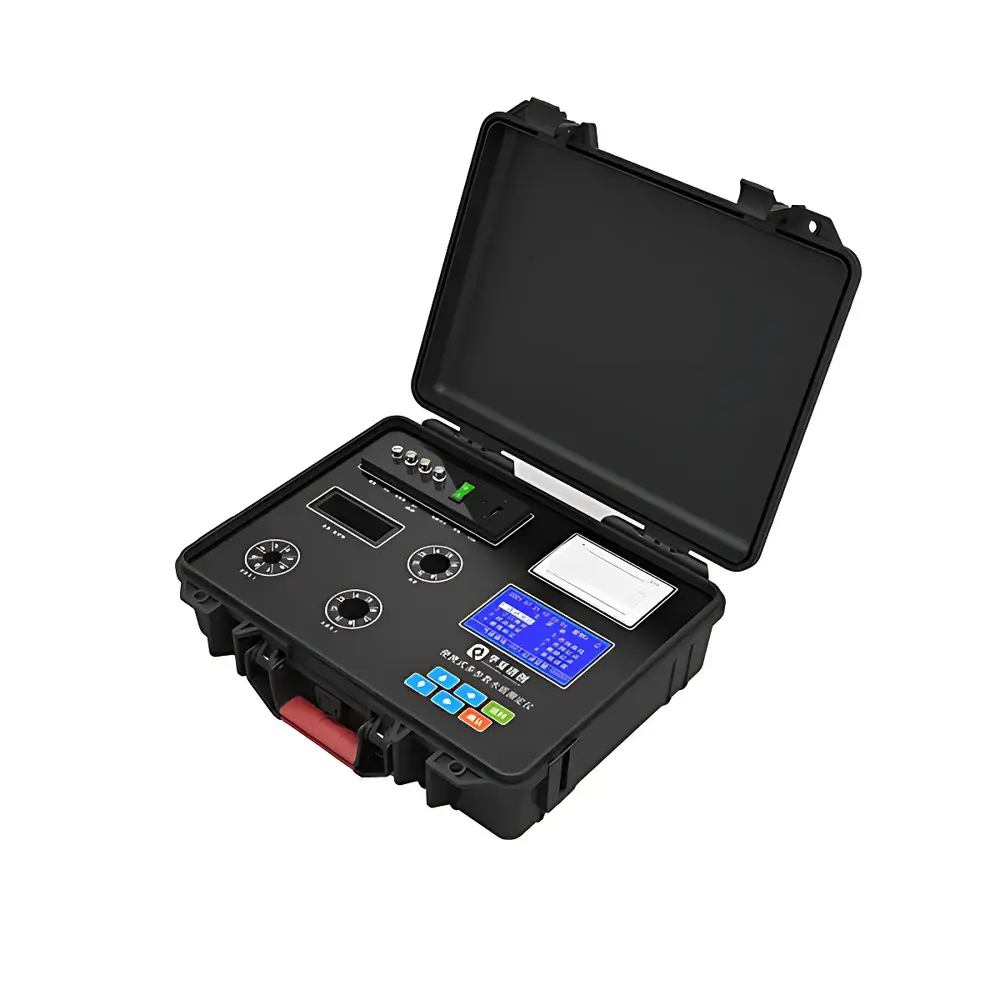
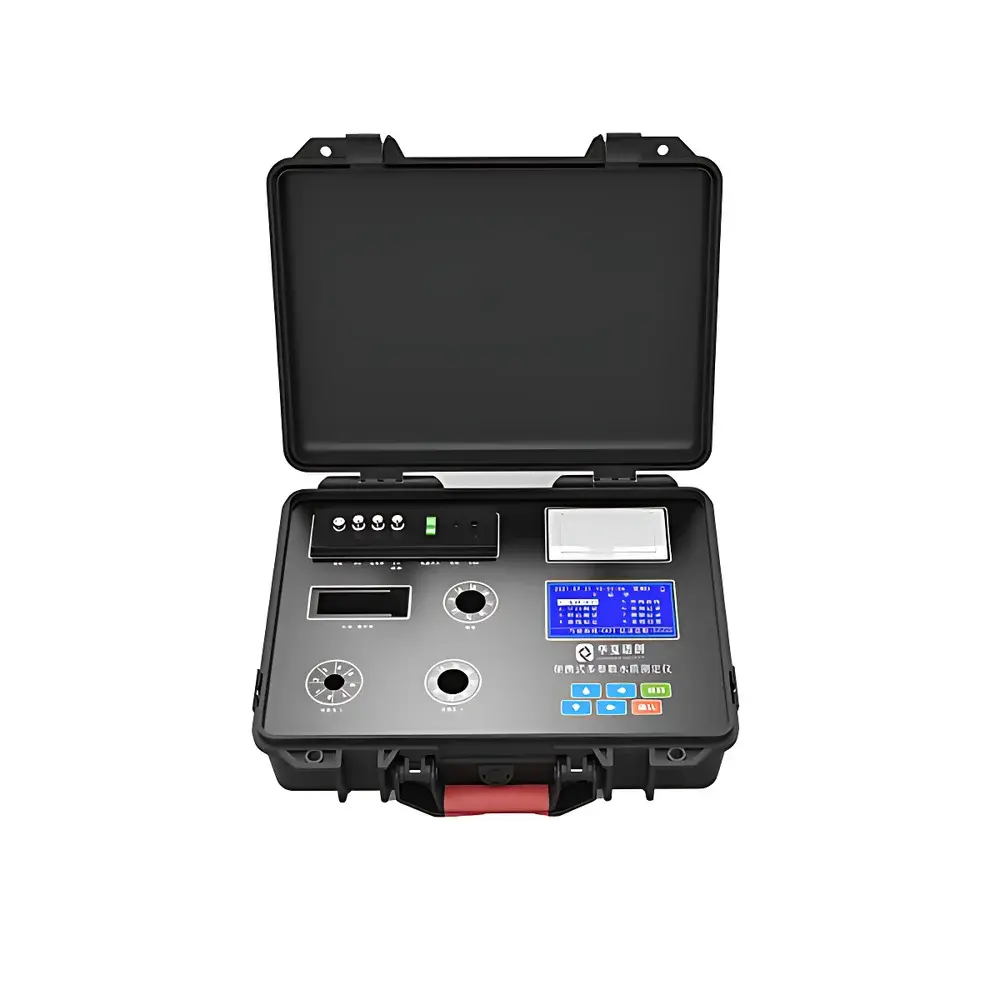
Spectra Invent HXGW-1640 Portable Multi-Parameter Water Quality Analyzer
| Brand | Spectra Invent |
|---|---|
| Origin | Zhejiang, China |
| Model | HXGW-1640 |
| Instrument Type | Portable/Handheld Water Quality Analyzer |
| Detection Principle | Optical (LED-based narrow-band interference photometry) + Electrochemical (pH, conductivity, dissolved oxygen) |
| Optical Channels | 4 / 8 / 12 / 16 (customizable from 1 to 16) |
| Wavelength Options | 340 nm, 420 nm |
| Data Storage | Timestamped & parameter-tagged records with power-loss protection |
| Calibration | Factory pre-loaded curves + user-definable calibration curves (stored onboard) |
| Connectivity | USB interface for PC data export |
| Power Supply | Rechargeable lithium-ion battery |
| Optional Accessories | Integrated portable digestion unit |
Overview
The Spectra Invent HXGW-1640 is a field-deployable, multi-method water quality analyzer engineered for reliable in-situ and laboratory-grade measurement of critical physicochemical parameters in drinking water, surface water, wastewater, and process streams. It integrates dual analytical modalities—solid-state LED-based photometry with narrow-band interference optical filtering and electrochemical sensing—within a single ruggedized handheld platform. The photometric module operates on Beer-Lambert law principles, utilizing fixed-wavelength LEDs (340 nm and 420 nm) to quantify colorimetrically reactive analytes such as nitrate, phosphate, ammonia, COD, and total chlorine. Simultaneously, the integrated electrochemical probe suite supports real-time, direct-read measurements of pH (glass electrode), electrical conductivity (four-electrode cell), and dissolved oxygen (Clark-type polarographic or optical luminescent sensor—configurable per application). This hybrid architecture eliminates methodological trade-offs between portability and analytical rigor, enabling traceable, repeatable results compliant with standard methods including ISO 7888 (conductivity), ISO 5814 (DO), and APHA Standard Methods 4500 series (colorimetric assays).
Key Features
- Modular optical design with selectable channel configurations: 4, 8, 12, or 16 independent photometric channels—scalable to any integer count between 1 and 16 for application-specific assay bundling.
- Stable cold-light source system employing high-intensity, temperature-compensated LEDs and precision interference filters—ensuring <±0.5% photometric repeatability over extended field operation.
- Onboard calibration management: Supports storage of multiple factory-installed calibration curves plus unlimited user-defined curves; all curves retain metadata (date, operator ID, standard lot number).
- One-touch firmware and curve recovery: Restores original factory calibration data and user-uploaded curves from embedded non-volatile memory in case of accidental deletion or corruption.
- Full data integrity architecture: Each measurement record includes timestamp, parameter ID, channel assignment, raw absorbance/voltage values, calculated concentration, and operator annotation field—all retained during power interruption via EEPROM-backed memory.
- USB 2.0 interface compliant with CDC ACM class drivers; enables seamless data transfer to Windows/Linux workstations without proprietary software installation.
- Integrated rechargeable lithium-ion battery pack delivering ≥12 hours continuous operation under mixed-use conditions (photometry + DO + conductivity).
Sample Compatibility & Compliance
The HXGW-1640 accepts standard 10–25 mm round vials and flat-bottom cuvettes compatible with EPA-approved digestion protocols. When paired with the optional portable digestion module (HX-DIG-PRO), it supports heated, temperature-controlled digestion for COD, total phosphorus, and total nitrogen analysis per ISO 6060, ISO 11908, and ASTM D1253. All electrochemical sensors meet IP67 ingress protection rating and are certified for repeated immersion in turbid or particulate-laden matrices. Instrument firmware and data logging routines support audit-trail generation required under GLP environments; raw data files include digital signatures verifying immutability post-export. While not FDA 21 CFR Part 11–certified out-of-box, the system architecture allows integration with validated third-party LIMS platforms supporting electronic signature and role-based access control.
Software & Data Management
Data acquisition and reporting are managed through the open-format SpectraLog CSV export protocol—no closed binary formats or vendor-locked viewers. Each exported file contains UTF-8 encoded headers, ISO 8601 timestamps, SI-unit-conforming values (e.g., µS/cm, mg/L, % saturation), and embedded QC flags (e.g., “CAL_EXPIRED”, “OUT_OF_RANGE”). Optional SpectraView Desktop Suite (v3.2+) provides curve fitting (linear, quadratic, log-log), statistical outlier detection (Dixon’s Q-test), and automated report generation aligned with ISO/IEC 17025 documentation templates. All calibration events and measurement logs are time-stamped with hardware RTC synchronized to GPS-derived UTC when connected to external GNSS modules.
Applications
- Field verification of municipal drinking water compliance with WHO Guidelines and GB 5749–2022 (China National Standard for Drinking Water Quality).
- Rapid screening of eutrophication indicators (TP, TN, NH₃-N, NO₃⁻) in lake and river monitoring programs.
- Wastewater treatment plant effluent auditing against discharge permits (e.g., EU Urban Wastewater Treatment Directive Annex I parameters).
- Industrial process water surveillance in pharmaceutical manufacturing (USP , EP 2.2.43) and semiconductor fab cooling loops.
- Educational use in environmental science laboratories requiring pedagogical transparency in calibration and error propagation analysis.
FAQ
Can the HXGW-1640 be used for regulatory reporting under ISO 17025-accredited laboratories?
Yes—provided that metrological validation (including linearity, LOD/LOQ, intermediate precision) is performed per ISO/IEC 17025:2017 Clause 7.7, and instrument-specific uncertainty budgets are documented.
Is custom wavelength selection supported beyond 340 nm and 420 nm?
Wavelength customization requires optical module reconfiguration at factory level; 340 nm and 420 nm are standard options optimized for common EPA and ISO colorimetric methods.
Does the instrument support automatic temperature compensation for conductivity and pH measurements?
Yes—integrated NTC thermistor (±0.2 °C accuracy) enables real-time ATC across full operational range (0–50 °C).
What is the maximum allowable turbidity for photometric measurements?
Optical pathlength and filter bandwidth limit reliable quantification to samples with turbidity ≤20 NTU; higher turbidity requires filtration or centrifugation prior to analysis.
How many measurement records can be stored internally?
The device supports ≥10,000 timestamped entries with full metadata, expandable via microSD card (not included).







