
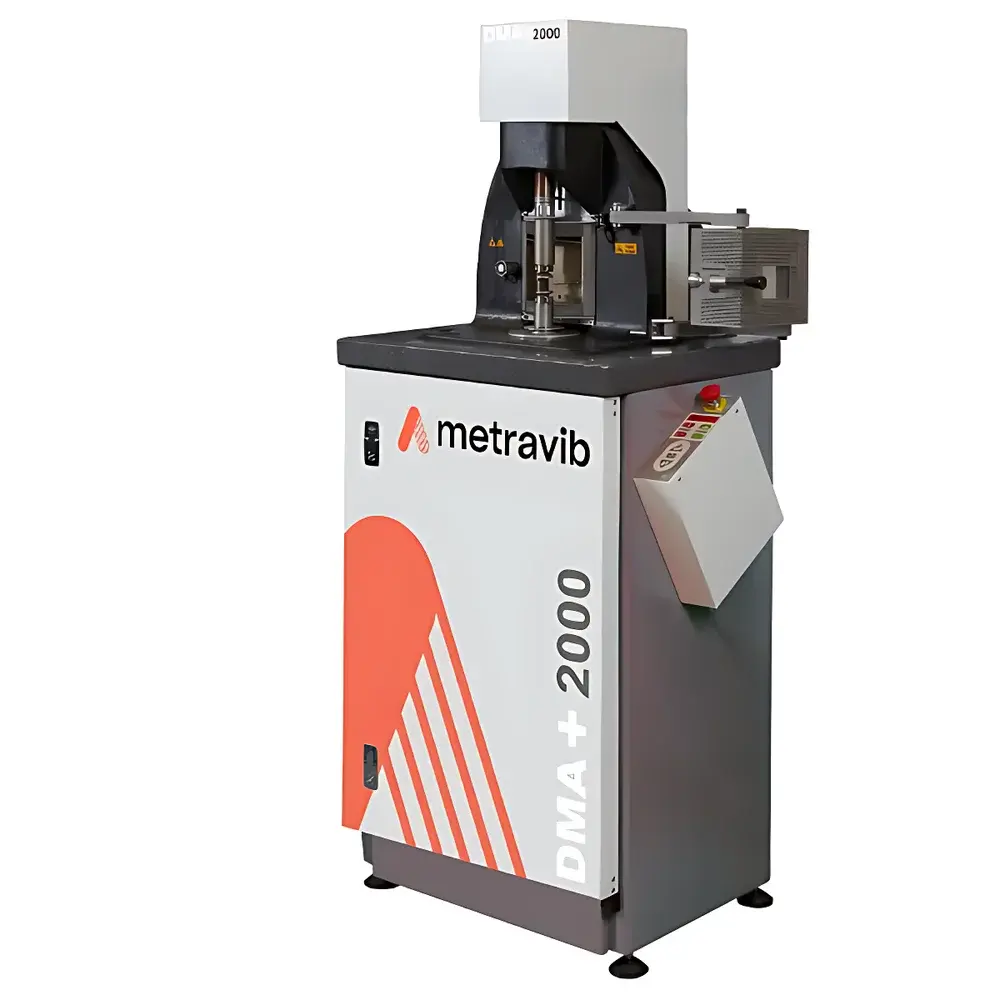
Metravib DMA+2000 Dynamic Mechanical Analyzer
| Brand | Metravib |
|---|---|
| Origin | France |
| Model | DMA+2000 |
| Instrument Type | Dynamic Mechanical Analyzer (DMA/DMTA) |
| Temperature Range | −150 °C to 500 °C |
| Temperature Accuracy | ±0.1 °C |
| Force Range | −1000 N to +1000 N (peak-to-peak: 2000 N) |
| Displacement Range | ±6 mm (peak-to-peak: 12 mm) |
| Frequency Range | 1×10⁻⁵ Hz to 200 Hz (optional up to 1000 Hz) |
| Minimum Detectable Force | 0.01 N |
| Minimum Detectable Displacement | 0.1 µm |
| Modulus Measurement Range | 500 Pa to 3×10¹² Pa (6 decades) |
Overview
The Metravib DMA+2000 is a high-performance dynamic mechanical analyzer engineered for precision viscoelastic characterization of solid and semi-crystalline materials across extreme thermal and mechanical conditions. Based on over four decades of expertise in dynamic mechanical instrumentation, the DMA+2000 implements a monolithic mechanical frame architecture—designed to eliminate parasitic resonances and maximize structural stiffness—enabling stable, low-noise measurement at ultra-low forces (<0.01 N) and sub-micron displacements (0.1 µm). Its operating principle relies on controlled sinusoidal or arbitrary waveform excitation applied to a sample while simultaneously measuring the resulting stress–strain response under programmable temperature environments. This enables direct quantification of storage modulus (E′), loss modulus (E″), and tan δ as functions of temperature, frequency, time, or strain amplitude—critical parameters for mapping glass transitions (Tg), secondary relaxations, curing kinetics, fatigue behavior, and nonlinear phenomena such as the Payne and Mullins effects in elastomers.
Key Features
- Monolithic, ultra-rigid mechanical frame minimizing compliance and enhancing signal-to-noise ratio across the full dynamic range
- High-force electromagnetic actuator delivering ±1000 N peak force (2000 N peak-to-peak) with active force feedback control
- Extended displacement capability: ±6 mm (12 mm peak-to-peak), supporting large-strain DMA, creep, stress relaxation, and tensile/compression testing
- Ultra-broad frequency spectrum: 10⁻⁵ Hz to 200 Hz standard; optional extension to 1000 Hz for high-rate dynamic response analysis
- Cryogenic–high-temperature environmental chamber: −150 °C (liquid nitrogen cooling) to +500 °C, with thermal stability better than ±0.1 °C
- Modulus measurement range spanning six decades—from 500 Pa (soft gels, hydrogels) to 3×10¹² Pa (carbon-fiber composites, ceramics)
- Optional atmosphere control (inert, oxidative, humidified) and multi-zone thermal profiling for process-relevant simulation
- Tool-free modular fixture system enabling rapid configuration for tension, compression, bending, shear, and dual-cantilever modes
Sample Compatibility & Compliance
The DMA+2000 accommodates diverse geometries and material classes—including thermoplastics, thermosets, elastomers, fiber-reinforced composites, biomaterials, adhesives, and thin films—without requiring specialized sample preparation beyond ASTM D4065 and ISO 6721 standards. Its open-sample-access design supports in-situ monitoring of industrial components and prototype assemblies. All thermal and mechanical calibrations are traceable to NIST-certified reference materials. The instrument complies with GLP and GMP requirements through audit-trail-enabled software logging, electronic signatures, and full 21 CFR Part 11 compliance when configured with validated DYNATEST and MULTITEST modules. Temperature calibration adheres to ISO 11357-2, while dynamic force calibration follows ISO 178 and ASTM D7028 protocols.
Software & Data Management
DYNATEST and MULTITEST software suites provide integrated control, real-time visualization, and advanced post-processing. DYNATEST supports synchronized DMA/TMA experiments, allowing concurrent measurement of dimensional changes and viscoelastic response during thermal ramps. MULTITEST delivers full waveform programmability—including triangle, square, sawtooth, and user-defined profiles—for fatigue life prediction, hysteresis loop analysis, and damage accumulation modeling. Both platforms feature automated baseline correction, harmonic distortion analysis, time–temperature superposition (TTS), and master curve generation. Raw data export is available in ASCII, HDF5, and universal .tdms formats. All acquisition parameters, metadata, and operator actions are permanently timestamped and stored with cryptographic integrity for regulatory review.
Applications
- Identification and quantification of primary (Tg) and secondary (β, γ) relaxations in polymers and biopolymers
- Monitoring crosslinking kinetics and exothermic reactions in thermoset resins and composites
- Evaluation of filler–matrix interactions in rubber compounds via Payne and Mullins effect analysis
- Fatigue lifetime assessment under variable amplitude loading and temperature cycling per ASTM D3479
- Creep and stress relaxation behavior under static and dynamic loads for long-term reliability modeling
- Thermo-mechanical performance validation of aerospace-grade composites and electric vehicle battery pack materials
- Characterization of damping properties in vibration isolation systems and acoustic metamaterials
- Crack initiation and propagation studies using optional crack growth fixtures and digital image correlation (DIC) synchronization
FAQ
What is the difference between the standard and optional 1000 Hz frequency capability?
The 1000 Hz option employs a high-bandwidth actuator and dedicated signal conditioning electronics to extend dynamic response fidelity into the ultrasonic regime—enabling high-rate viscoelastic mapping and microstructural resonance detection not accessible at lower frequencies.
Can the DMA+2000 perform simultaneous DMA and TMA measurements?
Yes—DYNATEST software enables true synchronized acquisition of both dynamic mechanical response and dimensional change (e.g., coefficient of thermal expansion) within a single thermal program.
Is liquid nitrogen handling automated or manual?
Liquid nitrogen delivery is fully automated via integrated level sensing, pressure-regulated flow control, and auto-refill scheduling—eliminating operator intervention during extended low-temperature experiments.
How is force calibration verified across the full range?
Force transducers are calibrated using NIST-traceable dead-weight standards at five points (0.01 N, 1 N, 10 N, 100 N, and 1000 N), with linearity deviation <0.15% FS and hysteresis <0.1% FS.
Does the system support custom waveform generation for non-sinusoidal fatigue testing?
Yes—MULTITEST allows import of arbitrary waveforms (CSV or MATLAB-generated), real-time parameter modulation, and closed-loop strain/force control during complex loading sequences.



