
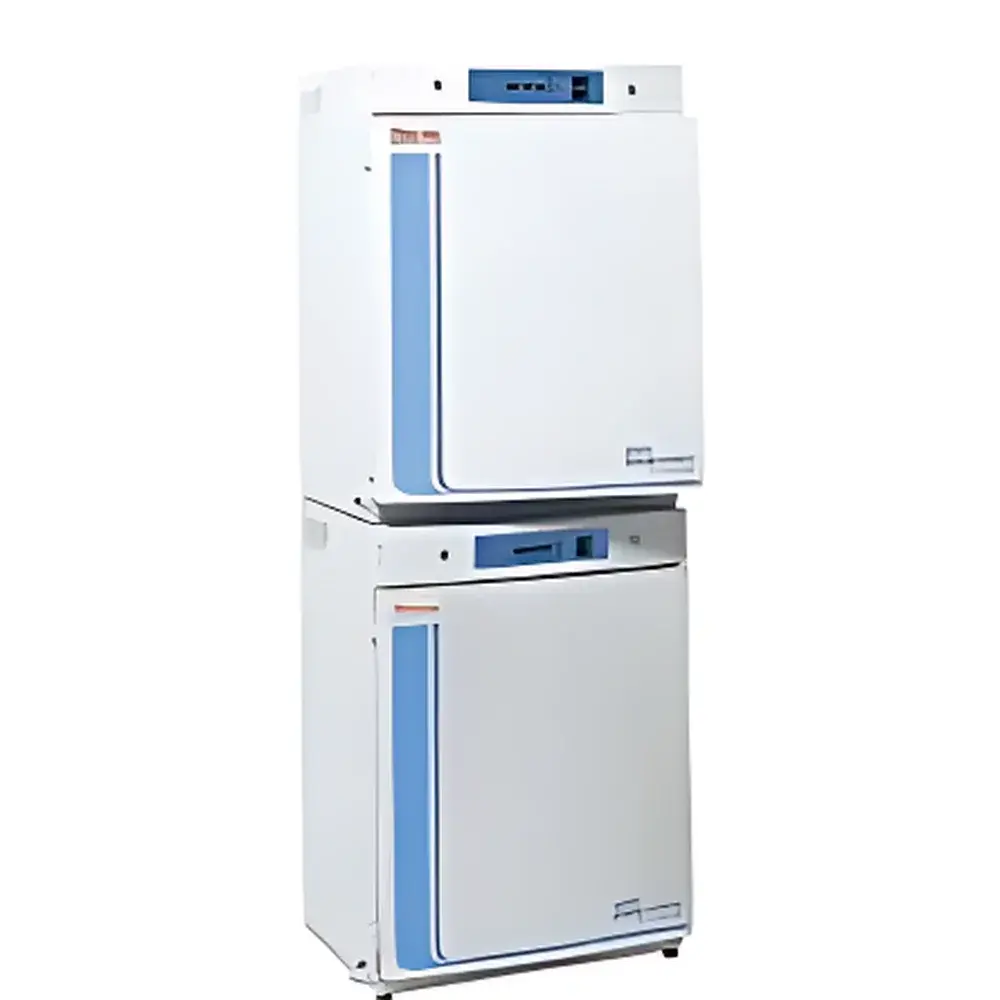
Thermo Fisher Scientific Steri-Cycle 370 Series High-Temperature Dry-Heat Sterilizable CO₂ Incubator
| Brand | Thermo Fisher Scientific |
|---|---|
| Origin | USA |
| Model | 370 Series |
| Temperature Range | Ambient +5°C to 50°C |
| Temperature Uniformity (at 37°C) | ±0.3°C |
| Temperature Control Accuracy | ±0.1°C |
| CO₂ Control Accuracy | Better than ±0.1% |
| CO₂ Sensor Type | Thermocouple (T/C) or Infrared (IR) |
| Humidity Range (at 37°C) | Ambient RH to 95% RH |
| Humidification Reservoir Capacity | 3.0 L (standard) |
| Internal Volume | 184.1 L |
| Internal Dimensions (W×H×D) | 540 × 681 × 508 mm |
| External Dimensions (W×H×D) | 663 × 1003 × 635 mm |
| Standard Shelf Quantity | 4 |
| Net Weight | 118 kg |
| Sterilization Cycle Duration | ~14 h (including preheat, sterilization at ≥180°C, and cool-down) |
| Air Exchange Rate | One full internal air exchange per minute via Class 100 HEPA filtration |
Overview
The Thermo Fisher Scientific Steri-Cycle 370 Series is a high-performance, dry-heat sterilizable CO₂ incubator engineered for stringent cell culture applications where microbial contamination control is non-negotiable. Unlike conventional incubators relying solely on UV or copper-lined chambers, the 370 Series integrates a validated high-temperature dry-heat sterilization cycle—operating at ≥180°C for sustained duration—to achieve sterility assurance levels compliant with ISO 14644-1 Class 5 (equivalent to USP Grade A environments) for critical cell therapy, stem cell expansion, and GMP-aligned bioproduction workflows. Its core architecture employs six-sided direct heating, eliminating thermal gradients common in single-point heated systems and ensuring rapid temperature recovery and spatial uniformity (±0.3°C at 37°C). The incubator maintains precise CO₂ concentration (typically 5% or user-defined) via dual-sensor options—thermocouple (T/C) for cost-sensitive routine use or infrared (IR) for enhanced long-term stability and reduced calibration drift—and delivers humidity control up to 95% RH at 37°C using a 3.0 L integrated reservoir.
Key Features
- Six-sided direct heating system for superior thermal uniformity and faster recovery after door openings
- Automated high-temperature dry-heat sterilization cycle (≥180°C), validated to inactivate bacterial endospores, mycobacteria, fungi, and viruses—fully compliant with ISO 14644-1 and supporting ALCOA+ data integrity principles
- Class 100 HEPA filtration with continuous air recirculation: one complete internal air exchange per minute, maintaining ISO 5-equivalent airborne particle counts (<100 particles ≥0.5 µm per cubic foot)
- Programmable overnight sterilization: fully autonomous cycle initiation, execution, and post-cycle cooldown; incubator resumes operational setpoints automatically upon completion
- Dual CO₂ sensing technology: selectable thermocouple (T/C) or infrared (IR) sensor, both meeting ASTM E2915-22 requirements for gas concentration monitoring accuracy (±0.1% CO₂)
- Intuitive touchscreen interface with multi-level password protection, audit trail logging, and configurable alarm thresholds per ICH Q9 risk management guidelines
Sample Compatibility & Compliance
The Steri-Cycle 370 Series accommodates standard tissue culture vessels—including T-flasks (up to 175 cm²), multiwell plates (6–96-well), Petri dishes, and roller bottles—across all four standard stainless-steel shelves. Its interior chamber is constructed from electropolished 316L stainless steel with welded seams and zero crevices, facilitating cleaning validation per FDA Guidance for Industry: Sterile Drug Products Produced by Aseptic Processing (2004) and EU Annex 1 (2022). The sterilization cycle is documented per ISO 17665-1:2017 for moist-heat equivalence assessment and supports IQ/OQ/PQ protocols required under 21 CFR Part 11 and EU GMP Annex 11. All firmware and configuration logs are time-stamped, immutable, and exportable for regulatory submissions.
Software & Data Management
Embedded firmware provides real-time monitoring of temperature, CO₂, humidity, door status, and sterilization phase progression. Data is stored locally with 30-day rolling buffer and exportable via USB or Ethernet to CSV or PDF. Optional Thermo Fisher Connect™ integration enables remote access, centralized fleet monitoring, and automated report generation aligned with GLP/GMP documentation standards. Audit trails record operator ID, timestamp, parameter changes, and event acknowledgments—meeting FDA 21 CFR Part 11 electronic record requirements for signature, retention, and traceability.
Applications
- Stem cell and primary cell expansion under ISO 5-grade environmental control
- Monoclonal antibody production in adherent or suspension cultures requiring low-bioburden conditions
- Regenerative medicine workflows subject to FDA IND/CTA submission requirements
- Academic and contract research laboratories performing high-value, low-replicate experiments where contamination failure is unacceptable
- QC/QA testing of biologics, vaccines, and ATMPs in compliance with USP , EP 5.1.3, and JP XVII
FAQ
What sterilization standard does the 370 Series meet?
It achieves ≥6-log reduction of Geobacillus stearothermophilus spores per ISO 17665-1, validated through thermocouple-mapped cycle development and biological indicator challenge studies.
Can the incubator operate during sterilization?
No—sterilization is a dedicated, isolated cycle requiring chamber evacuation and temperature ramping to ≥180°C; all culture functions are suspended until cycle completion and safe cooldown.
Is remote monitoring supported out of the box?
Basic Ethernet connectivity is standard; Thermo Fisher Connect™ cloud integration requires optional license activation and network configuration per site IT policy.
How often must the HEPA filter be replaced?
Filter life is rated for 24 months under continuous operation; replacement interval is tracked in-system and triggers maintenance alerts based on cumulative runtime and pressure differential.
Does the unit support custom CO₂ setpoints outside 5%?
Yes—user-defined CO₂ ranges from 0.1% to 20.0%, adjustable in 0.1% increments, with IR sensor recommended for extended stability above 10%.




