
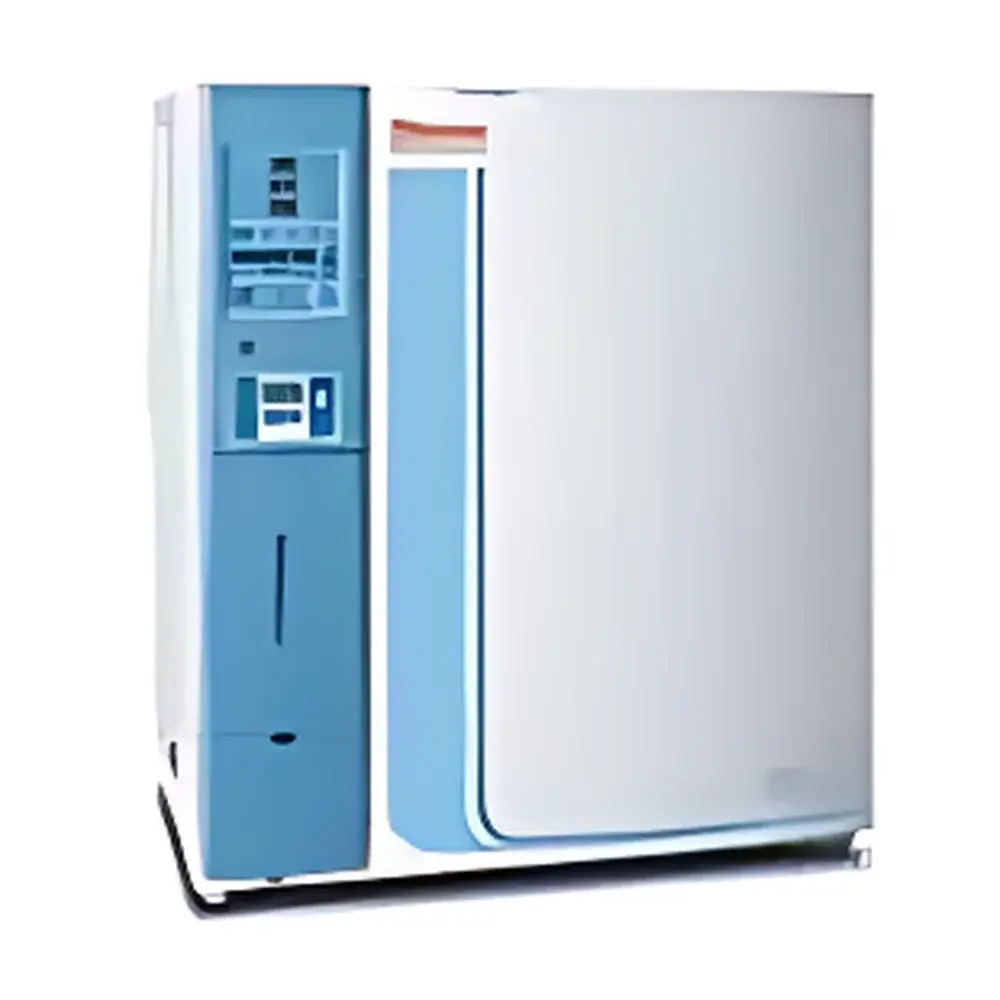
Thermo Scientific Steri-Cult 3308/3311 Infrared CO₂ Incubator
| Brand | Thermo Fisher Scientific |
|---|---|
| Origin | USA |
| Model | 3308 / 3311 |
| Temperature Range | Ambient +5°C to 50°C |
| CO₂ Range | 0–20% |
| CO₂ Control Accuracy | ±0.1% |
| Temperature Uniformity (at 37°C) | ±0.2°C |
| Temperature Accuracy | ±0.1°C |
| Humidity Range (at 37°C) | Ambient RH to 95% RH, non-condensing |
| Humidity Control Accuracy | ±2.0% |
| Humidity Reservoir Capacity | 3.8 L |
| Internal Volume | 232 L (3308) / 323 L (3311) |
| External Dimensions (W×H×D, mm) | 889×1001×686 (3308) / 1092×1001×686 (3311) |
| Internal Dimensions (W×H×D, mm) | 528×833×523 (3308) / 732×833×523 (3311) |
| Shelf Capacity | 5 standard / up to 22 shelves |
| CO₂ Sensor Type | Dual-beam Infrared (IR) |
| Sterilization Method | 140°C Dry-Heat Decontamination |
| Air Filtration | Class 100 HEPA Recirculation (1 air change per minute) |
| Humidity Delivery | External Water Reservoir with Microprocessor-Controlled Steam Generator |
Overview
The Thermo Scientific Steri-Cult 3308 and 3311 Infrared CO₂ Incubators are engineered for high-integrity, long-term mammalian cell culture under strictly controlled environmental conditions. Leveraging over three decades of Forma incubator heritage, these models integrate dual-beam infrared CO₂ sensing, precision microprocessor-based environmental regulation, and validated 140°C dry-heat decontamination — a critical capability for eliminating bacterial endospores, mycoplasma, and viral contaminants without chemical residues. Unlike conventional thermal conductivity (TC) sensors, the IR-based detection system delivers stable, drift-free CO₂ measurement across the full 0–20% range, independent of humidity or O₂ fluctuations. The incubators operate within a temperature range of ambient +5°C to 50°C, with ±0.1°C setpoint accuracy and ±0.2°C uniformity at 37°C — performance aligned with ISO 13408-1 (aseptic processing) and ASTM E2927-18 (performance verification of CO₂ incubators). Designed for compliance-driven environments, the Steri-Cult series supports audit-ready operation in GLP, GMP, and clinical research laboratories.
Key Features
- Dual-beam infrared CO₂ sensor with automatic background compensation, ensuring long-term stability and minimizing calibration frequency
- 140°C dry-heat decontamination cycle, validated to achieve ≥6-log reduction of Geobacillus stearothermophilus spores per ISO 14644-1 and USP <1211>
- Class 100 HEPA filtration system recirculating internal atmosphere at ≥1 air change per minute, maintaining ISO 5-equivalent air quality inside the chamber
- Externally mounted, user-accessible humidity reservoir (3.8 L capacity) with blue-dyed water level indicator and low-level flashing LED alert — eliminates internal condensation and simplifies maintenance
- Microprocessor-controlled steam generator enables precise relative humidity control from ambient to 95% RH at 37°C (±2.0% accuracy), with no liquid water contact inside the chamber
- Enviro-Scan™ environmental monitoring system continuously logs temperature, CO₂, humidity, door status, and sterilization cycle parameters with timestamped records
- Stainless steel interior with seamless, crevice-free construction and rounded corners for effective cleaning and disinfection
Sample Compatibility & Compliance
The Steri-Cult 3308/3311 accommodates standard tissue culture flasks (T25–T225), multiwell plates (6–96-well), roller bottles, and custom bioreactor vessels via configurable shelf spacing (up to 22 shelves). Its stainless-steel chamber and inert gas-compatible seals ensure compatibility with CO₂/O₂/N₂ tri-gas applications when retrofitted with optional gas mixing modules. Regulatory alignment includes design conformity to IEC 61010-1 (safety), IEC 61326-1 (EMC), and support for 21 CFR Part 11-compliant data integrity when paired with Thermo Fisher’s ChronoLog™ software. Validation documentation packages (IQ/OQ/PQ protocols) are available to support FDA, EMA, and PMDA submissions.
Software & Data Management
Integrated Enviro-Scan firmware provides real-time parameter visualization, event logging, and password-protected user access levels (operator, supervisor, administrator). All operational data — including sterilization cycle thermograms, CO₂ ramp profiles, and humidity deviation alerts — are stored onboard with 30-day circular memory. Optional ChronoLog™ software enables secure remote monitoring, automated PDF report generation, electronic signature workflows, and ALCOA+ compliant audit trails meeting FDA 21 CFR Part 11 Annex 11 requirements. Data export formats include CSV, XML, and PDF for integration into LIMS or QMS platforms.
Applications
- Stem cell expansion and differentiation under tightly regulated hypoxic or normoxic conditions
- Monoclonal antibody production in CHO and hybridoma cultures requiring batch-to-batch consistency
- Primary neuronal and organoid culture where humidity stability prevents medium evaporation and osmotic stress
- GMP-compliant cell banking and working cell stock maintenance per ICH Q5D
- Toxicology assays requiring uninterrupted environmental fidelity over 72–168 hour exposures
- Regulatory stability studies conducted under ICH Q1A–Q1E guidelines
FAQ
What validation support is provided for GMP installation?
Thermo Fisher supplies IQ/OQ templates compliant with ASTM E2500 and EU Annex 15, including temperature mapping protocols, CO₂ linearity verification, and HEPA leak test procedures.
Can the incubator be integrated into a central building management system (BMS)?
Yes — optional Modbus RTU or Ethernet/IP communication modules enable real-time parameter streaming and alarm forwarding to facility SCADA systems.
Is the 140°C decontamination cycle validated per ISO 14644-2?
The cycle achieves ≥120 minutes at ≥135°C throughout the entire chamber volume, satisfying ISO 14644-2:2015 clause 8.2.3 for periodic requalification.
How often does the IR CO₂ sensor require recalibration?
Under normal operation, recalibration is recommended every 12 months; however, built-in zero-point verification using ambient air allows daily functional checks without external gas standards.
Does the external humidity reservoir meet USP <797> requirements for sterile compounding environments?
Yes — the sealed, externally accessed design eliminates internal water pan contamination risks and complies with USP <797> Section 11.3 on environmental control system design.
Related Products



