
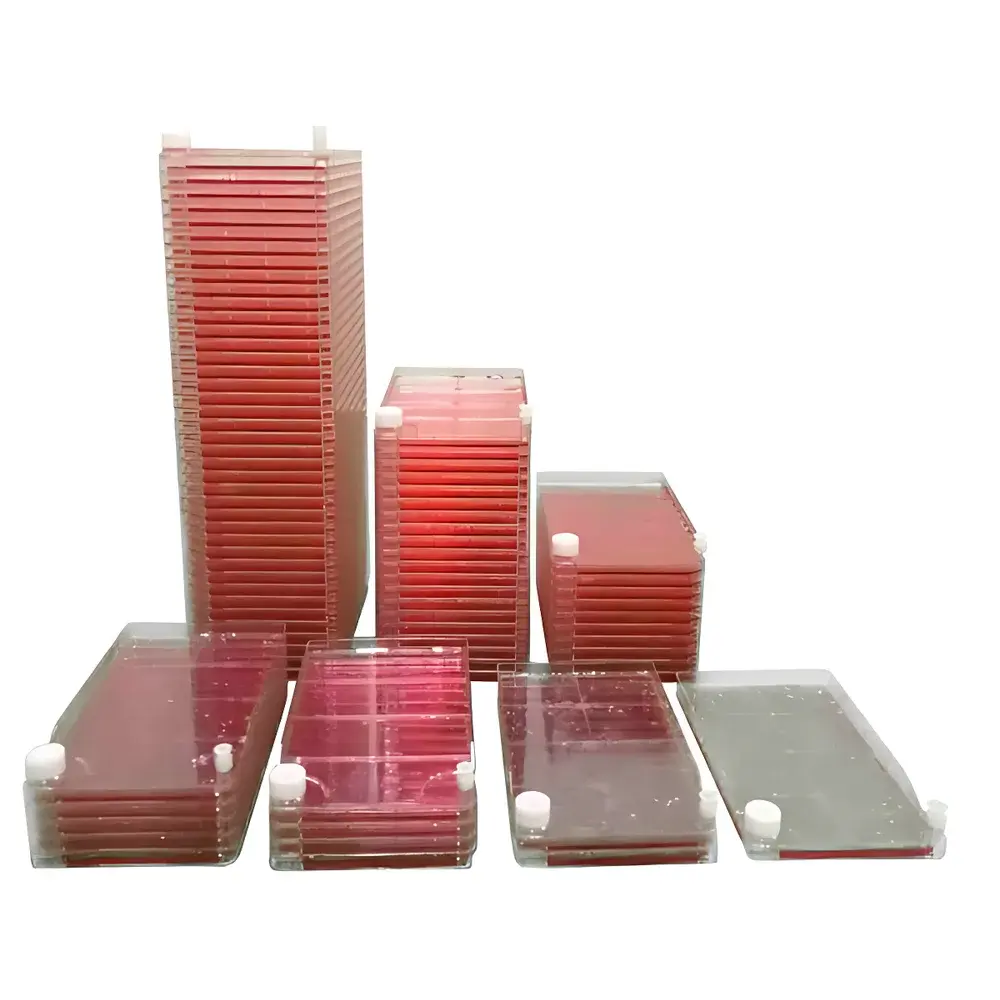
DHS Large-Scale Cell Culture System
| Brand | DHS |
|---|---|
| Origin | Tianjin, China |
| Manufacturer Type | Authorized Distributor |
| Country of Origin | China |
| Model | 0402257 (Configurable Layer Count) |
| Price Range | USD 7,000 – 14,000 (FOB Tianjin) |
| Temperature Range | Ambient to 40 °C (with optional incubator integration) |
| Working Volume per Layer | 200 mL |
| Total Configurable Capacity | Up to 10 layers = 36 parallel culture vessels |
| Material | Medical-Grade Imported Polymeric Resin (USP Class VI compliant) |
| Sterilization Method | Autoclavable (121 °C, 20 min, saturated steam) |
Overview
The DHS Large-Scale Cell Culture System is a modular, stackable bioreactor platform engineered for scalable adherent cell expansion under controlled environmental conditions. Unlike traditional roller bottles or static flasks, this system employs a fixed-bed, multi-layer architecture based on gas-permeable, surface-treated polymeric culture chambers. Each layer integrates a precisely engineered cell-adhesive surface—modified via low-temperature ultra-high-vacuum plasma treatment—to promote uniform monolayer attachment while minimizing shear-induced DNA damage and metabolic stress. The system operates in ambient or externally regulated temperature environments (up to 40 °C), with compatibility for integration into standard CO₂ incubators or dedicated climate-controlled cabinets. Designed for reproducible, GMP-aligned workflows, it supports transition from R&D-scale screening to pilot-scale production of therapeutic cells—including mesenchymal stromal cells (MSCs), induced pluripotent stem cells (iPSCs), and viral vector producer lines—without process requalification.
Key Features
- Plasma-modified cell-binding surface: Low-temperature ultra-high-vacuum plasma treatment ensures consistent extracellular matrix mimicry, significantly reducing genotoxic stress compared to conventional roller bottle agitation.
- Modular scalability: Configurable from 1 to 40 layers; standard configurations include 1, 2, 5, 10, 20, and 40 layers—each layer holds 200 mL working volume, with 10-layer units functionally equivalent to 36 individual T175 flasks.
- Pre-sterilized, ready-to-use format: All components undergo validated moist-heat sterilization (121 °C, 20 min, saturated steam) and are certified pyrogen-free, endotoxin-free (<0.03 EU/mL), and non-cytotoxic per ISO 10993-5.
- Optimized fluid handling: Wide-mouth inlet/outlet ports facilitate rapid, bubble-free medium exchange and harvesting with minimal residual volume (<5% hold-up).
- Space-efficient footprint: Vertical stacking reduces benchtop occupancy by >80% versus equivalent flask-based systems—critical for cleanroom-limited facilities.
- Material integrity: Constructed from USP Class VI-certified imported polymeric resin, ensuring chemical resistance to common disinfectants (e.g., 70% ethanol, 0.5% sodium hypochlorite) and compatibility with long-term serum-free culture media.
Sample Compatibility & Compliance
The DHS system supports a broad range of anchorage-dependent mammalian cell lines—including CHO-K1, HEK293, Vero, MRC-5, and primary human fibroblasts—as well as stem cell-derived progenitors requiring high-surface-area, low-shear microenvironments. All materials comply with ISO 10993-1 (biological evaluation of medical devices), USP (biological reactivity tests), and EU Pharmacopoeia 2.6.17. The system is compatible with ISO 5-class (Class 100) laminar flow hoods and may be deployed within ISO 7 or ISO 8 cleanrooms. While the base unit is not inherently ISO 13485-certified, documentation packages—including sterilization validation reports, material traceability records, and biocompatibility summaries—are available upon request to support GLP/GMP audits.
Software & Data Management
The DHS Large-Scale Cell Culture System is a hardware-only platform and does not include embedded sensors or digital controls. However, it is fully compatible with third-party environmental monitoring systems (e.g., Vaisala, Omega) for real-time tracking of incubator temperature, CO₂, and humidity. Users routinely integrate it with LIMS platforms (e.g., LabVantage, STARLIMS) via manual log entry or barcode-scanned batch records. For regulatory submissions, full traceability is maintained through lot-specific sterilization certificates, material declarations (RoHS/REACH), and QC test reports—all archived per 21 CFR Part 11–compliant document management protocols when used in FDA-regulated environments.
Applications
- Expansion of clinical-grade adherent cells for autologous and allogeneic therapies (e.g., MSCs for orthopedic or immunomodulatory indications).
- Production of lentiviral and retroviral vectors in stable producer lines under serum-free conditions.
- High-yield monoclonal antibody expression using adherent CHO platforms prior to suspension adaptation.
- Toxicity and differentiation assays requiring large, homogeneous cell populations with minimal passage-induced heterogeneity.
- Bridging studies between 2D static culture and bioreactor-based 3D systems—enabling seamless scale-up without re-optimizing coating or feeding strategies.
FAQ
Is the DHS system suitable for cGMP manufacturing?
Yes—when operated within qualified cleanroom environments and supported by appropriate procedural documentation (SOPs, batch records, sterilization logs), the system meets foundational requirements for Phase I/II clinical material production per ICH Q5D and USP <1043>.
Can layers be added or removed during an ongoing culture?
No—layer configuration is fixed per unit at time of sterilization. Reconfiguration requires unpacking, decontamination, and re-sterilization; therefore, users must define final layer count prior to autoclaving.
What validation support is provided?
DHS provides DQ/IQ documentation templates, sterilization cycle validation summaries (including biological indicator logs), and extractables/leachables data upon request for qualifying customers.
Does the system require specialized gas supply or vacuum connections?
No—it operates under passive gas exchange via integrated hydrophobic membrane vents; no external gas manifolds, pumps, or controllers are needed.
How is contamination risk mitigated during medium exchange?
The wide-mouth design enables closed-system transfer using sterile tubing welders or aseptic connectors (e.g., CPC, Qosina), minimizing open manipulations and operator-dependent variability.
Related Products




