
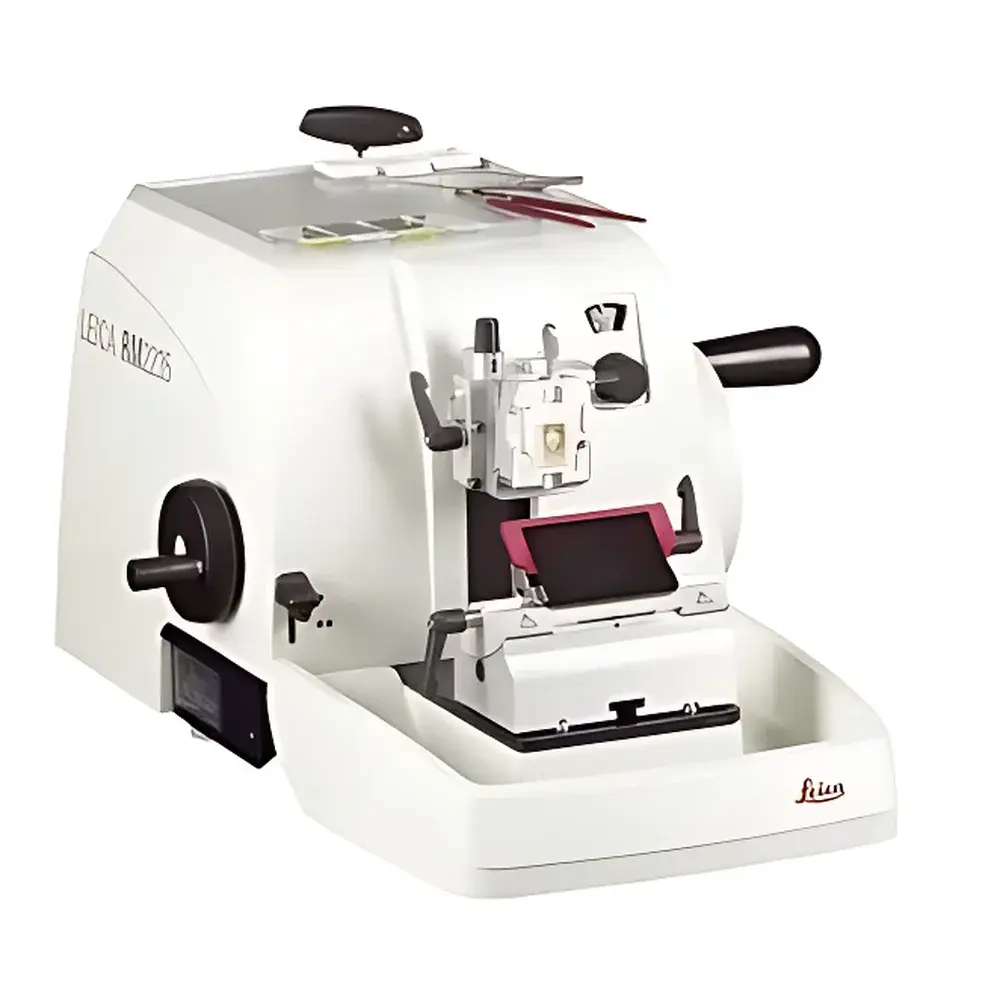
Leica RM2235 Manual Rotary Microtome
| Brand | Leica |
|---|---|
| Origin | Germany |
| Model | RM2235 |
| Maximum Specimen Size | 33 × 40 mm |
| Section Thickness Range | 0.25–100 µm |
| Incremental Advance | 1 µm |
| Vertical Stroke | 70 mm |
| Optional Precision X/Y Stage | ±8° adjustment with calibrated zero-reference marks |
Overview
The Leica RM2235 is a precision-engineered manual rotary microtome designed for routine paraffin-embedded tissue sectioning in histopathology, biomedical research, and academic laboratories. It operates on the fundamental principle of controlled linear advancement of the specimen block against a stationary cutting blade—enabling reproducible, high-fidelity sections through mechanical translation and precise rotational handwheel actuation. Engineered for ergonomic efficiency and long-term mechanical stability, the RM2235 integrates German manufacturing rigor with user-centric design elements that reduce operator fatigue while maintaining strict dimensional fidelity across thousands of serial sections. Its robust cast-aluminum base, integrated safety shroud, and magnetically secured waste tray collectively support GLP-compliant workflow integrity and benchtop space optimization.
Key Features
- Ergonomic handwheel positioning—located 80 mm closer to the operator than comparable models—to minimize wrist flexion and muscular strain during extended sectioning sessions.
- 70 mm vertical stroke capacity—accommodating oversized embedding cassettes (up to 33 × 40 mm) and increasing clearance between specimen surface and knife edge for safer, more intuitive block repositioning.
- Patented adjustable handwheel counterbalance system—prevents gravitational sag of the specimen holder during pauses, eliminating unintended contact between block face and blade and preserving sample integrity.
- Dual-position handwheel lock mechanism—top-mounted lock fixes the wheel at its highest position for rapid coarse approach; secondary lock engages at any rotational angle for fine-tuned sectioning pauses or intermediate positioning.
- Optional 8° X/Y precision stage—with dual red-indexed zero-reference markers and independent calibration screws—enables repeatable repositioning for serial sectioning, recuts, or targeted region relocation without visual realignment.
- Integrated protective hood and magnetic chip tray—reducing airborne particulate dispersion and simplifying cleanup while extending mechanical component service life under daily laboratory use.
Sample Compatibility & Compliance
The RM2235 supports standard paraffin-embedded tissues, frozen sections (with optional cryo-adaptation), and moderately dense materials such as decalcified bone or resin-embedded specimens. Its 0.25–100 µm section thickness range—adjustable in 1 µm increments—meets ASTM E29–23 requirements for incremental resolution in manual microtomy. The instrument complies with IEC 61000-6-2 (EMC immunity) and IEC 61000-6-4 (EMC emission) standards. While not classified as a medical device under EU MDR 2017/745, it is routinely deployed in ISO 15189-accredited histology labs and supports audit-ready documentation when paired with Leica’s optional digital annotation modules and traceable calibration logs.
Software & Data Management
As a fully manual platform, the RM2235 does not incorporate embedded firmware or onboard software. However, its mechanical repeatability and standardized mounting interfaces ensure seamless integration into digital pathology workflows. When used alongside Leica’s DM6 B or ICC50 W imaging systems, sectioning metadata—including thickness setting, orientation angle (if using X/Y stage), and operator ID—can be manually logged or synchronized via LMS (Leica Microsystem Suite) through external lab information management systems (LIMS). All optional accessories—including the precision stage and knife holders—are serialized and documented per ISO/IEC 17025 traceability protocols, enabling full chain-of-custody compliance for regulated environments.
Applications
- Routine diagnostic histology: Hematoxylin & eosin (H&E), special stains, and immunohistochemistry (IHC) preparation on paraffin blocks.
- Academic and preclinical research: Serial section reconstruction, morphometric analysis, and correlative light-electron microscopy (CLEM) sample preparation.
- Quality control in biobanking: Standardized sectioning of archived tissue cores for downstream molecular assays.
- Material science applications: Sectioning of polymer-embedded composites, mineralized tissues, or low-density foams requiring mechanical stability over thermal sensitivity.
- Training and education: Pedagogical tool for teaching microtomy fundamentals due to transparent mechanics, tactile feedback, and intuitive force modulation.
FAQ
Is the RM2235 compatible with disposable blades or only reusable steel knives?
It accepts both standard Leica 818-type disposable blades and reusable tungsten-carbide or stainless-steel knives via the universal knife holder.
Can the optional X/Y stage be retrofitted to an existing RM2235 unit?
Yes—the stage mounts directly onto the specimen head without modification and is field-installable using Leica-certified service tools.
What maintenance intervals are recommended for optimal performance?
Daily cleaning of the waste tray and knife area; monthly lubrication of the advance mechanism with Leica-approved silicone-free grease; annual calibration verification of the micrometer scale per ISO 9001 internal audit guidelines.
Does the RM2235 meet FDA 21 CFR Part 11 requirements?
As a non-computerized, non-data-generating instrument, it falls outside the scope of Part 11—but its mechanical consistency and traceable accessory IDs support ALCOA+ data integrity principles when integrated into validated workflows.
Is technical support available outside Germany?
Leica Microsystems maintains certified service centers in over 40 countries, with multilingual documentation, remote diagnostics, and on-site calibration services aligned with ISO/IEC 17025 accreditation.



