
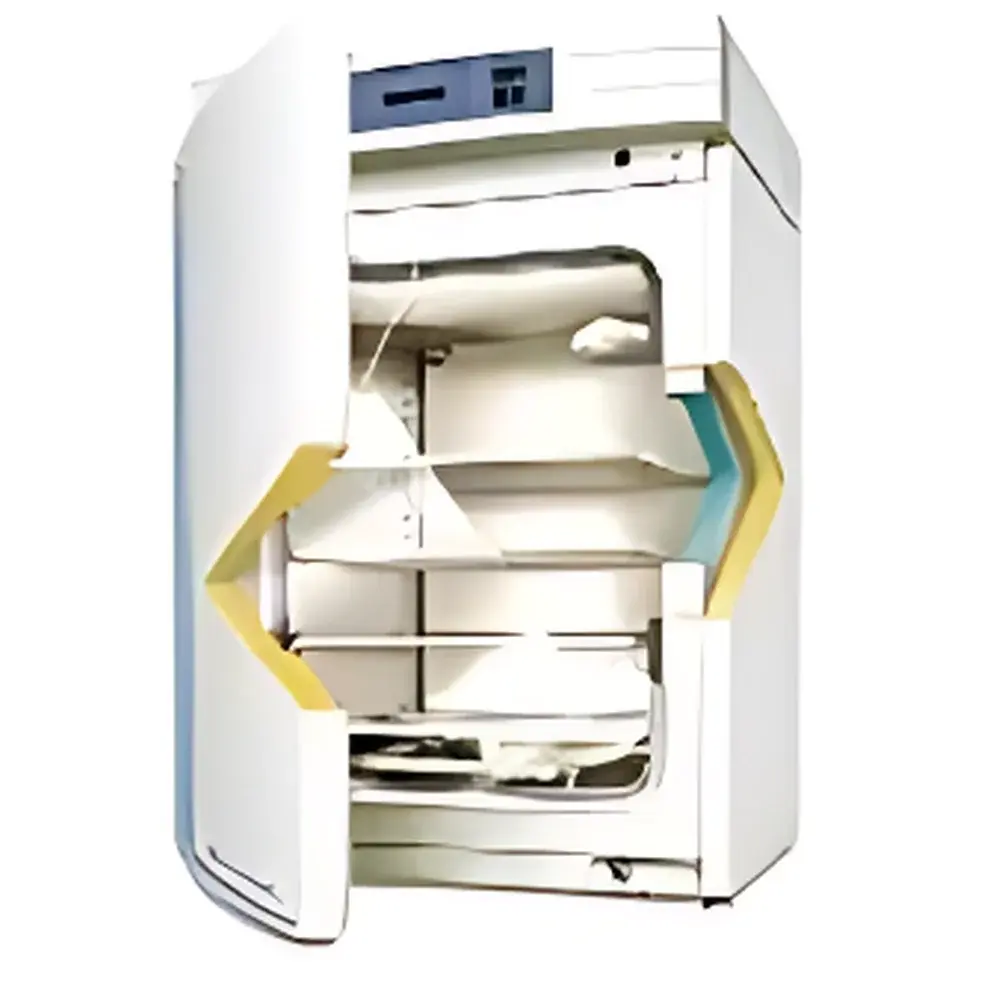
Thermo Fisher Scientific 3110 Series Water-Jacketed CO₂ Incubator
| Brand | Thermo Fisher Scientific |
|---|---|
| Origin | USA |
| Model | 3110 Series |
| Chamber Volume | 184.1 L |
| Water Jacket Capacity | 43.5 L |
| Temperature Range | Ambient +5°C to 55°C |
| Temperature Uniformity (at 37°C) | ±0.2°C |
| Temperature Accuracy | ±0.1°C |
| CO₂ Range | 0–20% |
| CO₂ Control Accuracy | Better than ±0.1% |
| O₂ Range | 1–20% |
| O₂ Sensor Type | Fuel Cell |
| Relative Humidity (at 37°C) | Ambient to 95% RH |
| Humidification Pan Capacity | 3.0 L |
| Internal Dimensions (W×H×D) | 544 × 681 × 508 mm |
| External Dimensions (W×H×D) | 668 × 1003 × 635 mm |
| Standard Shelving | 4 shelves (max 17) |
| Net Weight | 120 kg |
| HEPA Filtration | Class 100 internal environment |
| Power Input Pressure | 15 PSIG |
Overview
The Thermo Fisher Scientific 3110 Series Water-Jacketed CO₂ Incubator is engineered for high-fidelity cell culture maintenance in demanding research, clinical diagnostics, and biopharmaceutical manufacturing environments. Unlike forced-air (gas-jacketed) incubators, the 3110 series employs a thermally stable water-jacketed chamber design—providing superior thermal inertia and minimizing temperature fluctuations during door openings or power interruptions. Its core architecture integrates dual-gas control (CO₂ and O₂), real-time environmental monitoring via the Enviro-Scan microprocessor system, and a Class 100 internal air environment maintained by an integrated HEPA filtration system. This configuration ensures ISO 13485-aligned environmental consistency and supports GLP/GMP-compliant workflows where reproducibility of physiological conditions—particularly for stem cell expansion, primary culture, hypoxia studies, and co-culture models—is non-negotiable.
Key Features
- Water-jacketed thermal mass delivers exceptional temperature stability: chamber temperature drift remains ≤7.6°C after a 10-hour power outage—nearly 2× less deviation than typical gas-jacketed units.
- Patented heated inner glass door eliminates condensation formation, removing a known vector for microbial ingress and cross-contamination between experiments.
- Integrated fuel-cell O₂ sensor and T/C or IR-based CO₂ sensor are mounted entirely within the chamber—ensuring direct, contamination-free gas-phase measurement without external sampling lines or dead-volume traps.
- Enviro-Scan environmental scanning microcontroller enables intuitive, menu-driven parameter setting with no programming required; all setpoints (temperature, CO₂, O₂, humidity) are continuously monitored and logged with timestamped values.
- Compact footprint (668 × 1003 × 635 mm) supports space-efficient lab layouts; units are stackable and configurable for left- or right-handed door swing to accommodate modular cleanroom or biosafety cabinet integration.
- Class 100 internal air quality achieved via continuous recirculation through a certified HEPA filter—validated per ISO 14644-1—and supported by positive-pressure differential relative to ambient lab space.
Sample Compatibility & Compliance
The 3110 Series accommodates standard tissue culture formats including T-flasks (up to T225), multiwell plates (6–384-well), Petri dishes, roller bottles, and custom bioreactor vessels up to 17 shelf levels. Its humidity range (ambient to 95% RH at 37°C) and precise O₂ modulation (1–20%) make it suitable for normoxic, physioxic, and hypoxic culture protocols—including those referenced in ASTM F3023-15 (standard guide for hypoxia-controlled cell culture). The system complies with IEC 61010-1 for laboratory equipment safety and supports audit-ready data integrity when paired with optional 21 CFR Part 11–compliant software extensions. All materials in contact with the chamber interior—including stainless-steel walls, rounded corners, and removable shelving—are autoclavable or compatible with validated liquid disinfectants (e.g., 70% ethanol, hydrogen peroxide vapor).
Software & Data Management
The embedded Enviro-Scan controller stores ≥30 days of continuous environmental data (temperature, CO₂, O₂, humidity) with 1-minute resolution. Optional Ethernet or RS-232 connectivity enables integration into centralized lab information management systems (LIMS) or enterprise SCADA platforms. Data export is supported in CSV format with ISO 8601 timestamps. When deployed in regulated environments, optional firmware upgrades provide electronic signature capability, user-access tiering (admin/operator/observer), and immutable audit trails—fully aligned with FDA 21 CFR Part 11 requirements for electronic records and signatures. No third-party drivers or proprietary runtimes are required for data retrieval or remote status polling.
Applications
- Mammalian cell line maintenance (e.g., CHO, HEK293, HeLa) under tightly controlled CO₂ (5–10%) and humidity conditions.
- Hypoxia modeling for cancer biology, ischemia-reperfusion studies, and HIF pathway analysis using programmable O₂ setpoints from 1–5%.
- Stem cell and iPSC culture requiring minimized thermal and gaseous perturbation across multi-day differentiation protocols.
- Microbiological work involving fastidious organisms (e.g., Helicobacter pylori, Campylobacter jejuni) that require microaerophilic or capnophilic atmospheres.
- Regulatory submissions supporting USP , , and EU Annex 1 compliance for sterile product development and testing environments.
FAQ
What is the difference between water-jacketed and gas-jacketed CO₂ incubators?
Water-jacketed designs use a surrounding layer of heated water to buffer temperature changes, resulting in slower ramp times but significantly higher thermal stability during disruptions. Gas-jacketed units rely on heated air circulation, offering faster recovery but greater susceptibility to ambient fluctuations.
Can the 3110 Series be validated for GMP use?
Yes—the system supports IQ/OQ/PQ documentation packages, includes calibrated sensor traceability to NIST standards, and offers optional 21 CFR Part 11–enabled software for electronic record integrity.
Is the humidification system self-regulating?
Humidity is maintained passively via a 3.0 L stainless-steel pan; saturation level is thermodynamically coupled to chamber temperature and airflow—no ultrasonic misting or active steam generation is used, eliminating mineral deposit risks.
How often must the HEPA filter be replaced?
Under continuous operation in a Class 10,000 lab environment, the HEPA filter is rated for 12–18 months; replacement intervals should be verified via particle counter validation per ISO 14644-3.
Are third-party CO₂ sensors compatible with this model?
No—only Thermo Fisher–certified T/C or IR CO₂ sensors are supported to maintain calibration integrity and warranty coverage; field-sensor swaps void metrological validation.







