
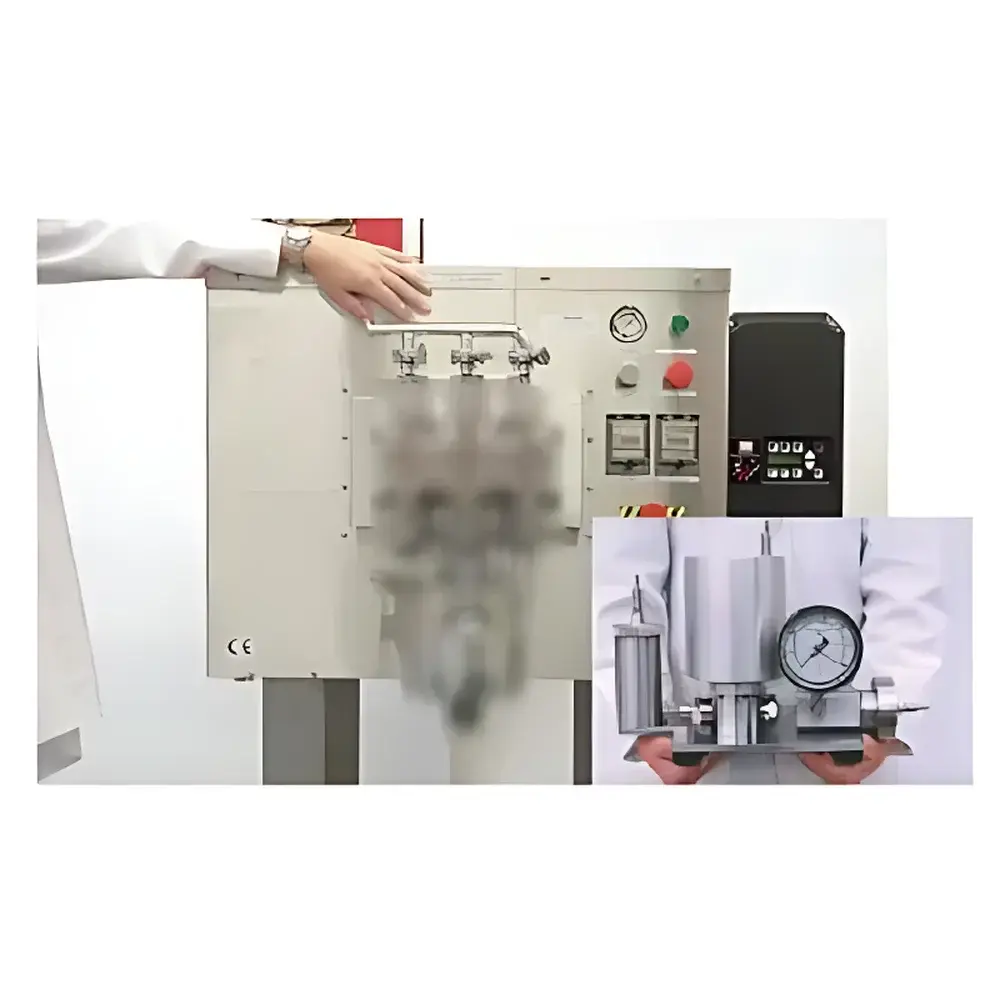
AVESTIN EmulsiFlex Series High-Pressure Homogenizer
| Brand | AVESTIN |
|---|---|
| Origin | Canada |
| Model | EmulsiFlex |
| Instrument Type | High-Pressure Homogenizer |
| Dimensions (W×D×H) | 335 × 280 × 650 mm |
| Processing Volume Range | 15–1,000,000 mL |
| Wetted Materials | Metal-to-Metal & Metal-to-Ceramic Seals Only |
| Sterilization | SIP-Compatible (Steam-in-Place), All Wetted Parts Autoclavable |
| Temperature Control | Stainless Steel Heat Exchanger Included |
| Regulatory Compliance | Designed for GLP/GMP Environments, Supports 21 CFR Part 11 Audit Trail Configuration (via optional software package) |
Overview
The AVESTIN EmulsiFlex Series is a family of high-pressure homogenizers engineered for precision nanoscale particle size reduction, cell disruption, and stable emulsion or liposome formation across laboratory, pilot-scale, and full production environments. Based on the principle of controlled fluid shear, cavitation, and impact forces generated by forcing process fluids through a precisely engineered micro-orifice valve at pressures up to 30,000 psi (207 MPa), the EmulsiFlex platform delivers reproducible sub-micron and nano-dispersions with narrow polydispersity indices (PDI). Its design originates from over three decades of specialization in high-pressure fluid mechanics and bioprocess engineering by AVESTIN Inc., a Canadian manufacturer headquartered in Ottawa. Unlike conventional homogenizers relying on elastomeric seals, the EmulsiFlex eliminates all O-rings and gaskets from the wetted path—replacing them with machined metal-to-metal and metal-to-ceramic static seals—ensuring chemical compatibility, thermal stability, and long-term integrity under repeated sterilization cycles.
Key Features
- Metal-sealed fluid path: No elastomers in contact with process material; enables compatibility with aggressive solvents, high-pH buffers, and organic phases.
- Modular scalability: Identical core valve architecture and control logic across EF-C (lab), EF-B (pilot), and EF-F (production) models ensure seamless technology transfer.
- Dynamic valve adjustment: Real-time pressure modulation via servo-controlled hydraulic actuation maintains consistent energy input despite viscosity or flow-rate fluctuations.
- Integrated temperature management: Standard stainless steel counterflow heat exchanger allows precise inlet/outlet temperature control (±0.5 °C) without external chillers.
- SIP-ready construction: Fully drainable, self-venting geometry with orbital welding joints and 316L SS or Hastelloy® C-22 wetted surfaces certified for steam-in-place cycles at 121–135 °C.
- Unified homogenization–extrusion–filtration platform: Optional high-pressure filtration module mounts directly to the discharge manifold, enabling inline sterile filtration (0.22 µm) or lipid nanoparticle extrusion post-homogenization.
Sample Compatibility & Compliance
The EmulsiFlex series accommodates aqueous, organic, and biphasic systems—including mammalian and bacterial cell lysates, polymer nanoparticle suspensions, lipid-based drug carriers (e.g., LNP, SLN), microemulsions, and pigment dispersions. All wetted components meet ASME BPE-2022 surface finish specifications (Ra ≤ 0.4 µm) and are traceably documented per ISO 9001:2015 and ISO 13485:2016. The system supports validation protocols aligned with FDA Process Validation Guidance (ICH Q5A, Q5C), EU Annex 1 (sterile manufacturing), and USP for container closure integrity testing preparation. When configured with validated firmware and audit-trail-enabled software, it satisfies 21 CFR Part 11 requirements for electronic records and signatures in regulated pharmaceutical development.
Software & Data Management
EmulsiFlex controllers feature embedded Linux-based HMI with real-time pressure, temperature, flow, and cycle-count monitoring. Data logging is performed at 100 Hz resolution with automatic timestamping and CSV export. Optional AVESTIN ProcessLink™ software provides remote operation, recipe management, deviation alerting, and electronic batch record (EBR) generation compliant with GAMP 5 principles. All operational parameters—including valve position, pressure ramp profiles, and thermal history—are archived with immutable hash verification to support regulatory inspections and quality investigations.
Applications
- Biopharmaceuticals: Mammalian cell lysis for monoclonal antibody purification, viral vector processing, and mRNA-LNP formulation.
- Vaccinology: Preparation of adjuvanted nanoemulsions and virosome-based delivery systems.
- Materials science: Dispersion of quantum dots, graphene oxide, and metal-organic frameworks (MOFs) in functional coatings and inks.
- Cosmeceuticals: Stabilization of active ingredient nanosuspensions (e.g., retinol, curcumin) with enhanced dermal bioavailability.
- Food science: Production of cold-processed plant-based milks, nanoencapsulated nutraceuticals, and shelf-stable flavor emulsions.
FAQ
What is the maximum operating pressure of the EmulsiFlex series?
Standard models operate up to 30,000 psi (207 MPa); custom configurations support higher pressures upon engineering review.
Can the EmulsiFlex be used for sterile manufacturing under cGMP conditions?
Yes—its SIP-capable design, autoclavable wetted parts, and optional 21 CFR Part 11 software enable full integration into validated aseptic processing lines.
Is metal-to-metal sealing compatible with highly viscous or particulate-laden feeds?
The EmulsiFlex valve geometry and dynamic actuation accommodate viscosities up to 10,000 cP and suspended solids ≤ 50 µm; pre-filtration is recommended for particles >25 µm.
How does the system ensure batch-to-batch reproducibility?
Through closed-loop pressure control, calibrated flow meters, temperature-compensated valve positioning, and automated cycle logging with metadata tagging.
Does AVESTIN provide installation qualification (IQ) and operational qualification (OQ) documentation?
Yes—factory-verified IQ/OQ protocols, including calibration certificates and performance test reports, are supplied with each system.



