
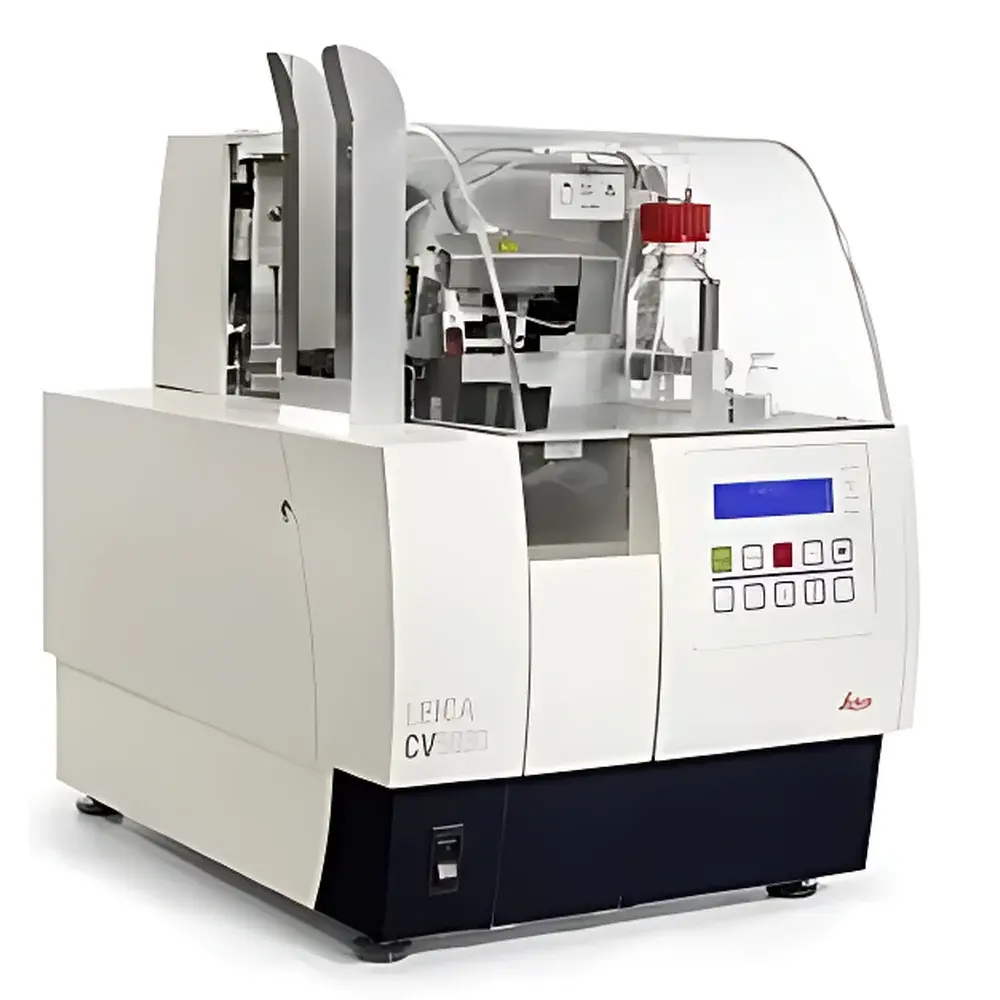
Leica CV5030 Automated Glass Coverslipper
| Origin | Germany |
|---|---|
| Manufacturer Type | Authorized Distributor |
| Origin Category | Imported |
| Model | CV5030 |
| Pricing | Upon Request |
Overview
The Leica CV5030 Automated Glass Coverslipper is an engineered solution for high-throughput, reproducible coverslipping in histopathology and cytology laboratories. Designed around precision fluid dynamics and programmable robotic handling, the CV5030 applies cover glasses onto microscope slides using controlled capillary action and vacuum-assisted positioning—ensuring uniform sealant distribution, minimal air bubble formation, and optical-grade clarity. Its core architecture supports both aqueous- and xylene-based mounting media, including modern xylene-substitute resins (e.g., limonene-, terpene-, or aliphatic hydrocarbon-based media), enabling compliance with evolving occupational safety and environmental regulations. As a modular component of Leica Biosystems’ integrated staining and coverslipping workflow, the CV5030 operates as a standalone unit or interfaces seamlessly with the Leica ST5010 or ST5020 automated stainers via standardized I/O protocols and physical slide-transfer rails.
Key Features
- Throughput of up to 400 slides per hour using standard 75 × 25 mm glass slides and cover glasses ranging from 22 × 22 mm to 24 × 60 mm—validated under ISO 15190:2020 laboratory safety and performance conditions.
- Dual-mode application: configurable wet-mount (liquid medium dispense + cover glass placement) and dry-mount (pre-mounted slide processing) workflows—ideal for immunohistochemistry (IHC), fluorescence in situ hybridization (FISH), and routine H&E applications.
- Integrated fume extraction system featuring activated carbon filtration with ≥95% adsorption efficiency for aromatic hydrocarbons (e.g., xylene, mesitylene) and common xylene alternatives, meeting OSHA PEL and EU Directive 2004/37/EC exposure limit requirements.
- Open reagent architecture supporting third-party mounting media—including water-soluble, resin-based, and low-toxicity formulations—without hardware modification or vendor lock-in.
- Modular footprint (W × D × H: 720 × 780 × 560 mm) with adjustable height and rear-access service panel, enabling flexible integration into existing lab layouts, laminar flow hoods, or automated track-based systems.
Sample Compatibility & Compliance
The CV5030 accommodates all standard glass slide formats (including Leica, Sakura, and Thermo Fisher-compatible racks) and accepts both manually loaded and auto-fed slide carriers. It maintains consistent coverage across diverse specimen types—including paraffin-embedded tissue sections, frozen sections, cytology smears, and cell pellets—without manual intervention or parameter recalibration. The system complies with IEC 61010-1:2010 for electrical safety in laboratory equipment and adheres to ISO 13485:2016 quality management principles for in vitro diagnostic (IVD) support instrumentation. While not an IVD device itself, its operation supports GLP- and CAP-accredited pathology workflows where traceability, repeatability, and audit readiness are critical.
Software & Data Management
The CV5030 runs on Leica’s proprietary Coverslip Control Software v3.x, offering intuitive touchscreen navigation, user-level access control (admin/operator modes), and full audit trail functionality compliant with FDA 21 CFR Part 11 requirements—including electronic signatures, time-stamped event logging, and immutable operation records. Process parameters (dispense volume, dwell time, pressure profile, drying interval) are stored per protocol and exportable in CSV or PDF format. Optional integration with Leica eSlide Manager or LIS/HIS systems via HL7 or ASTM E1384 interfaces enables bidirectional slide tracking and QC metric aggregation.
Applications
- Routine histopathology: high-volume H&E, special stains, and IHC preparation with consistent refractive index matching and long-term archival stability.
- Cytology: automated coverslipping of liquid-based cytology (LBC) preparations without edge curling or media overflow.
- Research pathology: reproducible mounting for multiplexed fluorescence imaging, where optical homogeneity and UV transmission integrity are essential.
- Reference laboratories: scalable throughput for centralized slide processing while maintaining individual case traceability and regulatory documentation standards.
FAQ
Can the CV5030 be integrated with non-Leica stainers?
Yes—via custom mechanical interface kits and RS-232/Modbus TCP communication modules; integration validation must be performed per ISO/IEC 17025 calibration and verification guidelines.
Does it support barcode-based slide tracking?
Yes—the optional Slide ID Reader module scans 1D/2D barcodes pre- or post-coverslipping and synchronizes metadata with LIS systems.
What maintenance intervals are recommended?
Daily wipe-down of dispensing nozzles and vacuum chucks; quarterly calibration of fluid delivery accuracy and annual preventive maintenance by Leica-certified engineers.
Is training provided for operators and service personnel?
Leica Biosystems offers on-site operator certification and remote technical support, plus authorized service engineer training programs aligned with ISO 9001 competency frameworks.




