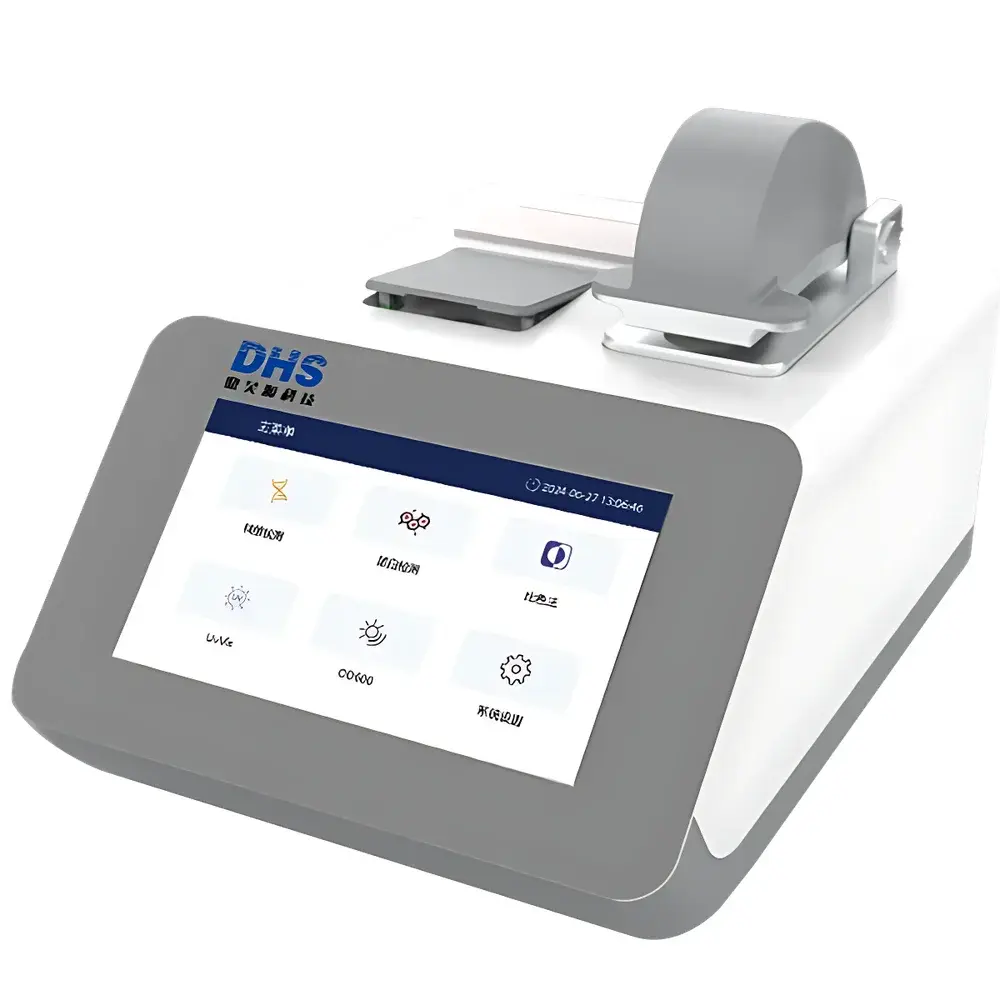
DHS NanoPro-One Ultra-Micro Spectrophotometer
| Brand | DHS |
|---|---|
| Origin | Tianjin, China |
| Model | NanoPro-One |
| Sample Volume | 0.5 µL |
| Cuvette Mode | Yes |
| Analytes | DNA, RNA, Protein, Cell Culture Suspensions |
| dsDNA Detection Range | 2–27,500 ng/µL |
| BSA Detection Range | 0.06–820 mg/mL |
| Wavelength Accuracy | ≤ ±1 nm |
| Measurement Time | < 5 s |
| Integrated Thermal Printer | Yes |
| OD₆₀₀ Capability | Yes |
| Fluorescence Option (NanoPro-OneR) | pg-level dsDNA quantification with compatible dyes |
| Operating System | Android-based, 7-inch capacitive touchscreen |
| Data Export | USB, Excel-compatible .csv, JPG image export |
| Compliance | Designed for GLP-compliant workflows |
Overview
The DHS NanoPro-One Ultra-Micro Spectrophotometer is an integrated, standalone UV-Vis absorption instrument engineered for rapid, precise quantification and quality assessment of nucleic acids and proteins in life science laboratories. Utilizing fixed-pathlength microvolume measurement based on surface tension-assisted sample retention (non-cuvette mode), it operates on the Beer-Lambert principle across a spectral range of 190–850 nm. Its core architecture eliminates dependency on external computers, enabling immediate analysis via an embedded Android OS and responsive 7-inch capacitive touchscreen interface. The system incorporates dual optical modes: microvolume (0.5 µL drop-on-demand) and standard 1-cm pathlength cuvette-based detection—making it equally suitable for high-concentration dsDNA screening and bacterial culture turbidity (OD₆₀₀) monitoring. Unlike traditional spectrophotometers requiring serial dilution or recalibration, the NanoPro-One employs a four-pathlength optical switching mechanism that dynamically selects optimal measurement geometry per sample absorbance, thereby extending linear dynamic range without manual intervention.
Key Features
- Microvolume quantification with only 0.5 µL sample requirement—minimizing consumption of precious clinical, single-cell, or synthetic biology samples
- Four-pathlength optical configuration (0.05 mm, 0.2 mm, 1.0 mm, and 2.0 mm) automatically selected to maintain absorbance within optimal photometric range (0.1–1.5 AU), ensuring linearity and reproducibility across 2–27,500 ng/µL dsDNA
- Integrated thermal printer for immediate hard-copy documentation—critical for lab notebooks, SOP adherence, and regulatory traceability
- Dual-mode operation: microvolume drop assay + standard 1-cm cuvette compatibility for OD₆₀₀ of microbial cultures, enzyme kinetics, or colored reagents
- Low-frequency pulsed xenon lamp with minimal photodegradation risk—preserving integrity of light-sensitive nucleic acid preparations during repeated measurements
- On-device automatic blank calibration and auto-zeroing—eliminating operator-induced variability and reducing hands-on time
- Fluorescence-ready variant (NanoPro-OneR) supports intercalating dye-based assays (e.g., PicoGreen®, Qubit®-compatible reagents) for sub-pg/µL dsDNA detection when paired with certified fluorometric kits
Sample Compatibility & Compliance
The NanoPro-One accommodates native, unpurified, and column-eluted nucleic acid extracts—including genomic DNA, plasmid preps, RNA isolates, and CRISPR ribonucleoprotein complexes—without mandatory dilution. It also supports common protein standards (BSA, lysozyme) and cell suspensions (E. coli, yeast, mammalian lines). All measurements comply with ISO 8655-7 (volumetric instruments) and ASTM E275-22 (spectrophotometric terminology) for reporting absorbance-based concentration. The embedded software logs metadata (date/time, operator ID, wavelength, pathlength, blank reference) in tamper-evident format—enabling alignment with GLP and GMP documentation requirements. While not FDA 21 CFR Part 11-certified out-of-the-box, its audit trail structure supports validation protocols for regulated environments including clinical diagnostics and contract research organizations.
Software & Data Management
Running a customized Android 9.0 OS, the NanoPro-One features intuitive graphical navigation, multilingual UI support (English, Spanish, German, Chinese), and local storage for ≥10,000 test records. Data exports include CSV files compatible with Microsoft Excel and Prism for downstream statistical analysis, as well as annotated JPG snapshots showing full-spectrum scans and peak annotations. USB host interface enables direct transfer to Windows/macOS/Linux systems without proprietary drivers. No cloud connectivity or remote telemetry is enabled by default—ensuring data sovereignty and compliance with institutional IT security policies. Firmware updates are delivered via signed ZIP packages loaded from USB drive, preserving version control integrity.
Applications
- Nucleic acid QC in NGS library preparation workflows—verifying fragment integrity and concentration prior to sequencing
- CRISPR editing efficiency assessment via post-transfection DNA yield and A260/A280 ratio tracking
- Recombinant protein expression monitoring in E. coli lysates using A280 and A260/A280 purity metrics
- Environmental microbiology: rapid OD₆₀₀ screening of enrichment cultures under varying nutrient conditions
- Educational labs: teaching Beer-Lambert law principles, dilution series design, and spectral interference identification
- Food safety labs: quantifying PCR inhibitors in plant or soil extracts via A230 absorbance deviation
FAQ
Does the NanoPro-One require routine lamp replacement?
No—the xenon flash lamp is rated for >1 × 10⁶ pulses and typically exceeds five years of daily laboratory use without degradation.
Can I import custom extinction coefficients for non-standard proteins?
Yes—user-defined molar absorptivity values and molecular weights can be saved per assay template for consistent batch-to-batch calculations.
Is the cuvette holder compatible with standard 10-mm square quartz or plastic cuvettes?
Yes—it accepts industry-standard 12.5 × 12.5 mm cross-section cuvettes with pathlengths from 1 mm to 50 mm via optional adapters.
How is photometric accuracy verified during routine operation?
Built-in NIST-traceable neutral density filters allow daily verification at 260 nm, 280 nm, and 405 nm without external calibration tools.
What file formats does the instrument generate for raw spectral data?
Full-wavelength scan data (1 nm increments, 190–850 nm) is stored in ASCII-delimited text (.txt) and embedded in exported CSV reports.