
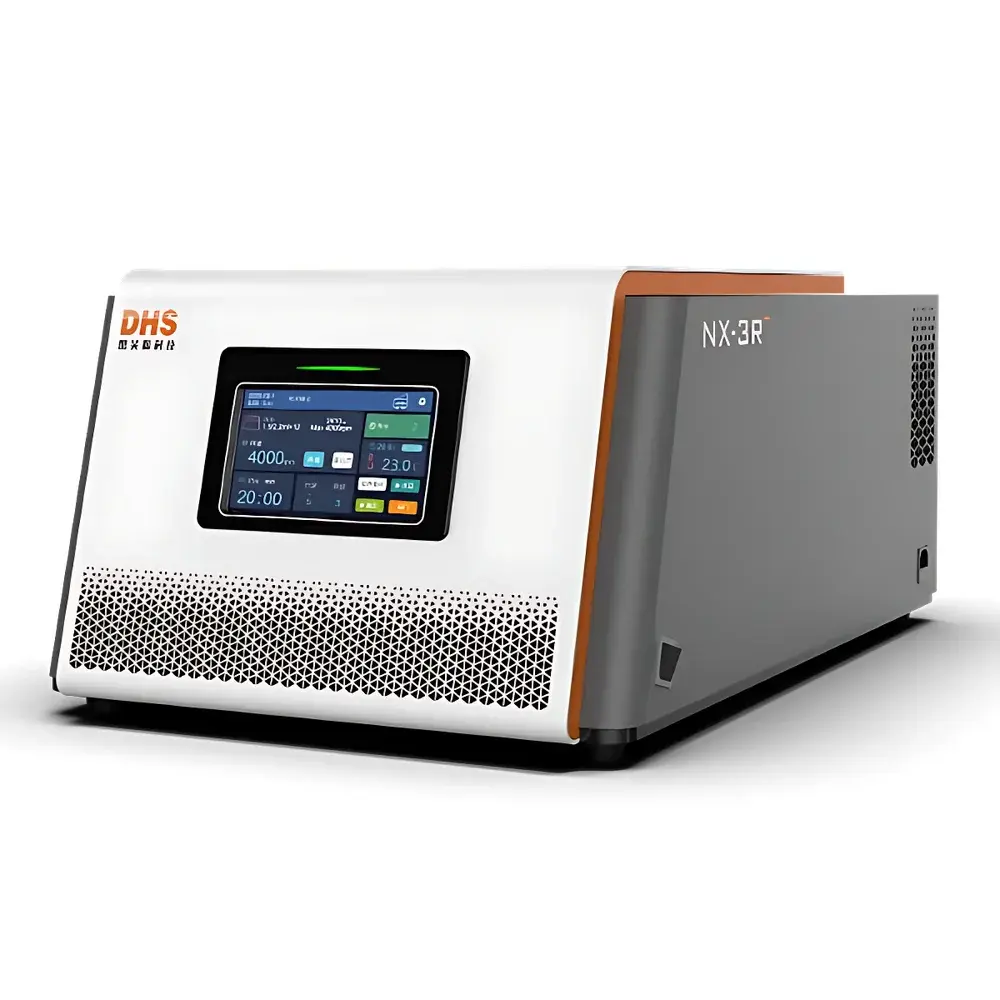
DHS NX-3R Pro High-Speed Refrigerated Benchtop Centrifuge
| Brand | DHS |
|---|---|
| Origin | Tianjin, China |
| Model | NX-3R Pro |
| Instrument Type | Benchtop Centrifuge |
| Category | High-Speed Refrigerated Centrifuge (10,000–30,000 rpm) |
| Maximum Speed | 21,000 rpm |
| Maximum RCF | 33,500 × g |
| Maximum Capacity | 4 × 250 mL |
| Minimum Temperature | –20 °C |
| Dimensions (W × D × H) | 325 × 470 × 740 mm |
| Rotor Compatibility | Fixed-angle rotors with multiple adapter options |
| Control Interface | 7-inch HD color touchscreen |
| Drive System | Direct-drive inverter motor |
| Safety Features | Electronic imbalance detection, auto rotor recognition, lid interlock, overspeed/overtemperature protection |
| Programmability | 100 user programs, up to 10 segments per program |
| Acceleration/Deceleration | 9-step acceleration, 10-step deceleration |
| Construction | Full metal housing with corrosion-resistant powder coating |
| Refrigeration | Eco-friendly non-CFC compressor system |
Overview
The DHS NX-3R Pro is a high-performance refrigerated benchtop centrifuge engineered for precision separation of biomolecular samples under controlled thermal conditions. Designed around the principles of fixed-angle rotor sedimentation dynamics and governed by Newtonian fluid mechanics in rotating reference frames, the NX-3R Pro delivers reproducible pelleting, clarification, and fractionation of nucleic acids, proteins, organelles, and viral particles. Its maximum rotational speed of 21,000 rpm and corresponding RCF of 33,500 × g enable rapid separation of macromolecular complexes while maintaining structural integrity—critical for downstream applications such as Western blotting, PCR template preparation, and cryo-EM sample vitrification. Integrated non-CFC refrigeration ensures stable temperature maintenance from –20 °C to +40 °C across all operational speeds, mitigating thermal denaturation during prolonged high-speed runs.
Key Features
- Direct-drive inverter motor architecture ensures minimal mechanical wear, low acoustic emission (<65 dB at 21,000 rpm), and extended service life without belt or gear degradation.
- 7-inch high-resolution capacitive touchscreen interface provides real-time visualization of setpoints and actual parameters—including speed, RCF, time, temperature, and rotor ID—on a single screen with intuitive icon-based navigation.
- Electronic imbalance detection system continuously monitors vibration amplitude and automatically halts operation if asymmetry exceeds ISO 1940-1 G2.5 tolerance thresholds, preventing rotor failure and sample loss.
- Auto rotor recognition validates installed rotor type and enforces speed/temperature limits based on certified mechanical specifications, enforcing compliance with IEC 61010-2-020 safety standards for laboratory centrifuges.
- PWM-controlled acceleration and deceleration profiles (9 ramp-up and 10 ramp-down steps) minimize resuspension of pelletized material—particularly advantageous for sensitive subcellular fractions and ribonucleoprotein complexes.
- Full-metal chassis with electrostatic powder-coated finish offers enhanced rigidity, resistance to organic solvents and mild corrosives, and compliance with IP20 ingress protection requirements for laboratory environments.
Sample Compatibility & Compliance
The NX-3R Pro supports a broad spectrum of biological and biochemical sample formats via 13 interchangeable fixed-angle rotors, including configurations for 1.5–2.0 mL microtubes, 15–50 mL conical tubes, and 250 mL bottles. Adapters accommodate standard polypropylene, polycarbonate, and ultracentrifuge-grade tubes compliant with ASTM D543 and ISO 8536-5 specifications. All rotors are certified to EN 61000-6-3 (EMC immunity) and undergo dynamic balancing per ISO 1940-1 Class G2.5. The instrument meets essential requirements of the EU Machinery Directive 2006/42/EC and carries CE marking. Refrigeration performance conforms to IEC 60068-2-1 (cold testing) and IEC 60068-2-2 (dry heat testing), ensuring reliability under ambient conditions ranging from 10 °C to 32 °C.
Software & Data Management
While the NX-3R Pro operates as a standalone instrument, its embedded firmware supports GLP-compliant data traceability through timestamped program logs stored internally (100-program capacity). Each program records rotor ID, speed, RCF, duration, temperature setpoint, and start/stop timestamps—accessible via USB export for audit trail reconstruction. Though no external software suite is bundled, the device’s parameter structure aligns with common LIMS integration protocols (e.g., ASTM E1578-18 metadata schema), facilitating manual import into laboratory information management systems. All safety-critical events—including imbalance aborts, lid-open interrupts, and overtemperature alerts—are logged with millisecond resolution and retained for ≥30 days.
Applications
- Isolation of plasmid DNA and genomic DNA from bacterial lysates using silica-membrane or cesium chloride gradient protocols.
- Preparation of exosome-enriched supernatants from cell culture media via sequential centrifugation (e.g., 300 × g → 2,000 × g → 10,000 × g → 33,500 × g).
- Clarification of recombinant protein expression lysates prior to affinity chromatography or size-exclusion analysis.
- Subcellular fractionation workflows including mitochondrial isolation (using sucrose density gradients) and nuclear pellet enrichment.
- Routine QC of vaccine formulations requiring cold-chain preservation during high-G pelleting steps.
- Environmental microbiology applications such as concentration of waterborne pathogens (e.g., Legionella, enteroviruses) prior to qPCR detection.
FAQ
What is the minimum operating temperature and how quickly does the chamber reach it?
The refrigeration system achieves –20 °C within ≤15 minutes from ambient (25 °C) with empty chamber; cooling rate under load depends on rotor mass and tube volume but remains within ±1.5 °C stability during continuous operation at maximum speed.
Does the NX-3R Pro support swing-bucket rotors?
No—the NX-3R Pro is configured exclusively for fixed-angle rotors optimized for high-RCF pelleting; swing-bucket compatibility is not supported due to mechanical and thermal design constraints.
How is rotor calibration validated during installation?
Each rotor includes an RFID tag encoded with manufacturer-certified inertia values and maximum rated speeds; the centrifuge reads this tag upon lid closure and cross-references against internal firmware tables before enabling run initiation.
Can programs be exported to other DHS centrifuges?
Program files are proprietary binary format and not interoperable across models; however, parameter values (speed, time, temperature, acceleration profile) can be manually replicated on compatible NX-series instruments.
Is the instrument suitable for use in ISO Class 5 cleanrooms?
Yes—the sealed metal enclosure, brushless motor, and absence of internal lubricants or particulate-generating components meet ISO 14644-1 Class 5 airborne particle limits when operated inside laminar flow hoods or classified enclosures.



