
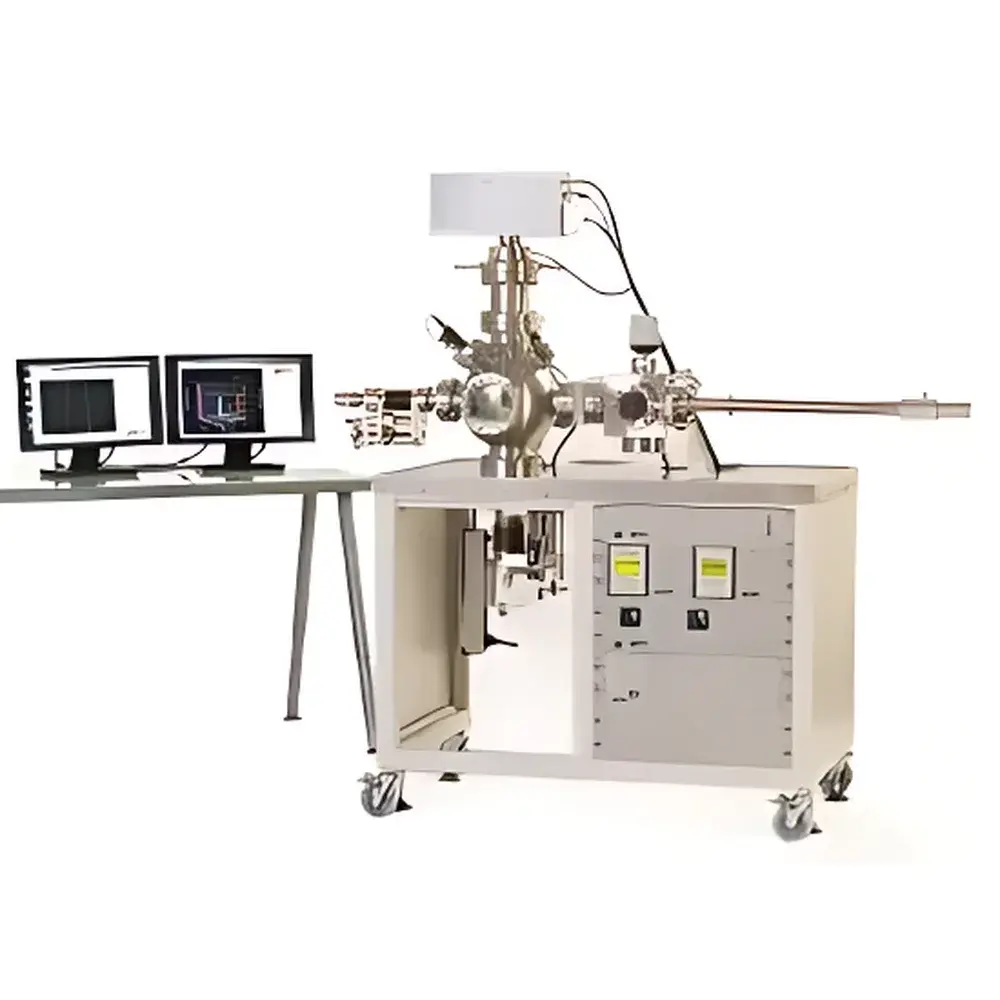
Ultra-High Vacuum TPD Workstation (Hiden 3F/PIC)
| Origin | UK |
|---|---|
| Manufacturer Type | Authorized Distributor |
| Origin Category | Imported |
| Model | TPD Workstation |
| Pricing | Available Upon Request |
| Vacuum System | Integrated UHV-compatible pumping station with viewport and programmable sample heating stage |
| Mass Spectrometer | Hiden 3F/PIC triple-filter quadrupole mass spectrometer with pulsed ion counting detection |
| Mass Range | 1–300, 510, or 1000 amu (user-selectable) |
| Data Acquisition Rate | >500 data points/second |
| Maximum Sample Temperature | 1000 °C |
| Automation | Sealed, motorized autosampler |
| Software | Integrated TPD control suite with real-time temperature ramping, peak integration, spectral deconvolution, and time-resolved desorption profiling |
Overview
The Ultra-High Vacuum TPD Workstation (Hiden 3F/PIC) is a fully integrated surface science instrumentation platform engineered for quantitative thermal desorption spectroscopy (TDS) under ultra-high vacuum (UHV) conditions—typically <1×10⁻⁹ mbar. It combines a UHV-compatible vacuum chamber with a high-stability, resistively heated sample stage, optical viewport for in situ visual monitoring, and a high-sensitivity, fast-response quadrupole mass spectrometer featuring pulsed ion counting (PIC) technology. The system operates on the fundamental principle of controlled temperature-programmed desorption: adsorbed species on catalytic, metallic, or functionalized surfaces are thermally activated and released as gaseous fragments, which are then ionized, mass-filtered, and quantified in real time. This enables precise determination of adsorption binding energies, surface coverage, desorption kinetics (e.g., zeroth-, first-, or second-order), and reaction intermediates—critical parameters in heterogeneous catalysis, thin-film deposition, hydrogen storage material characterization, and surface reaction mechanism studies.
Key Features
- UHV-capable pumping station with all-metal seals, turbomolecular pump, and ion getter pump—ensuring base pressure ≤5×10⁻¹⁰ mbar after bake-out
- Programmable sample heating stage with closed-loop PID control, calibrated up to 1000 °C (±1 °C accuracy) and ramp rates from 0.1 to 50 °C/min
- Hiden 3F/PIC quadrupole mass spectrometer: triple-stage mass filter architecture minimizes background noise and enhances signal-to-noise ratio; pulsed ion counting enables sub-femtoamp detection sensitivity and linear dynamic range exceeding 106
- Mass resolution: M/ΔM ≥ 300 at 10% valley definition across full mass range (1–300 / 510 / 1000 amu)
- Sealed, motorized autosampler capable of sequential analysis of up to 12 pre-loaded samples without venting the main chamber
- Real-time data acquisition at >500 spectra per second, supporting transient desorption event capture and high-temporal-resolution kinetic modeling
Sample Compatibility & Compliance
The workstation accommodates standard sample geometries—including 10 mm diameter disc electrodes, TEM grid-mounted nanomaterials, and sputter-deposited thin films on single-crystal substrates. Sample holders are compatible with common UHV feedthroughs (e.g., K-type thermocouples, low-noise heater leads). All vacuum components conform to ASTM E577-22 (Standard Practice for Calibration of Surface Analytical Instruments) and ISO 14644-1 Class 4 cleanroom assembly protocols. The system supports GLP-compliant operation via audit-trail-enabled software logging (timestamped parameter changes, calibration events, and raw data file generation), and meets essential requirements for FDA 21 CFR Part 11 readiness when deployed in regulated R&D environments.
Software & Data Management
The proprietary TPD Control Suite provides a unified interface for experiment design, instrument orchestration, and post-acquisition analysis. Users define multi-step temperature programs (ramp-hold-cool cycles), assign mass channels for simultaneous monitoring of multiple fragments (e.g., H2+, CO+, CH4+, H2O+), and trigger synchronized data capture. Built-in algorithms perform baseline correction, peak integration using Gaussian-Lorentzian fitting, spectral deconvolution for overlapping signals (e.g., CO vs. N2 at m/z = 28), and Redhead analysis for activation energy estimation. Raw data exports to ASCII, CSV, and HDF5 formats; processed results integrate seamlessly with MATLAB, Python (via h5py), and OriginLab for advanced kinetic modeling (e.g., Polanyi-Wigner formalism).
Applications
- Quantitative evaluation of catalyst poisoning mechanisms (e.g., sulfur or carbonaceous deposit desorption profiles on Pt/Al2O3)
- Hydrogen spillover and recombination kinetics on metal–support interfaces
- Surface diffusion barriers and island coalescence behavior in epitaxial growth studies
- Decomposition pathways of MOFs and COFs under thermal stress
- Adsorbate–substrate bond strength mapping for battery electrode interphases (SEI/CEI)
- Calibration transfer between UHV-TDS and ambient-pressure XPS or AP-XPS experiments
FAQ
What vacuum level can the system achieve, and how is it verified?
Base pressure ≤5×10⁻¹⁰ mbar is attainable after standard 12-hour bake-out at 150 °C; verified using a calibrated Bayard–Alpert gauge and residual gas analyzer (RGA) scan.
Is the mass spectrometer capable of detecting isotopic ratios?
Yes—the 3F/PIC’s mass resolution and stability support isotopic differentiation (e.g., D2 vs. H2 at m/z = 4 and 2, or 13CO vs. 12C18O at m/z = 29) with <1 amu peak separation.
Can the system be upgraded for coupling with synchrotron-based techniques?
The chamber includes standard DN63CF ports and alignment fiducials, enabling straightforward integration with external photon beamlines for time-resolved photoelectron spectroscopy (TR-PES) or near-ambient pressure XPS (NAP-XPS).
Does the software support automated batch processing of multiple TPD runs?
Yes—scriptable workflows allow unattended execution of multi-sample sequences, including auto-calibration, background subtraction, and standardized peak area reporting per sample.
What maintenance intervals are recommended for the ion source and detector?
Under typical usage (≤1000 hrs/year), the filament requires replacement every 18–24 months; the PIC detector exhibits >5-year service life with periodic gain calibration every 6 months.





