
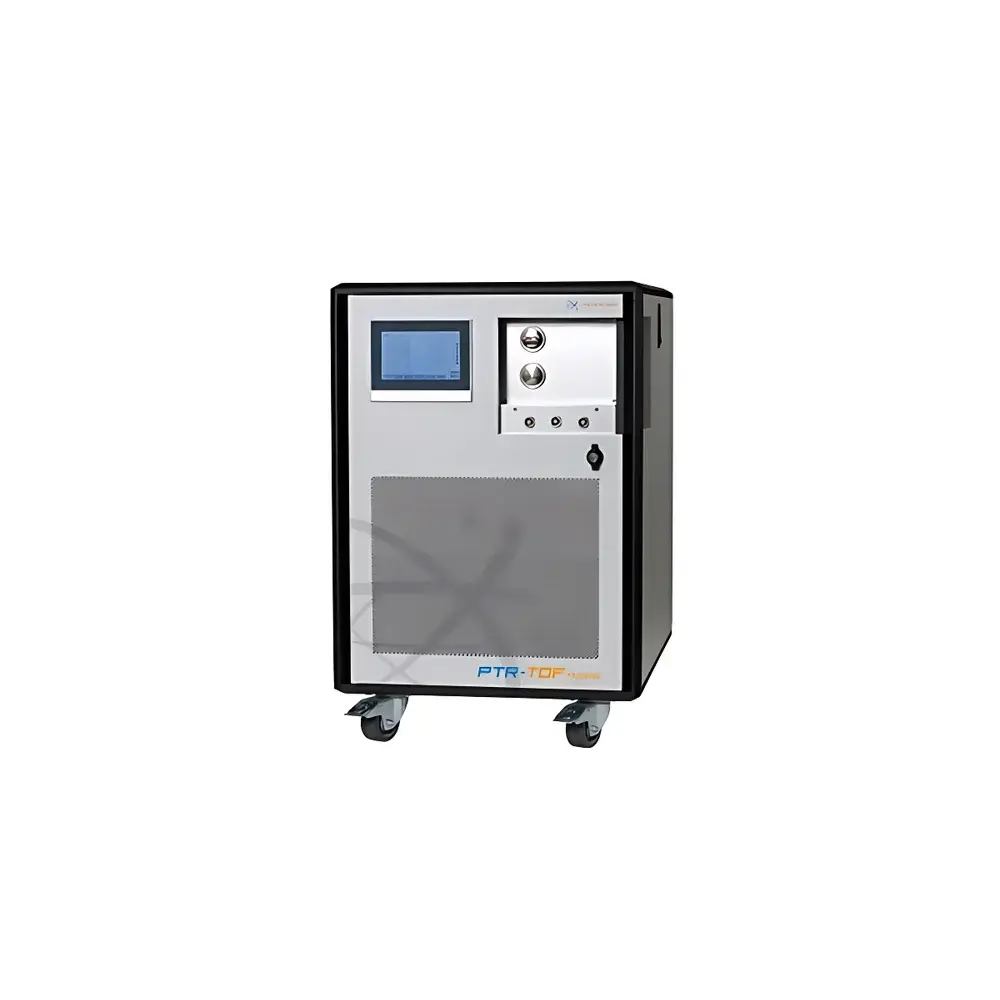
Ionicon PTR-TOF 4000 High-Resolution Proton-Transfer-Reaction Time-of-Flight Mass Spectrometer
| Origin | Austria |
|---|---|
| Manufacturer Type | Authorized Distributor |
| Origin Category | Imported Instrument |
| Model | PTR-TOF 4000 |
| Pricing | Upon Request |
Overview
The Ionicon PTR-TOF 4000 is a compact, high-performance proton-transfer-reaction time-of-flight mass spectrometer engineered for real-time, quantitative analysis of volatile organic compounds (VOCs) in the gas phase at ultra-trace concentrations. It operates on the principle of soft chemical ionization via hydronium (H3O+) reagent ions, enabling near-fragment-free molecular ion formation with minimal in-source decomposition. Coupled with a high-resolution orthogonal acceleration time-of-flight (oa-TOF) mass analyzer and hexapole-based ion optics, the system achieves mass resolution >4500 (FWHM at m/z 200), sub-100 ms response time, and detection limits below 1 pptv (parts-per-trillion by volume) for many VOCs. Its integrated design maintains the same footprint and weight as the PTR-TOF 1000—facilitating deployment in mobile laboratories, field measurement campaigns, cleanroom environments, and fixed-site atmospheric monitoring stations—without compromising analytical performance.
Key Features
- Compact, benchtop-optimized architecture with identical dimensions to the PTR-TOF 1000—ideal for space-constrained labs and transportable platforms
- Hexapole ion guide for efficient ion transmission and improved signal-to-noise ratio across broad mass ranges
- TRU-E/N™ multi-reagent-ion source supporting H3O+, NH4+, NO+, and O2+—enabling selective ionization, isomer differentiation, and expanded compound coverage (e.g., carbonyls, nitrates, amines)
- Real-time operation with <100 ms temporal resolution—suitable for eddy-covariance flux measurements, breath-by-breath analysis, and rapid process monitoring
- No sample preconcentration or derivatization required; direct ambient air or headspace injection ensures quantitative fidelity and eliminates memory effects
- Robust vacuum architecture with turbomolecular pumping and active pressure regulation for stable long-term operation under variable environmental conditions
Sample Compatibility & Compliance
The PTR-TOF 4000 accepts gaseous samples directly from ambient air, breath, reactor effluents, or headspace above solids/liquids—compatible with standard 1/4″ Swagelok or PTFE tubing interfaces. When coupled with optional accessories—including the CHARON aerosol inlet, Fast GC module, or LCU liquid calibration unit—it extends quantification capability to particulate-phase organics, structural isomers, and aqueous-phase VOCs. The instrument meets key regulatory and methodological frameworks: data acquisition supports audit-trail-enabled operation compliant with FDA 21 CFR Part 11 when used with certified software configurations; spectral output aligns with EPA TO-15/TO-17 compound identification criteria; and routine calibration protocols conform to ISO/IEC 17025 traceability requirements for environmental testing laboratories.
Software & Data Management
Control and data processing are managed through the proprietary TOF-DAQ v4.x platform, which provides synchronized acquisition of mass spectra, analog sensor inputs (T, P, RH), and external trigger signals. Real-time peak integration uses centroid-based algorithms with dynamic background subtraction and isotopic pattern deconvolution. Export formats include mzML (for ProteoSAFe, GNPS), NetCDF, and CSV—ensuring interoperability with open-source tools (e.g., RMassBank, MZmine) and commercial chemometric suites. All raw and processed datasets retain full metadata (ionization mode, dwell time, calibration coefficients, instrument state logs), satisfying GLP/GMP documentation standards for regulated research environments.
Applications
- Atmospheric chemistry: Online monitoring of biogenic and anthropogenic VOCs, OH-radical reactivity studies, and secondary organic aerosol (SOA) precursor quantification
- Human health & exposomics: Exhaled breath profiling for disease biomarker discovery (e.g., lung cancer, asthma, metabolic disorders) using BET interface
- Food & flavor science: Real-time release kinetics of aroma compounds during processing, packaging, or sensory evaluation
- Industrial emissions control: Fenceline monitoring of fugitive VOC sources, stack testing, and catalyst efficiency assessment
- Materials science: Off-gassing characterization of polymers, adhesives, coatings, and electronic components per ASTM D6886 and ISO 16000-9
- Plant physiology: Emission dynamics of stress-induced volatiles (e.g., isoprene, monoterpenes) under controlled-environment chambers
FAQ
What is the mass resolution specification, and how is it measured?
Resolution is defined as m/Δm (FWHM) at m/z 200 and exceeds 4500 under standard operating conditions with H3O+ chemistry.
Can the PTR-TOF 4000 quantify isomeric compounds?
Yes—when interfaced with the optional Fast GC module, chromatographic separation precedes ionization, enabling unambiguous distinction of structural isomers such as α-pinene vs. β-pinene or ortho-/para-xylene.
Is the system compatible with automated sampling workflows?
Yes—the AutoSampler option supports up to 270 vial positions for solid/liquid headspace analysis, with programmable thermal desorption and pressure-controlled injection sequences.
Does Ionicon provide application-specific method development support?
Yes—customers receive access to Ionicon’s Application Support Team, including method optimization, spectral library curation (NIST, MoNA, MassBank), and validation documentation aligned with ISO/IEC 17025 requirements.
What maintenance intervals are recommended for routine operation?
Ion source cleaning is recommended every 3–6 months depending on sample matrix; turbomolecular pump oil replacement every 12 months; and annual calibration verification using certified gas standards traceable to NIST SRMs.







