
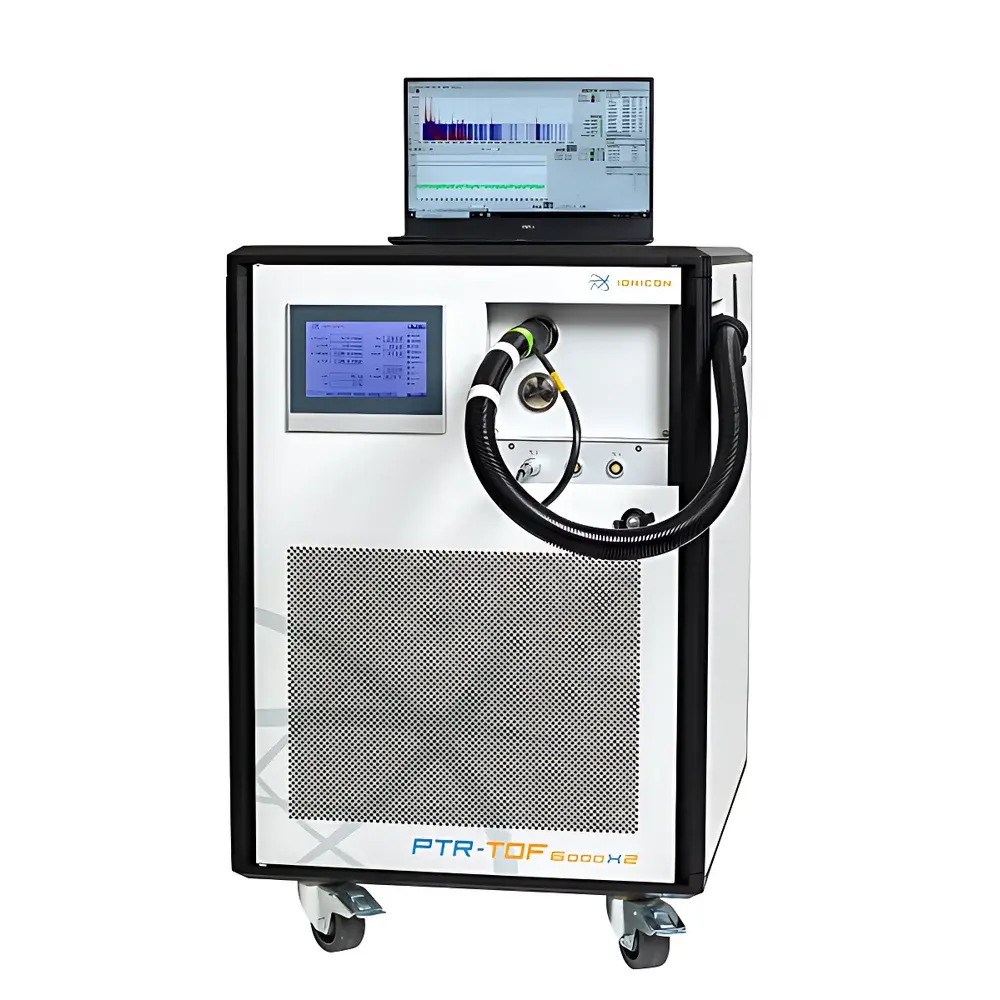
IONICON PTR-TOF 6000X2 High-Performance Online VOCs Analyzer
| Brand | IONICON Analytik GmbH |
|---|---|
| Origin | Austria |
| Model | PTR-TOF 6000X2 |
| Detection Limit | < 1 pptv |
| Sensitivity | > 2000 cps/ppbv |
| Mass Resolution | > 6000 (m/Δm, FWHM) |
| Ionization Modes | H₃O⁺, NO⁺, O₂⁺, NH₄⁺ |
| Response Time | < 100 ms |
| Ion Optics | ION-BOOSTER ion funnel + hexapole ION-GUIDE |
| Mass Analyzer | high-resolution iTOF (ion time-of-flight) |
| Optional Modules | SRI, Fast GC, AutoSampler (270-position), Multiplexing inlet, CHARON, LCU, BET |
| Compliance | Designed for GLP/GMP-aligned workflows |
Overview
The IONICON PTR-TOF 6000X2 is a high-sensitivity, real-time online volatile organic compound (VOC) analyzer based on proton-transfer-reaction time-of-flight mass spectrometry (PTR-TOF MS). Engineered for continuous, quantitative trace-gas analysis in ambient air, industrial emissions, breath, and headspace applications, it delivers sub-pptv detection limits with millisecond-level temporal resolution. Its core measurement principle relies on soft chemical ionization via controlled proton transfer from H₃O⁺ (and optionally NO⁺, O₂⁺, or NH₄⁺) reagent ions to analyte molecules—minimizing fragmentation and preserving molecular ion signals for unambiguous identification. Coupled with a high-resolution ion time-of-flight (iTOF) mass analyzer (>6000 m/Δm at FWHM), the system enables accurate mass determination (<2 ppm mass error), critical for distinguishing isobaric species and assigning elemental compositions in complex matrices.
Key Features
- ION-BOOSTER ion funnel and hexapole ION-GUIDE optics: Enhance ion transmission efficiency and signal stability across broad mass ranges, especially for low-abundance, high-mass VOCs.
- TRU-E/N™ reagent ion source: Delivers stable, tunable H₃O⁺, NO⁺, O₂⁺, and NH₄⁺ ion beams—expanding compound coverage beyond conventional PTR-MS capabilities (e.g., carbonyls, alkenes, nitrates, amines).
- Real-time response: Sub-100 ms duty cycle enables dynamic process monitoring, including turbulent eddy-covariance flux measurements and rapid breath-by-breath profiling.
- Zero-sample-prep operation: Direct ambient air or gas-phase sampling eliminates derivatization, preconcentration, or thermal desorption steps—reducing analytical bias and operational complexity.
- Modular architecture: Supports field-upgradable add-ons including SRI (switchable reagent ion source), Fast GC (for isomer separation), 270-position AutoSampler (for solid/liquid emission screening), multiplexed multi-inlet systems, CHARON (aerosol-phase VOC extraction), LCU (liquid-phase calibration and aqueous VOC quantification), and BET (breath-exhaled VOC analysis).
Sample Compatibility & Compliance
The PTR-TOF 6000X2 accepts gaseous samples directly from ambient air, stack emissions, bioreactor headspace, human breath (via heated tubing and moisture management), and calibrated standard gas mixtures. With optional CHARON and LCU modules, it extends compatibility to aerosol-bound organics (e.g., SOA components) and dissolved VOCs in water or biological fluids. The instrument’s design aligns with fundamental requirements of Good Laboratory Practice (GLP) and Good Manufacturing Practice (GMP) environments: hardware timestamps, audit-trail-capable firmware logging, and deterministic data acquisition ensure traceability. When deployed with validated third-party LIMS or ELN integrations and appropriate procedural controls, it meets functional expectations for data integrity under FDA 21 CFR Part 11 and EU Annex 11 frameworks.
Software & Data Management
Controlled via TOF-DAQ v4.x software, the system provides synchronized acquisition, real-time mass spectral visualization, and automated peak integration using exact mass filtering. Raw data are stored in open-format HDF5 files containing full metadata (pressure, temperature, drift time, ion counts, calibration parameters). Export options include CSV, mzML, and netCDF for downstream processing in R, Python (e.g., via PyOpenMS or SciPy), or commercial platforms such as MATLAB or SIMCA. Batch processing scripts support routine calibration verification, drift correction, and isotopic pattern matching. For regulated environments, optional software validation packages—including IQ/OQ documentation, electronic signature support, and change control logs—are available upon request.
Applications
- Ambient air quality monitoring: Real-time tracking of aromatic hydrocarbons, oxygenated VOCs (OVOCs), and biogenic emissions (isoprene, monoterpenes) at urban, rural, and forest sites.
- Industrial process control: Leak detection, solvent emission verification, and catalyst performance assessment in pharmaceutical, petrochemical, and coating manufacturing.
- Human exposure & health research: Quantitative breath metabolomics for biomarker discovery (e.g., acetone in diabetes, aldehydes in oxidative stress, limonene in fragrance exposure).
- Atmospheric chemistry: Lab-based reaction kinetics studies, chamber experiments, and field campaigns requiring speciated VOC time series with high mass accuracy.
- Food & flavor science: Headspace profiling of fermentation volatiles, shelf-life degradation markers, and authenticity screening via fingerprint mass spectra.
FAQ
What reagent ions are supported, and how are they selected?
The TRU-E/N™ source generates H₃O⁺ by default; NO⁺, O₂⁺, and NH₄⁺ are activated via voltage tuning and gas composition control—no hardware swaps required.
Can the system quantify VOCs without external calibration standards?
Yes—absolute quantification is possible using theoretical reaction rate constants and instrument sensitivity factors; however, for highest accuracy (±10%), calibrated standard gases or permeation tubes are recommended.
Is the PTR-TOF 6000X2 suitable for regulatory compliance reporting?
It is widely used in research-grade monitoring networks and method development; for legally binding emissions reporting, pairing with certified reference methods (e.g., EPA TO-15 or EN 14662) and site-specific validation is advised.
How does the AutoSampler interface with the PTR-TOF core?
The 270-position autosampler uses programmable thermal desorption and carrier gas purging to deliver headspace vapors directly into the drift tube—fully synchronized with TOF-DAQ acquisition and retention time indexing.
What maintenance intervals are recommended for long-term unattended operation?
Ion source cleaning every 3–6 months (depending on sample matrix), TOF reflectron vacuum check quarterly, and annual recalibration of mass axis and sensitivity—documented in the provided maintenance logbook.
Related Products







