
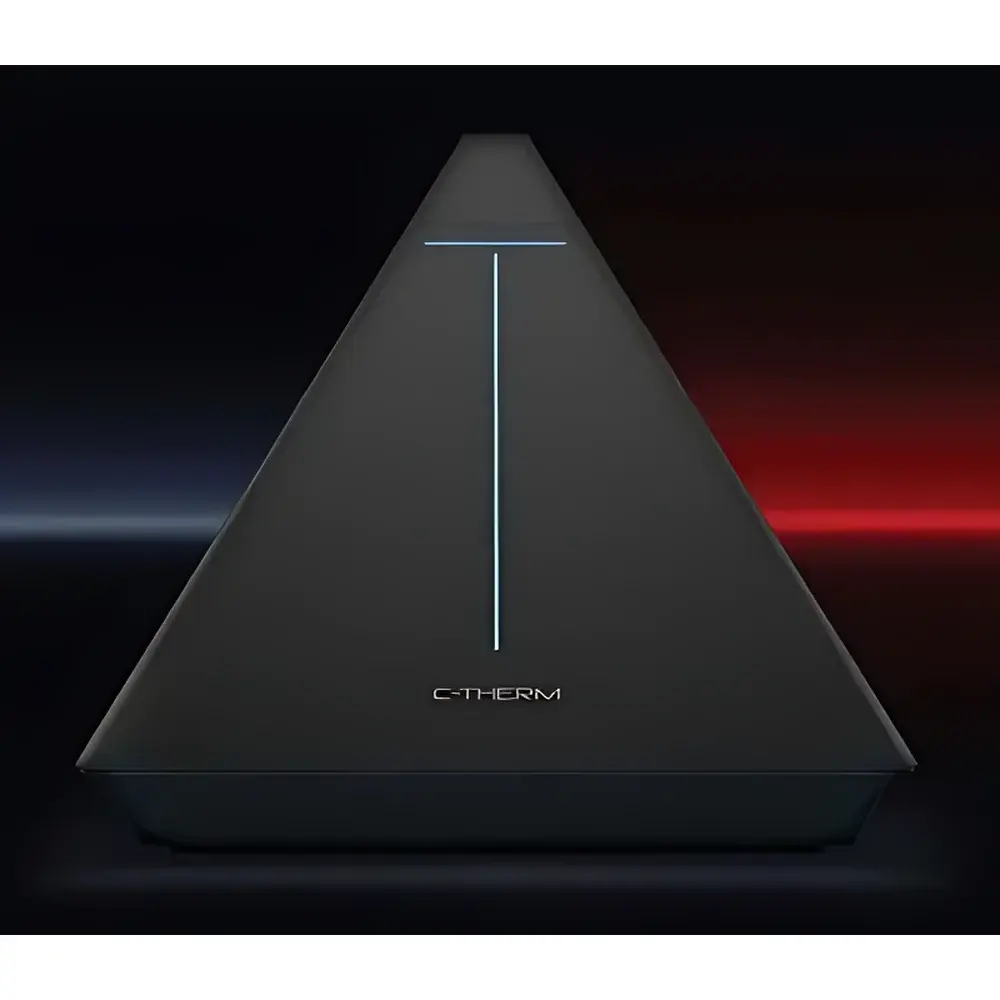
C-Therm Trident Tri-Method Thermal Conductivity Analyzer
| Origin | Canada |
|---|---|
| Manufacturer Type | Distributor |
| Origin Category | Imported |
| Model | Trident |
| Price Range | USD 65,000–105,000 |
| Instrument Type | Transient Plane Source (TPS) / Flexible TPS / Transient Line Source (TLS) |
| Dimensions (L×W×H) | 300 × 300 × 212 mm |
| Accuracy | ±1% |
| Thermal Conductivity Range | 0–500 W/(m·K) |
| Repeatability | High |
Overview
The C-Therm Trident Tri-Method Thermal Conductivity Analyzer is an engineered platform for high-fidelity thermal property characterization across diverse material classes. Unlike conventional single-principle instruments, the Trident integrates three complementary transient measurement methodologies—Modified Transient Plane Source (MTPS), Flexible Transient Plane Source (FLEX TPS), and Transient Line Source (TLS Needle)—within a unified hardware and software architecture. This tri-method design enables rigorous cross-validation of thermal conductivity (k) values under varying physical constraints: MTPS delivers rapid, surface-contact measurements ideal for thin films and soft solids; FLEX TPS accommodates irregular, curved, or low-conductivity surfaces with conformal sensor deployment; TLS Needle provides deep volumetric penetration for liquids, gels, powders, and heterogeneous composites. All methods operate on the principle of transient heat diffusion, where a known energy pulse is applied to a sensor element, and the resulting temperature rise over time is analyzed using Fourier-based inverse modeling to extract k. The system is calibrated against NIST-traceable reference materials and validated per ASTM D5334, ISO 22007-2, and ISO 22007-4 standards.
Key Features
- Tri-method measurement architecture supporting MTPS, FLEX TPS, and TLS Needle protocols in one instrument
- Operating temperature range: −50 °C to +200 °C (standard probe); optional high-temperature probes extend capability to +500 °C
- High-pressure compatibility: up to 2000 PSI for in-situ testing of compressed powders, foams, and thermally loaded interfaces
- No sample preparation required—measurements performed directly on as-received materials regardless of geometry or mechanical integrity
- Non-destructive operation: no cutting, polishing, or embedding necessary; preserves sample microstructure and functional state
- Compact benchtop footprint (300 × 300 × 212 mm) with robust aluminum chassis and ESD-safe enclosure
- Self-referencing sensor calibration—no external standardization or periodic recalibration needed
Sample Compatibility & Compliance
The Trident supports unmodified testing of solids (metals, ceramics, polymers, composites), liquids (coolants, oils, nanofluids), semi-solids (gels, pastes, phase-change materials), powders (metallic, ceramic, organic), and porous media (aerogels, foams, geological cores). Its modular probe system eliminates geometric restrictions—samples ranging from 10 cm³ can be characterized without adaptation. All measurement modes comply with internationally recognized thermal transport testing standards, including ASTM D5334 (TPS for soils and solids), ASTM D7896 (TLS for liquids), ISO 22007-2 (TPS for plastics), and ISO 22007-4 (TLS for liquids and soft solids). Data acquisition and reporting support GLP/GMP traceability requirements, including full audit trails, user authentication, and electronic signature compliance per FDA 21 CFR Part 11 when configured with optional secure software modules.
Software & Data Management
TridentControl™ v4.x is a Windows-based application providing real-time visualization, automated protocol selection, and multi-parameter analysis. It features embedded uncertainty quantification based on signal-to-noise ratio, thermal diffusivity estimation, and volumetric heat capacity derivation. Raw time-temperature data are stored in HDF5 format with metadata tagging (operator ID, environmental conditions, probe type, pressure/temperature setpoints). Export options include CSV, Excel, and PDF reports compliant with ISO/IEC 17025 documentation frameworks. Batch processing, statistical comparison across sample sets, and trend monitoring for QC applications are supported. Optional cloud synchronization enables centralized instrument fleet management and remote diagnostics.
Applications
- Thermal interface material (TIM) qualification for semiconductor packaging and power electronics
- Phase-change material (PCM) performance validation across melt/freeze cycles
- Insulation efficacy assessment of aerogels, mineral wool, and vacuum panels
- Thermal stability screening of energetic materials (propellants, explosives) under controlled thermal stress
- Process optimization of polymer extrusion and additive manufacturing via in-line thermal feedback
- Geothermal reservoir simulation using core samples under representative pressure-temperature conditions
- Functional textile development—measuring thermal buffering in smart fabrics and flame-retardant laminates
- Nanocomposite R&D—quantifying percolation thresholds and interfacial phonon scattering effects
FAQ
Does the Trident require routine calibration using reference standards?
No—each sensor incorporates integrated thermal reference elements and self-compensating circuitry. Calibration is performed automatically during system startup and does not rely on external reference materials.
Can the Trident measure anisotropic materials?
Yes—by orienting the TLS needle or MTPS sensor along principal axes and comparing directional k-values, the system supports basic anisotropy mapping when combined with rotational sample stages (optional accessory).
Is TLS Needle mode suitable for highly viscous fluids?
Yes—the needle probe design minimizes convective interference and maintains stable thermal contact even in viscosities up to 10⁴ Pa·s, provided the fluid remains static during the 1–10 second measurement window.
What environmental controls integrate with the Trident platform?
C-Therm offers certified accessories including Peltier-controlled thermal chambers (−70 °C to +300 °C), pneumatic compression cells (0–2000 PSI), and humidity-controlled glove boxes (10–95% RH, ±1% control), all programmable via TridentControl™ API.
How is data integrity ensured for regulated environments?
With the Secure Mode add-on, the system enforces role-based access control, immutable audit logs, electronic signatures, and encrypted data-at-rest—fully aligned with FDA 21 CFR Part 11 and EU Annex 11 requirements.



