
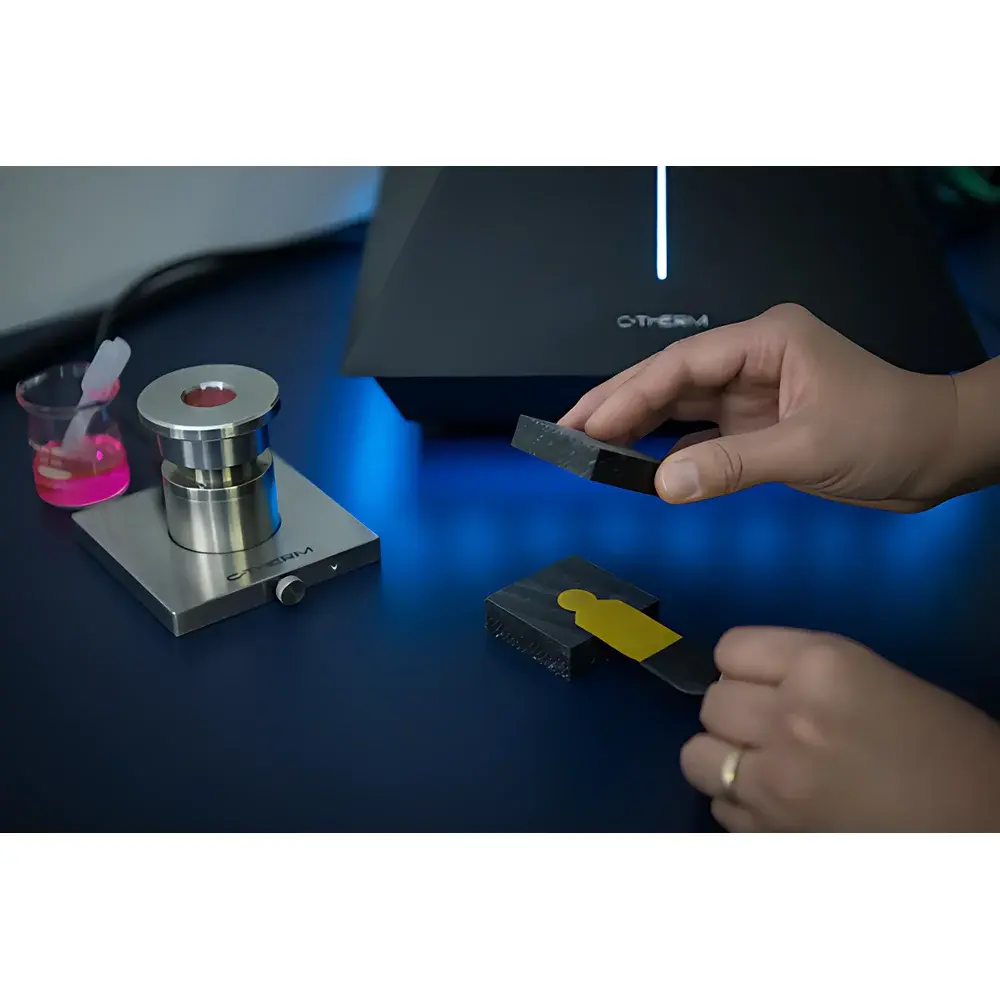
C-Therm Trident TPS Thermal Conductivity Analyzer
| Brand | C-Therm |
|---|---|
| Origin | Canada |
| Model | Trident TPS |
| Measurement Principle | Transient Plane Source (TPS) |
| Dimensions (L×W×H) | 40 × 40 × 40 cm |
| Accuracy | < 5% |
| Thermal Conductivity Range | 0 – 2000 W/m·K |
| Thermal Diffusivity Range | 0 – 1200 mm²/s |
| Specific Heat Capacity Range | 0 – 5 MJ/m³·K |
| Effusivity Range | 0 – 40,000 W·s⁰·⁵/m²·K |
| Repeatability | < 1% |
| Test Duration | 0.8 – 180 s |
| Compliance | ISO 22007-2:2015, GB/T 32064-2015 |
Overview
The C-Therm Trident TPS Thermal Conductivity Analyzer is a modular, benchtop instrument engineered for high-precision, non-destructive thermal property characterization of diverse materials using the transient plane source (TPS) method. Based on the well-established theory of transient heat conduction in solids and fluids, the system applies a known amount of energy to a thin, electrically resistive sensor acting simultaneously as both heater and temperature sensor. The time-dependent temperature rise at the sensor–sample interface is recorded and inverted using analytical solutions to Fourier’s heat equation, enabling simultaneous determination of thermal conductivity (λ), thermal diffusivity (α), volumetric specific heat capacity (ρcp), and thermal effusivity (e). Unlike steady-state techniques requiring long equilibration times, the TPS method delivers results in under 3 minutes—making it ideal for rapid screening, quality control, and R&D workflows where throughput and minimal sample preparation are critical.
Key Features
- Triple-method platform supporting Flex TPS (flexible dual-sided sensor), MTPS (modified transient plane source), and TLS (transient line source/needle probe) configurations—enabling optimal measurement geometry for solids, powders, pastes, liquids, thin films, and anisotropic composites.
- Modular sensor architecture with interchangeable probes: standard rigid TPS discs for bulk materials; ultra-thin flexible TPS sensors for curved, irregular, or low-contact-area surfaces; TLS needle probes for soft solids, gels, and in-situ measurements.
- Full parameter control via intuitive software interface: user-defined heating power (0.01–100 mW), test duration (0.8–180 s), and data acquisition rate (up to 10 kHz), ensuring method optimization across material classes.
- Built-in environmental compensation algorithms correct for ambient drift and contact resistance effects, contributing to <1% repeatability and <5% accuracy across the full 0–2000 W/m·K range.
- Rugged aluminum chassis (40 × 40 × 40 cm) with EMI-shielded electronics, designed for stable operation in shared lab environments without dedicated climate control.
Sample Compatibility & Compliance
The Trident accommodates a broad spectrum of physical forms—including rigid and compliant solids, granular powders, dispersions, emulsions, aerogels, foams, laminated composites, and anisotropic layered structures. Dedicated fixtures support standardized testing of thin films (<100 µm) and plates per ISO 22007-2:2015 Annex D and GB/T 32064-2015. All measurement protocols adhere to the fundamental assumptions of the TPS model: homogeneous, isotropic, infinite medium approximation—valid for samples ≥3× sensor radius in lateral dimension and ≥2× sensor thickness in depth. For anisotropic materials, directional measurements (in-plane vs. through-plane) are enabled using orientation-specific sensor mounting kits. Instrument validation includes traceable NIST SRM reference materials (e.g., Pyroceram 9606, graphite, stainless steel), and raw data files retain full metadata required for GLP/GMP audit trails.
Software & Data Management
Trident Control Software (v5.x) provides real-time visualization of temperature transients, automatic curve fitting using Levenberg–Marquardt nonlinear regression, and uncertainty propagation based on sensor calibration coefficients and noise statistics. Export formats include CSV, Excel, and HDF5 for integration with LIMS or statistical process control platforms. The software supports 21 CFR Part 11-compliant user access levels (Administrator, Technician, Viewer), electronic signatures, and immutable audit logs recording all parameter changes, calibration events, and result approvals. Batch processing mode enables unattended sequential analysis of up to 99 samples with auto-generated PDF reports containing raw curves, fitted parameters, confidence intervals, and compliance statements.
Applications
- Thermal interface material (TIM) qualification for EV battery packs and power electronics packaging.
- Quality assurance of ceramic matrix composites (CMCs) and carbon-carbon materials used in aerospace thermal protection systems.
- Development of phase-change materials (PCMs) and thermally conductive polymer blends for electronics thermal management.
- Characterization of geological cores, soil simulants, and lunar regolith analogs in planetary science research.
- Validation of thermal models in multiphysics simulation suites (e.g., COMSOL, ANSYS) via direct experimental input of λ, α, and ρcp.
FAQ
What standards does the Trident TPS comply with?
The system implements measurement protocols fully aligned with ISO 22007-2:2015 (Plastics — Determination of thermal conductivity and thermal diffusivity — Part 2: Transient plane heat source (hot disc) method) and GB/T 32064-2015 (Determination of thermal conductivity of solid materials — Transient plane source method).
Can the Trident measure anisotropic materials?
Yes—using optional directional sensor mounts and orthogonal test orientations, users can quantify in-plane and through-plane thermal conductivity independently, with uncertainty budgets accounting for sample alignment tolerances.
Is calibration traceable to national standards?
All factory calibrations are performed using NIST-traceable reference materials, and each instrument ships with a certificate of calibration including uncertainty statements per ISO/IEC 17025 requirements.
What sample preparation is required?
Minimal preparation is needed: flat, clean surfaces for rigid TPS; light clamping or adhesive-assisted contact for flexible TPS; insertion into soft media for TLS. No vacuum chamber or furnace is required.
How is data integrity ensured for regulated environments?
Audit trail logging, role-based access control, electronic signature capability, and exportable raw data with embedded timestamps satisfy FDA 21 CFR Part 11, EU Annex 11, and ISO 13485 documentation requirements.



