
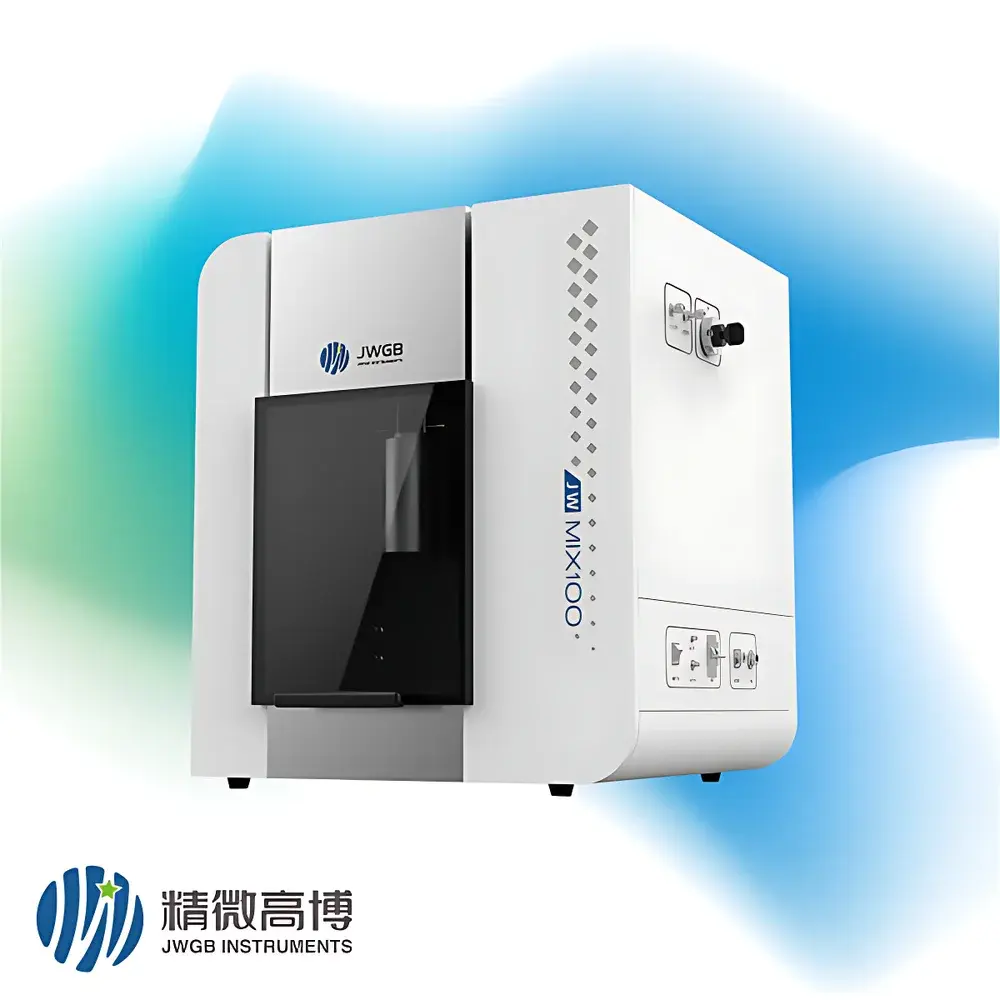
JWGB JW-MIX100 Multicomponent Competitive Adsorption and Breakthrough Curve Analyzer
| Brand | JWGB |
|---|---|
| Origin | Beijing, China |
| Manufacturer Type | Direct Manufacturer |
| Product Category | Domestic |
| Model | JW-MIX100 |
| Gas Range | Customizable |
| Mass Flow Controllers (MFCs) | 4 units |
| Column Configuration | Customizable breakthrough columns |
| Maximum Adsorption Pressure | 100 bar |
| Detector | Thermal Conductivity Detector (TCD) |
Overview
The JWGB JW-MIX100 Multicomponent Competitive Adsorption and Breakthrough Curve Analyzer is a precision-engineered benchtop system designed for quantitative dynamic adsorption characterization under controlled gas-phase flow conditions. It operates on the fundamental principles of frontal chromatography and transient-state mass balance, enabling high-fidelity measurement of breakthrough curves, competitive adsorption equilibria, intraparticle diffusion coefficients, and surface residence times in microporous and mesoporous adsorbents. The instrument integrates four independently calibrated mass flow controllers (MFCs) to deliver precise, programmable multicomponent gas mixtures—enabling true co-adsorption, displacement, and selectivity studies under industrially relevant pressure conditions up to 100 bar. Its modular column design supports customizable bed geometry, packing density, and thermal management configurations, ensuring compatibility with zeolites, MOFs, activated carbons, silica gels, and other advanced sorbent materials.
Key Features
- Four-channel MFC system with ±0.5% full-scale accuracy and sub-second response time for reproducible multicomponent gas blending and step-change experiments
- High-pressure breakthrough column manifold rated to 100 bar, compatible with stainless-steel, Hastelloy, or quartz-lined configurations for corrosive or high-purity applications
- Integrated TCD detector with temperature-stabilized reference and sensing cells, offering baseline stability < 0.1 mV/hour and detection limit of 10 ppm (v/v) for common permanent gases (N₂, CO₂, CH₄, H₂, O₂)
- Zero-Length Column (ZLC) mode implemented via rapid valve switching and ultra-short bed configuration—validated per ASTM D6879 and ISO 15901-2 for micropore diffusion coefficient determination
- Real-time data acquisition at up to 10 Hz sampling rate, synchronized with flow, pressure, and temperature signals for rigorous mass transfer modeling
- Modular thermal control unit supporting isothermal operation from ambient to 200 °C (±0.1 °C) or programmed ramping profiles for enthalpy-of-adsorption analysis
Sample Compatibility & Compliance
The JW-MIX100 accommodates powdered, pelletized, extruded, or monolithic adsorbent samples ranging from 0.1 to 5 g, with optional in-situ activation modules (vacuum heating, purge gas conditioning). Column internal diameters span 3–25 mm; bed lengths are adjustable between 10–100 mm to optimize Péclet number and axial dispersion effects. All wetted parts comply with ASTM A269 and ASME B31.3 standards. System architecture supports audit-ready operation under GLP and GMP environments: full electronic logbook, user access control, and configurable data integrity settings aligned with FDA 21 CFR Part 11 requirements for traceability and signature validation.
Software & Data Management
Control and analysis are executed via JW-AdsorbPro v4.x software—a Windows-based platform featuring intuitive experiment sequencing, real-time curve overlay, and integrated modeling tools. Built-in solvers support linear driving force (LDF), pore diffusion (PDM), and surface diffusion models (SDM); users may import custom transport equations using Python-compatible scripting interfaces. Raw sensor data is stored in HDF5 format with embedded metadata (timestamp, calibration ID, operator, SOP version). Export options include CSV, Excel, and XML for integration with MATLAB, Aspen Adsorption, or COMSOL Multiphysics. Software validation documentation (IQ/OQ/PQ protocols) and cybersecurity compliance reports (IEC 62443-3-3) are available upon request.
Applications
- Determination of binary/multicomponent selectivity coefficients (e.g., CO₂/N₂, H₂O/CH₄) for carbon capture and natural gas purification process design
- Diffusion coefficient mapping across temperature and loading ranges to validate molecular simulation outputs (GCMC + MD)
- Breakthrough time prediction for PSA and TSA cycle optimization under variable feed composition and pressure swing profiles
- Competitive adsorption hysteresis analysis during co-adsorption of VOCs on functionalized MOFs
- Thermodynamic consistency testing of IAST predictions against experimental multicomponent equilibrium data
- Accelerated aging studies via cyclic breakthrough testing under humidified or sulfur-containing feeds
FAQ
What types of adsorbent materials can be tested on the JW-MIX100?
Powdered, granular, pelletized, or monolithic forms of zeolites, metal–organic frameworks (MOFs), activated carbons, silica gels, alumina, and chemically modified sorbents—provided they are mechanically stable under dynamic gas flow and specified pressure/temperature conditions.
Is zero-length column (ZLC) functionality included as standard or optional?
ZLC mode is fully integrated into the base configuration, requiring only optional short-bed column hardware and valve timing calibration—no additional license or module purchase is required.
Can the system operate under vacuum or inert purge conditions prior to adsorption?
Yes. The manifold includes dedicated vacuum lines (≤10⁻³ mbar) and purge gas inlets, enabling in-situ degassing, thermal activation, and moisture removal prior to dynamic adsorption runs.
Does the software support automated IAST calculations?
Yes. JW-AdsorbPro includes an embedded IAST solver that imports pure-component isotherms (Langmuir, Toth, Sips) and computes predicted multicomponent loadings and selectivities directly from breakthrough-derived equilibrium data.
Are calibration certificates and traceable standards provided with the instrument?
Each system ships with NIST-traceable calibration reports for all MFCs and TCD channels, including uncertainty budgets per ISO/IEC 17025 guidelines. On-site calibration verification services are available globally through JWGB-certified engineers.



