
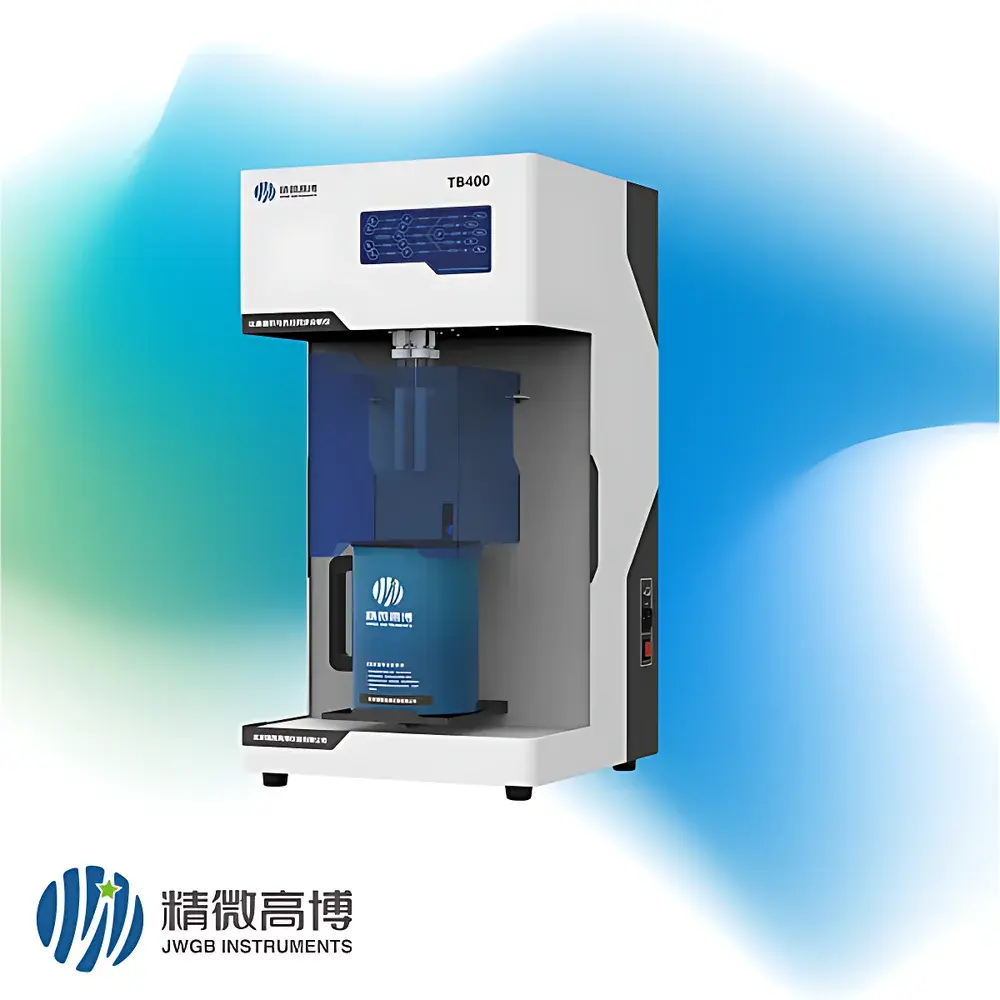
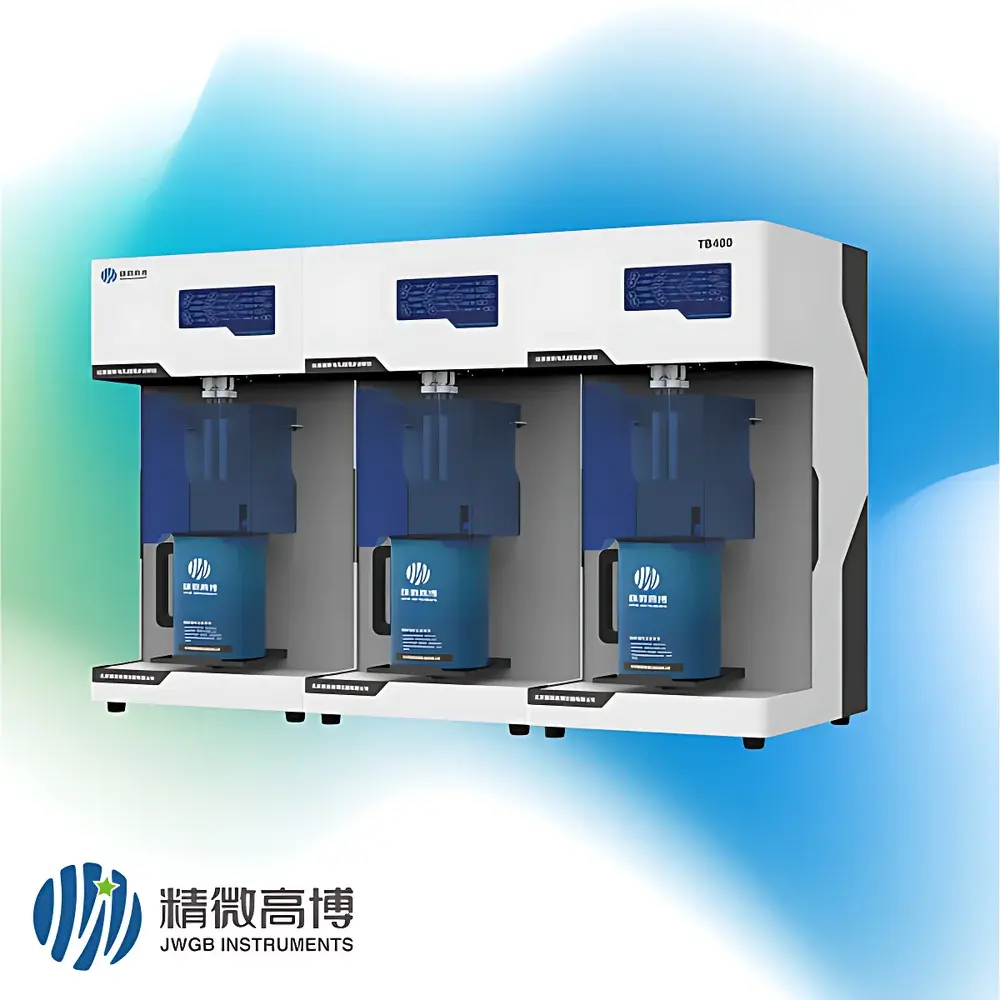
JWGB JW-TB400 Battery R&D Dedicated 12-Station Parallel BET Specific Surface Area Analyzer
| Brand | JWGB |
|---|---|
| Origin | Beijing, China |
| Manufacturer Type | Direct Manufacturer |
| Instrument Category | Domestic |
| Model | JW-TB400 Battery R&D Dedicated BET Specific Surface Area Analyzer (12-Station Parallel) |
| Instrument Type | Specific Surface Area and Pore Size Analyzer |
| Principle | Static Volumetric Gas Adsorption Method |
| Number of Analysis Stations | 12 |
| Specific Surface Area Range | >0.0005 m²/g |
| Pressure Range | 1×10⁻⁵ to 0.998 atm |
| Theoretical Basis | Static Volumetric Adsorption Method |
Overview
The JWGB JW-TB400 Battery R&D Dedicated 12-Station Parallel BET Specific Surface Area Analyzer is an engineered solution for high-throughput, metrologically robust characterization of electrode materials, cathode/anode powders, and porous separators used in lithium-ion, solid-state, and next-generation battery development. It operates on the static volumetric gas adsorption principle—widely accepted as the reference method for specific surface area and pore structure quantification per ISO 9277:2010, ASTM D3663, and IUPAC recommendations. Unlike dynamic (flow) systems, the static volumetric approach ensures thermodynamic equilibrium at each pressure step, enabling precise determination of monolayer capacity, adsorption isotherms, and pore volume distribution across all 12 stations simultaneously. Each station shares a single high-stability cryogenic Dewar and ultra-high-purity gas manifold, eliminating inter-station calibration drift and guaranteeing inter-run reproducibility ≤±1.2% RSD (n=10, N₂ on certified silica gel standard). Designed explicitly for battery R&D labs, the system integrates pre-conditioning protocols compliant with USP and ISO 15901-2 for degassing under controlled temperature ramping and vacuum hold.
Key Features
- 12 independent analysis stations operating in true parallel mode—no sequential scheduling or shared valve timing compromises.
- Integrated dual-stage turbo-molecular vacuum system achieving base pressure <5×10⁻⁷ mbar, ensuring complete removal of physisorbed moisture and contaminants prior to N₂/Ar adsorption.
- High-resolution capacitance manometers (0.01% FS accuracy) calibrated traceably to NIST standards across full pressure range (1×10⁻⁵–0.998 atm).
- Automated sample tube handling with programmable liquid nitrogen level monitoring and auto-refill interface for unattended 72+ hour operation.
- Rugged stainless-steel manifold architecture with electropolished internal surfaces and metal-sealed valves—designed for long-term stability under repeated thermal cycling and aggressive degassing conditions typical of battery active materials.
- Onboard temperature-controlled sample bath (±0.1 °C stability) for accurate thermal compensation during low-pressure adsorption steps.
Sample Compatibility & Compliance
The JW-TB400 accommodates standard 6–12 mm OD glass sample tubes and supports heterogeneous powder matrices including LiCoO₂, NMC, LFP, silicon composites, carbon black, graphene oxide, MOFs, and ceramic electrolytes. All sample preparation workflows align with ISO 15901-1 (gas adsorption methods) and ASTM D4641 (standard practice for degassing). Data acquisition meets ALCOA+ principles: attributable, legible, contemporaneous, original, accurate, and complete. Audit trail functionality records user actions, parameter changes, and instrument state transitions in accordance with FDA 21 CFR Part 11 requirements for regulated battery material qualification studies.
Software & Data Management
JW-Analyzer v5.2 software provides a validated, modular platform for raw isotherm processing, model selection, and report generation. Users select from 14 IUPAC-recognized models—including BET (single/multi-point), Langmuir, t-plot, BJH, HK, SF, DR/DA, NLDFT kernel libraries (carbon, silica, alumina)—with automatic outlier detection and uncertainty propagation. Export formats include ASTM E2919-compliant .csv, .xls, and PDF reports with embedded metadata (instrument ID, operator, timestamp, calibration certificate IDs). Data integrity is enforced via role-based access control, electronic signatures, and encrypted local database storage compatible with enterprise LIMS integration via ODBC.
Applications
- Quantifying specific surface area evolution during cathode calcination and coating processes.
- Correlating BET surface area and mesopore volume (2–50 nm) with rate capability and SEI formation kinetics.
- Validating pore size distribution shifts after electrolyte wetting or cycling-induced structural collapse.
- Screening carbon additives for conductivity network optimization using STSA and micropore volume (t-plot).
- Supporting DOE-driven formulation studies by delivering statistically powered datasets across ≥12 formulations per run.
- Generating GMP-compliant documentation packages for battery material release testing per ISO 17025-accredited QA laboratories.
FAQ
Does the JW-TB400 support argon adsorption at 87 K for microporous carbon characterization?
Yes—software-configurable cryogen selection and temperature-stabilized bath enable full compliance with ISO 15901-2 for Ar@87 K analysis.
Can raw isotherm data be exported for third-party NLDFT modeling outside the native software?
Yes—unprocessed adsorption/desorption points are exportable in tab-delimited format with absolute pressure, adsorbed volume, and temperature metadata.
Is the system qualified for GLP-regulated battery material stability studies?
The hardware and software architecture support full GLP compliance when deployed with documented IQ/OQ/PQ protocols and version-controlled firmware.
What maintenance intervals are recommended for the turbo-molecular pump and manometers?
Turbo pump service is recommended every 12 months or 5,000 operating hours; manometer recalibration is advised annually against NIST-traceable references.
How does the 12-station parallel design improve statistical confidence in battery material screening?
By eliminating inter-run variability and enabling identical thermal/vacuum history across all samples, it reduces Type II error in comparative studies—particularly critical for detecting subtle surface-area differences (<2% ΔSSA) between coated vs. uncoated anodes.



