
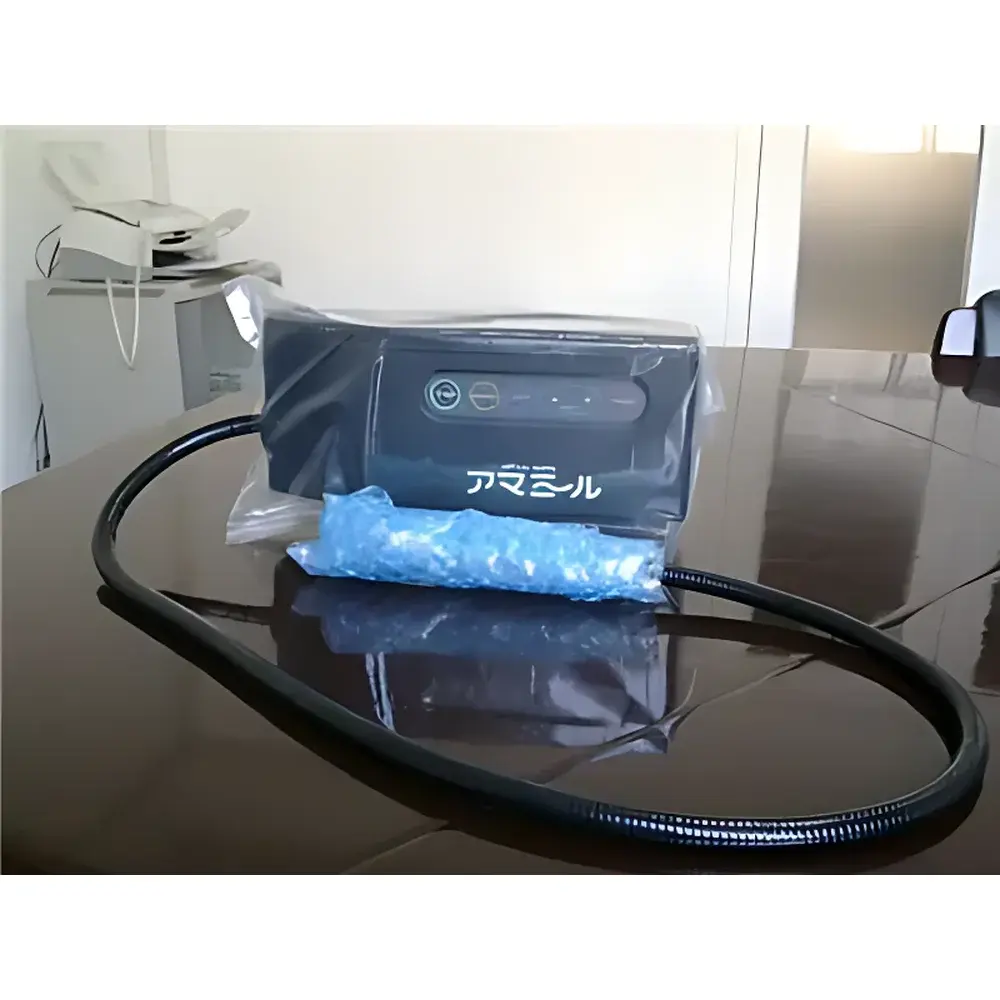
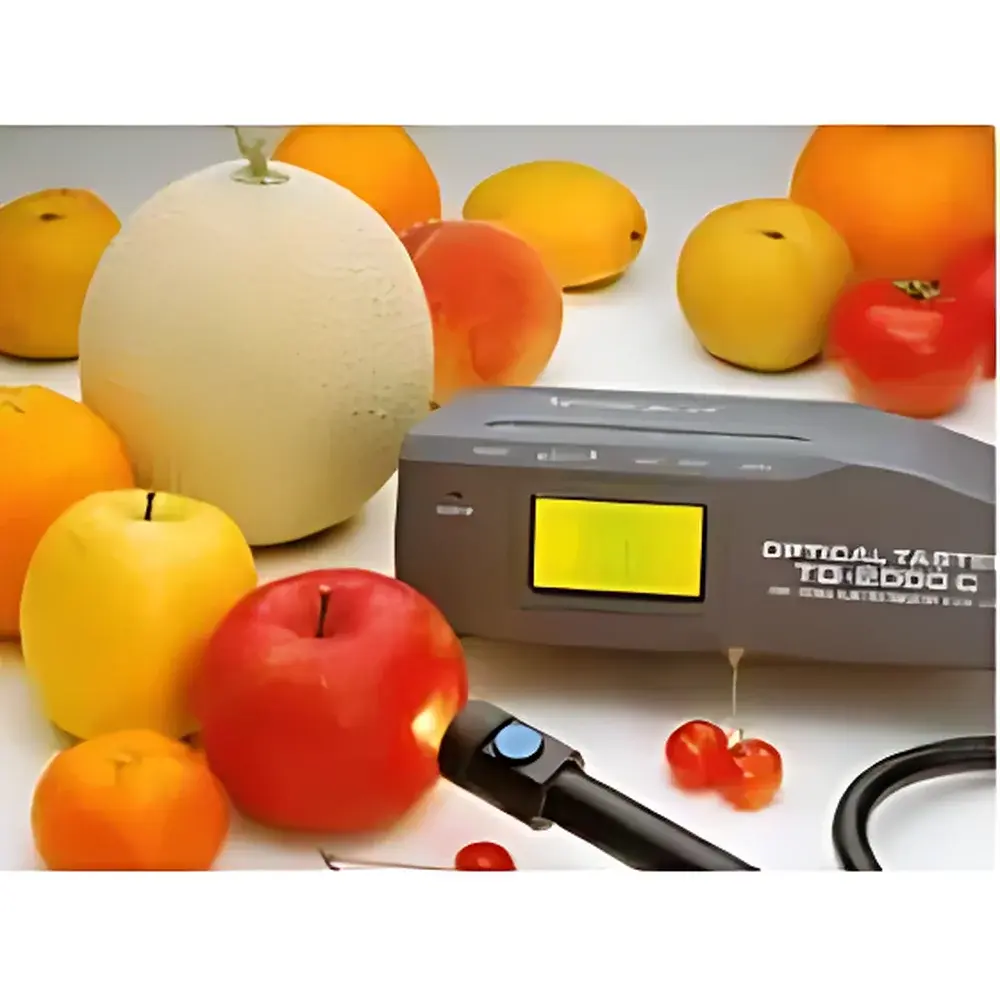
Towa TD-2010C Non-Destructive Fruit Refractometer
| Brand | Towa |
|---|---|
| Origin | Japan |
| Model | TD-2010C |
| Measurement Principle | Reflective Near-Infrared (NIR) Spectroscopy |
| Measurement Range | 5–30 °Brix |
| Response Time | ≤3 s |
| Operating Temperature | 10–30 °C |
| Dimensions | 240 × 120 × 80 mm |
| Weight | 1.2 kg |
| Power Supply | 5 × AA batteries |
| Max Power Consumption | 2.5 W |
| Sample Types | Apple, Pear, Melon, Watermelon, Citrus, Peach, Tomato, Strawberry, Mango, Papaya, Longan, Grape, Kyoho Grape |
| Instrument Type | Non-Destructive |
| Compliance | Designed for field-deployable agricultural QA/QC and research-grade Brix monitoring |
Overview
The Towa TD-2010C is a handheld, non-destructive fruit refractometer engineered for rapid, in-situ quantification of soluble solids content (SSC), expressed as degrees Brix (°Brix), directly on intact fruit surfaces. Unlike conventional destructive refractometers requiring juice extraction, the TD-2010C employs reflective near-infrared (NIR) spectroscopy—specifically optimized at wavelengths sensitive to C–H and O–H vibrational overtones in sucrose, glucose, and fructose—to estimate sugar concentration without penetration or tissue damage. This optical principle enables repeated longitudinal measurements on the same fruit throughout its developmental cycle, supporting phenotypic tracking in horticultural research, precision harvest scheduling, and post-harvest quality assurance under ambient field conditions.
Key Features
- Non-invasive measurement: Contact-based NIR probe eliminates sample preparation, preserving fruit integrity, shelf life, and marketability.
- Rapid analysis: Full spectral acquisition and algorithmic Brix estimation completed within ≤3 seconds per measurement.
- Field-portable design: Compact footprint (240 × 120 × 80 mm), lightweight construction (1.2 kg), and battery-powered operation (5 × AA) enable extended use in orchards, packing houses, and mobile labs.
- Broad-species compatibility: Pre-calibrated for 13 commercially significant fruits—including apple, grape, watermelon, citrus, and tomato—with validated performance across skin thicknesses and surface reflectivity variations.
- Robust environmental tolerance: Operational range of 10–30 °C accommodates typical outdoor harvesting and storage environments without thermal drift compensation hardware.
- Low-power architecture: Peak power draw limited to 2.5 W, supporting >8 hours of continuous operation on standard alkaline batteries.
Sample Compatibility & Compliance
The TD-2010C is validated for direct surface contact measurement on fruits with smooth-to-moderately-waxy epidermis and minimal surface moisture. It is not intended for use on highly irregular, hairy, or heavily bruised surfaces without prior empirical validation. While not certified to ISO/IEC 17025 or ASTM E2960, the instrument aligns with established good agricultural practice (GAP) and post-harvest quality control workflows. Its non-destructive methodology supports GLP-compliant longitudinal studies where individual fruit serve as repeated-measures units. Data outputs are traceable to factory calibration standards traceable to NIST-traceable sucrose reference solutions.
Software & Data Management
The TD-2010C operates as a standalone, embedded-system device with no onboard data logging or USB connectivity. All measurements are displayed in real time on a high-contrast LCD screen with °Brix resolution of 0.1 unit. For integration into structured QA/QC protocols, users manually record results or pair the instrument with external digital loggers (e.g., tablet-based LIMS entries). Towa provides calibration verification procedures and recommends quarterly field recalibration using standardized sucrose gel standards (5–30 °Brix) to maintain measurement consistency across seasonal temperature and humidity fluctuations.
Applications
- Agricultural decision support: Determining optimal harvest windows by mapping spatial and temporal Brix gradients across orchard blocks.
- Post-harvest grading: Enabling real-time, non-destructive sorting of fruit lots into commercial grade categories (e.g., premium, standard, processing) based on objective SSC thresholds.
- Research & breeding programs: Monitoring sugar accumulation kinetics during fruit development to evaluate cultivar performance, rootstock effects, irrigation regimes, and ripening interventions.
- Supply chain quality control: Verifying incoming shipments at wholesale markets, supermarkets, and hotel procurement centers without compromising salable yield.
- Viticulture & enology: Supporting grape maturity assessment for vintage timing decisions and must potential estimation prior to crushing.
- Nutritional labeling & dietary compliance: Assisting food service providers and clinical nutrition teams in selecting low- and moderate-sugar fruit options for diabetic or fructose-intolerant populations.
FAQ
Does the TD-2010C require sample homogenization or juice extraction?
No. The instrument performs surface-contact NIR reflectance measurement; no cutting, squeezing, or juice collection is necessary.
Can it measure through fruit wax or plastic packaging?
No. Direct, clean contact between the optical probe and bare fruit skin is required. Wax coatings must be removed from the measurement site.
Is the device suitable for frozen or refrigerated fruit?
Measurements are specified for 10–30 °C ambient operating temperature. Cold-soaked fruit should be equilibrated to room temperature before testing to avoid condensation and thermal signal noise.
How frequently should calibration be verified?
Towa recommends daily verification against a reference standard before critical measurement sessions, and full recalibration every 3 months or after 500 measurements, whichever occurs first.
Does the TD-2010C comply with FDA 21 CFR Part 11 or EU Annex 11 requirements?
No. As a standalone analog-output instrument without electronic audit trails, user authentication, or data export capabilities, it does not meet regulatory requirements for computerized system validation. It is intended for operational guidance—not regulated release testing.




