
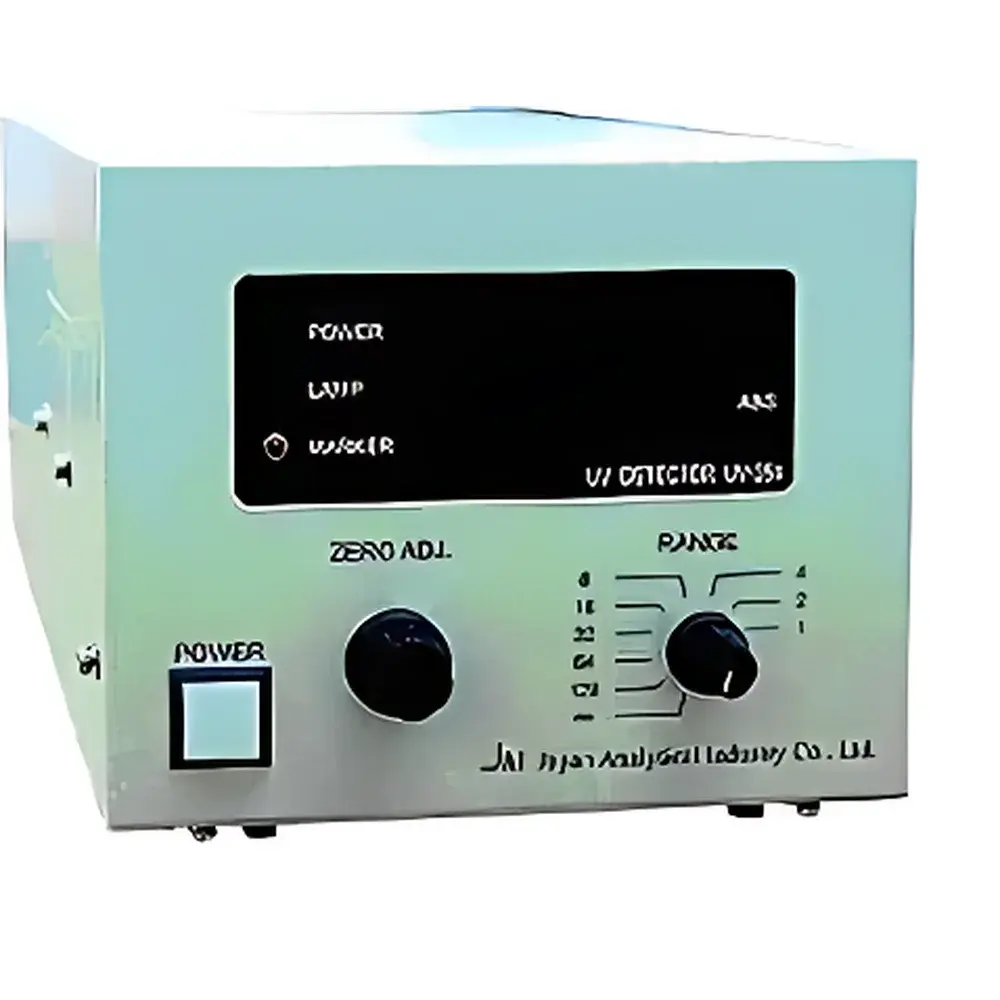
JAI UV-254 Fixed-Wavelength Ultraviolet Detector
| Brand | JAI |
|---|---|
| Origin | Japan |
| Instrument Type | UV Detector (UVD) |
| Wavelength | Fixed at 254 nm |
| Detection Principle | Dual-Beam Filter Photometry |
| Light Source | Low-Pressure Mercury Lamp |
| Noise | ≤0.00015 AU |
| Drift | ≤0.002 AU/hr |
| Flow Cell Pathlength | 0.5 mm (standard), optional 0.2 mm and 1.0 mm |
| Flow Cell Volume | 20 µL |
| Maximum Sample Concentration Tolerance | 4% (with 0.5 mm cell) |
| Output Signal | 100 mV full scale |
| Zero Adjustment | Manual potentiometer |
| Dimensions (W×H×D) | 150 × 120 × 370 mm |
| Power Supply | AC 85–240 V, 50/60 Hz, 200 VA |
| Weight | 4 kg |
Overview
The JAI UV-254 Fixed-Wavelength Ultraviolet Detector is a dedicated optical detection module engineered for integration with high-performance liquid chromatography (HPLC) systems—specifically designed as a plug-in detector for the LC-9200 series. It operates on the principle of dual-beam filter photometry, utilizing a low-pressure mercury lamp emitting a stable, narrow-band spectral line centered precisely at 254 nm—a wavelength widely adopted for detecting aromatic compounds, nucleic acids, proteins, and many pharmaceutical actives due to their strong π→π* absorption. Unlike variable-wavelength or diode-array detectors, the UV-254 employs a fixed optical configuration optimized for signal stability, minimal baseline drift, and long-term reproducibility in routine QC/QA environments. Its compact footprint (150 × 120 × 370 mm) and low thermal load (200 VA) support seamless installation in modular HPLC racks without requiring auxiliary cooling or vibration isolation.
Key Features
- Dual-beam optical architecture compensates for lamp intensity fluctuations and solvent absorbance variations, ensuring robust baseline stability over extended run times.
- Low-noise analog electronics deliver a noise level of ≤0.00015 AU (absorbance units), enabling reliable detection of trace analytes in low-concentration samples.
- Controlled drift performance of ≤0.002 AU/hr supports unattended overnight analyses and multi-day calibration verification protocols.
- Interchangeable flow cells (0.2 mm, 0.5 mm, and 1.0 mm pathlengths) allow optimization between sensitivity and linear dynamic range—0.5 mm being standard for general-purpose use with 20 µL internal volume.
- Manual zero adjustment via front-panel potentiometer provides quick baseline alignment without software dependency—critical in regulated labs where instrument simplicity reduces validation burden.
- 100 mV full-scale analog output is compatible with legacy chart recorders, integrators (e.g., Shimadzu C-R6A), and modern DAQ systems via standard BNC or screw-terminal interfaces.
Sample Compatibility & Compliance
The UV-254 detector is compatible with standard HPLC mobile phases including aqueous buffers, acetonitrile, methanol, and tetrahydrofuran—provided UV cutoff limits are observed. Its 4% saturation limit (with 0.5 mm cell) defines the upper concentration boundary before nonlinear response or signal compression occurs; this threshold aligns with ASTM E2915-21 guidance on detector linearity verification. The unit meets IEC 61010-1 safety requirements for laboratory electrical equipment and conforms to electromagnetic compatibility (EMC) standards per EN 61326-1. While not inherently 21 CFR Part 11 compliant (as it lacks digital audit trail functionality), its analog output and manual controls facilitate integration into validated chromatographic systems when paired with compliant data acquisition software and procedural controls under GLP/GMP frameworks.
Software & Data Management
As a hardware-only detector, the UV-254 does not include embedded firmware or onboard data storage. It functions exclusively as an analog transducer, converting absorbance changes into proportional voltage signals. Integration with chromatography data systems (CDS) such as Waters Empower, Thermo Chromeleon, or Agilent OpenLab requires external analog-to-digital conversion—typically handled by the CDS’s analog input module or a dedicated ADC interface. All calibration, peak integration, and report generation occur externally, preserving full traceability and enabling compliance with ALCOA+ data integrity principles when configured within a validated system. No proprietary drivers or vendor-specific software are required.
Applications
- Routine quality control of small-molecule pharmaceuticals (e.g., aspirin, paracetamol, antibiotics) in accordance with USP and EP 2.2.46.
- Monitoring DNA/RNA elution profiles during oligonucleotide purification (254 nm is optimal for nucleobase detection).
- Stability-indicating assays for forced degradation studies where consistent wavelength selection ensures method transferability across laboratories.
- Teaching laboratories requiring rugged, maintenance-light UV detection for introductory HPLC training—no lamp warm-up time or wavelength scanning overhead.
- Process analytical technology (PAT) applications where fixed-wavelength monitoring supports real-time feedback control loops in continuous chromatography systems.
FAQ
Is the UV-254 compatible with HPLC systems other than the LC-9200?
Yes—it can be interfaced with any HPLC system equipped with a standard 1/16″ stainless steel or PEEK capillary connection and a compatible analog input channel.
Does the detector require periodic lamp replacement?
Yes—the low-pressure mercury lamp has a typical service life of 1,500–2,000 hours; lamp status should be verified during preventive maintenance per manufacturer-recommended intervals.
Can the 254 nm wavelength be changed or adjusted?
No—this is a fixed-wavelength detector; no optical filters or monochromators are included or supported.
What is the minimum detectable absorbance change under optimal conditions?
Based on its specified noise level and typical system bandwidth settings, the practical limit of detection (LOD) for a 10 mm equivalent pathlength is approximately 0.0005 AU, assuming proper cell conditioning and mobile phase degassing.
Is the flow cell temperature controlled?
No—ambient temperature operation only; for temperature-sensitive separations, external column ovens and pre-heated mobile phase lines must be used to minimize thermal mismatch effects.





