
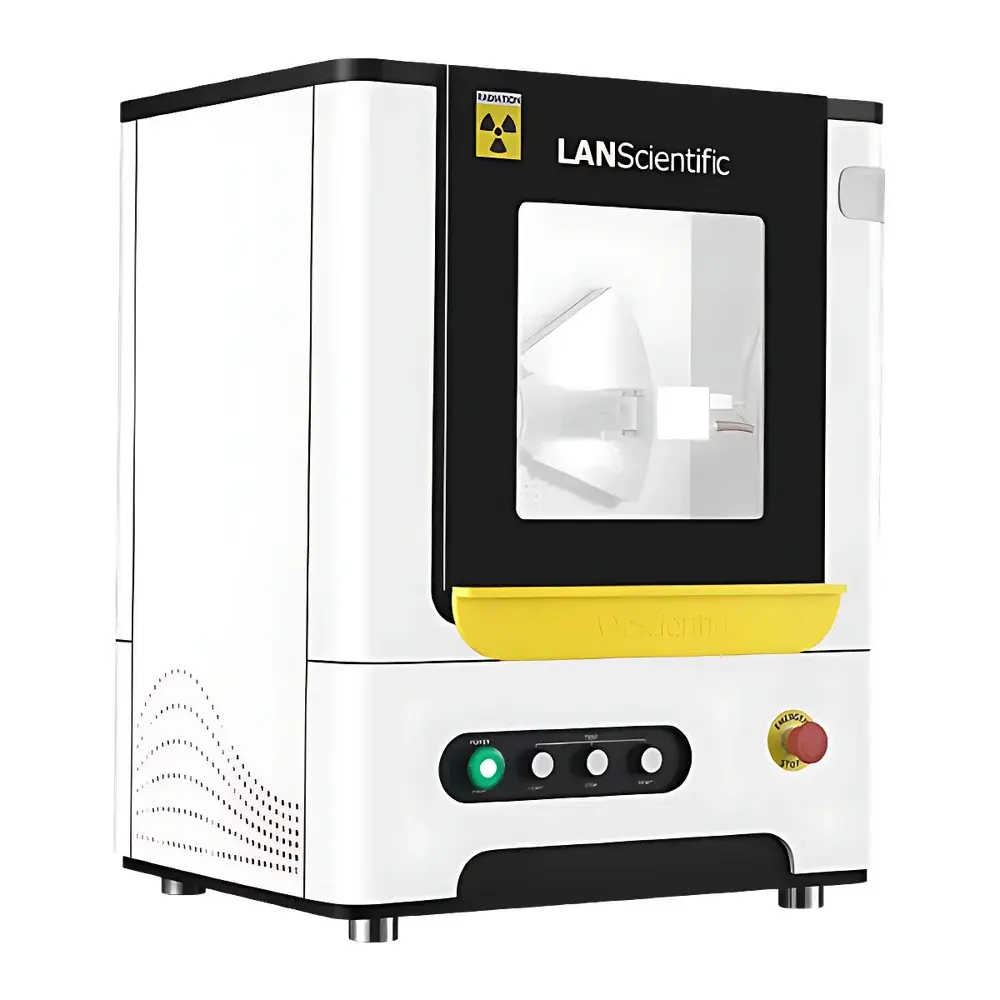
Brookfield FRINGE EVS Benchtop X-ray Diffractometer
| Brand | LANScientific |
|---|---|
| Origin | Jiangsu, China |
| Manufacturer Type | Original Equipment Manufacturer (OEM) |
| Product Category | Domestic |
| Model | FRINGE EVS |
| Instrument Type | Powder X-ray Diffractometer |
| Configuration | Benchtop |
| Power Rating | kW-class (water-cooled) |
| Detector | DPPS High-Resolution Energy-Dispersive Detector |
| Cooling System | Integrated Closed-Loop Water Circulation |
| Safety | Interlocked Sample Chamber with Auto-Shutdown, Full Enclosure During Operation |
| Optical Path | Integrated Soller Slit (Fixed, No Moving Parts) |
| Software | CrystalX™ Automated Phase Identification & Quantification Suite |
| Compliance | Designed for GLP/GMP-aligned workflows |
Overview
The Brookfield FRINGE EVS Benchtop X-ray Diffractometer is a compact, high-performance powder X-ray diffractometer engineered for rigorous crystalline phase analysis in academic research laboratories, quality control environments, and field-deployable analytical platforms. It operates on the fundamental principle of Bragg diffraction: monochromatic or polychromatic X-rays interact with periodic atomic lattices in crystalline materials, producing characteristic diffraction patterns that encode lattice parameters, crystal symmetry, phase composition, and structural disorder. Unlike traditional theta–theta goniometer systems requiring external monochromators, the FRINGE EVS integrates a Direct Pulse Processing Spectrometer (DPPS) energy-dispersive detector—enabling simultaneous acquisition across a broad 2θ range without mechanical scanning or spectral filtering. This architecture eliminates signal attenuation from graphite monochromators or β-filter foils, preserving intensity and improving counting statistics for low-concentration phases and thin-film samples.
Key Features
- kW-class sealed-tube X-ray source with integrated water-cooling loop—eliminates need for external chillers and enables stable, continuous operation in standard laboratory spaces.
- DPPS detector with <130 eV Mn Kα energy resolution at room temperature—supports direct energy discrimination, bypassing conventional wavelength-dispersive optics and enabling rapid qualitative/quantitative analysis without monochromator-induced intensity loss.
- Fixed Soller slit collimation system—no motorized adjustment required; enhances angular reproducibility and mechanical robustness for vibration-prone or mobile deployment (e.g., vehicle-mounted labs).
- Interlocked sample chamber with dual-safety logic: beam shutter deactivation and high-voltage cutoff occur automatically upon door opening; visual and software-based chamber status indicators ensure operator awareness.
- Benchtop footprint (<650 × 550 × 480 mm) with front-access sample loading—designed for integration into ISO Class 5 cleanrooms, fume hood bays, or shared instrumentation suites without dedicated shielding rooms.
Sample Compatibility & Compliance
The FRINGE EVS accommodates diverse physical forms including free-flowing powders (≥10 mg), pressed pellets, solid slugs, thin films (on Si, glass, or metal substrates), and coated electrodes—compatible with standard 25 mm Ø sample holders and optional custom-stage accessories (e.g., heating/cooling stages, humidity cells). Its optical design meets IEC 61010-1:2010 safety requirements for electrical equipment used in measurement, control, and laboratory use. When configured with CrystalX™ v3.2+ and enabled audit-trail logging, the system supports documentation practices aligned with FDA 21 CFR Part 11, ISO/IEC 17025, and ASTM E1420–22 standards for phase identification reporting in regulated environments.
Software & Data Management
CrystalX™ software provides fully automated workflow execution—from instrument initialization and parameter selection to raw pattern acquisition, background subtraction, peak search, reference pattern matching (via ICDD PDF-4+ database), Rietveld refinement (using GSAS-II engine integration), and quantitative phase analysis (QPA) via internal standard or matrix-flushing methods. All processing steps are timestamped and logged with user ID, instrument state, and calibration metadata. Raw data is stored in industry-standard .raw and .xye formats; processed reports export to PDF with embedded traceability metadata, supporting GLP-compliant archiving. Remote monitoring and queue-based batch analysis are supported via secure HTTPS API.
Applications
- Battery materials: cathode/anode phase evolution during cycling (e.g., NMC, LFP, silicon composites), SEI layer characterization, and degradation pathway mapping.
- Pharmaceutical solid-state analysis: polymorph screening, hydrate/solvate identification, amorphous content quantification (via spiking or PONKCS methods), and stability-indicating assays per USP & ICH Q5A guidelines.
- Thin-film metrology: out-of-plane texture analysis, strain evaluation in PVD/CVD coatings, and epitaxial quality assessment of perovskites and TCOs.
- Geological and metallurgical QC: mineralogical fingerprinting of ores, slag, and corrosion products; residual stress estimation in weld zones using sin²ψ methodology.
- Academic materials science: high-throughput combinatorial library screening, in situ thermal/ambient reaction monitoring (with optional stage), and nanocrystallite size/strain deconvolution via Williamson–Hall analysis.
FAQ
Does the FRINGE EVS require external radiation shielding?
No—the instrument meets IEC 60529 IP2X enclosure requirements and emits <0.5 µSv/h at 5 cm from any surface during operation. Standard lab walls provide adequate attenuation; no dedicated vault or lead lining is necessary.
Can CrystalX™ perform Rietveld refinement natively?
CrystalX™ interfaces with GSAS-II via standardized input/output protocols; full Rietveld modeling is executed externally but initiated and managed within the CrystalX™ GUI with seamless data handoff.
Is the DPPS detector sensitive to temperature drift?
The detector housing incorporates active thermal stabilization (±0.1°C) and real-time gain calibration; energy calibration remains stable over 8-hour continuous runs without manual intervention.
What sample preparation protocols are recommended for battery electrode powders?
Gentle grinding in agate mortar under inert atmosphere, followed by back-loading into zero-background Si sample holders—avoiding binder addition unless quantifying amorphous content via internal standard method.
How is compliance with 21 CFR Part 11 enforced in CrystalX™?
Audit trails record all user actions, parameter changes, and report generations; electronic signatures, role-based access control, and encrypted database storage are configurable per site-specific validation protocols.




