
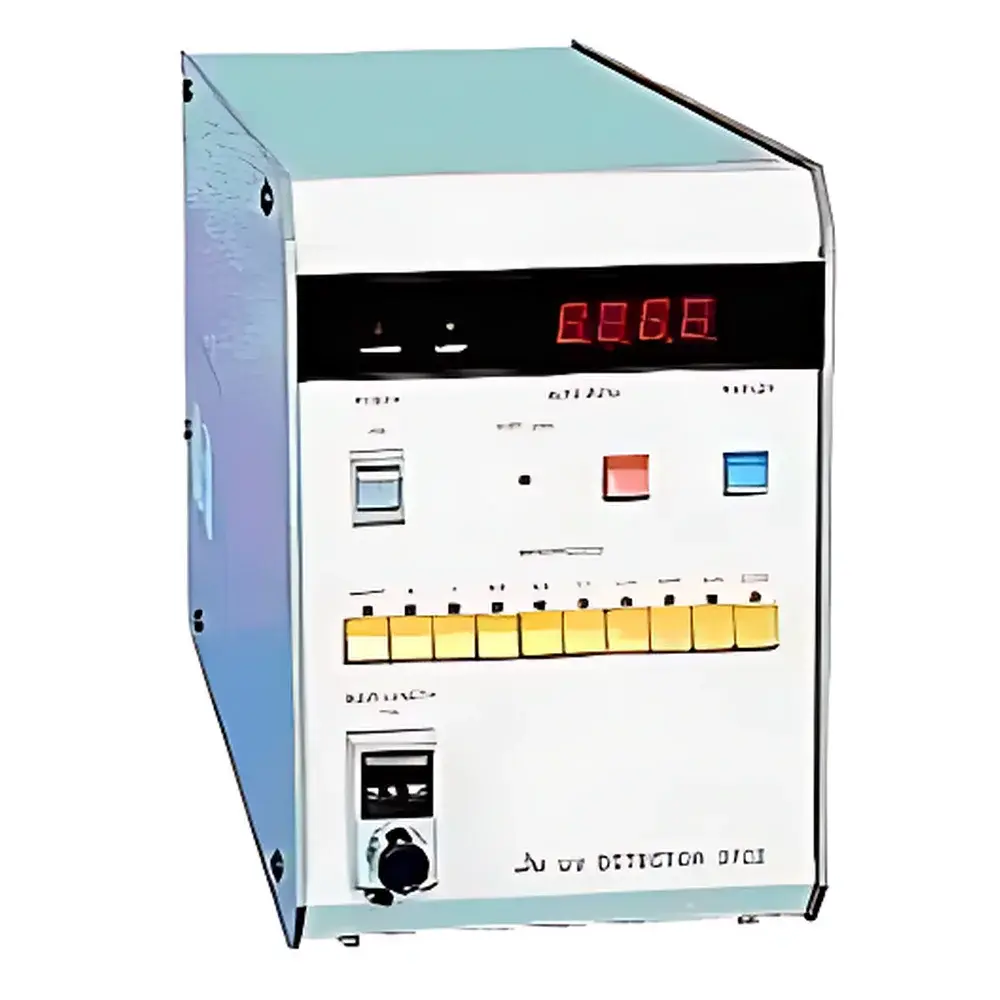
JAI UV-3702 Variable Wavelength UV-Vis Detector
| Brand | JAI |
|---|---|
| Origin | Japan |
| Model | UV-3702 |
| Detector Type | Ultraviolet-Visible (UV-Vis) Detector |
| Wavelength Range | 195–600 nm |
| Optical System | Dual-beam |
| Light Source | Deuterium Lamp |
| Noise | ≤0.00005 AU |
| Drift | ≤0.0005 AU/hr |
| Flow Cell Pathlength | 0.5 mm (standard), 0.2 mm / 1.0 mm optional |
| Flow Cell Volume | 20 µL |
| Full-Scale Output | 100 mV / 10 mV |
| Auto-Zero Function | Yes |
| Dimensions (W×H×D) | 156 × 225 × 450 mm |
| Power Supply | AC 85–135 V, 50/60 Hz, 200 VA |
| Weight | 14 kg |
Overview
The JAI UV-3702 Variable Wavelength UV-Vis Detector is a precision optical detection module engineered for integration with the LC-9100 series of high-performance liquid chromatography (HPLC) systems. Designed in accordance with fundamental photometric principles of absorbance measurement—based on the Beer–Lambert law—the detector operates across a broad spectral range from 195 nm to 600 nm, enabling quantitative and qualitative analysis of analytes exhibiting characteristic ultraviolet or visible absorption bands. Its dual-beam optical architecture compensates for source intensity fluctuations and lamp aging, ensuring long-term baseline stability and high reproducibility in trace-level detection. As a dedicated accessory for analytical and preparative HPLC workflows, the UV-3702 supports compliance-driven laboratories requiring consistent, low-drift performance under routine operation and regulatory audit conditions.
Key Features
- Dual-beam optical design with real-time reference beam correction for enhanced signal stability and reduced baseline drift
- Deuterium lamp as primary UV source, delivering stable continuum output from 195 nm through the near-UV and visible regions
- Low-noise analog electronics achieving ≤0.00005 AU peak-to-peak noise at 254 nm (1 s response time), critical for detecting low-abundance compounds
- Drift specification of ≤0.0005 AU/hr enables extended unattended runs without recalibration—essential for overnight or multi-day method validation studies
- Modular flow cell configuration with standard 0.5 mm pathlength (20 µL volume); optional 0.2 mm (low-volume) and 1.0 mm (high-sensitivity) cells support method flexibility across sample concentration ranges
- Automatic zeroing function eliminates manual baseline offset adjustments, improving operational efficiency and reducing operator-induced variability
- Standard analog output signals (100 mV and 10 mV full-scale) ensure seamless compatibility with legacy data acquisition systems, integrators, and modern chromatography data systems (CDS)
Sample Compatibility & Compliance
The UV-3702 is optimized for detection of organic molecules containing chromophores such as aromatic rings, conjugated dienes, carbonyl groups, and nitro functionalities—common in pharmaceuticals, environmental pollutants, natural products, and polymer additives. Its wavelength tunability allows method-specific optimization: e.g., 210 nm for aliphatic acids, 254 nm for aromatic compounds, or 450 nm for certain dyes and metal complexes. The detector meets mechanical and electrical safety requirements per IEC 61010-1 and is compatible with GLP/GMP-compliant workflows when paired with CDS software supporting 21 CFR Part 11 audit trails, electronic signatures, and instrument qualification protocols (IQ/OQ/PQ). While not a standalone regulated device, its performance characteristics align with ASTM E260 and ISO 17025 metrological expectations for chromatographic detection systems.
Software & Data Management
The UV-3702 operates as a hardware-controlled detector within host chromatography data systems. It does not include embedded firmware-based control software but provides standardized analog voltage outputs and TTL-compatible status signals (e.g., lamp-on, error flag) for synchronization with external controllers. When integrated into validated CDS environments—such as Waters Empower, Thermo Chromeleon, or Shimadzu LabSolutions—the detector’s analog response is digitized, time-stamped, and archived alongside raw chromatograms, method parameters, and audit logs. Its low-drift and low-noise profile minimizes post-acquisition baseline correction, preserving raw data integrity required for regulatory submissions to FDA, EMA, or PMDA. Optional analog-to-digital converter modules may be deployed to enhance resolution beyond 16-bit acquisition where high-dynamic-range quantitation is required.
Applications
- Pharmaceutical quality control: assay of active pharmaceutical ingredients (APIs), related substances, and degradation products per USP , EP 2.2.27, and JP 6.03
- Environmental analysis: determination of PAHs, phenols, pesticides, and endocrine disruptors in water and soil extracts
- Food and beverage testing: quantification of preservatives (e.g., benzoic acid), antioxidants (e.g., BHT), and colorants
- Academic and industrial research: kinetic monitoring of reaction mixtures, purity assessment of synthetic intermediates, and stability-indicating method development
- Biopolymer characterization: detection of nucleic acid fragments or modified amino acids in HPLC-purified fractions
FAQ
Is the UV-3702 compatible with non-JAI HPLC systems?
Yes—provided the system offers compatible flow cell mounting dimensions, analog input/output interfaces, and sufficient power delivery; mechanical and electrical integration may require custom brackets or signal conditioning.
Can the detector be used for gradient elution without baseline disturbance?
Yes—the dual-beam design and automatic zeroing significantly mitigate solvent gradient-induced absorbance shifts, though optimal performance requires matching reference and sample solvent compositions where possible.
What maintenance is required for the deuterium lamp?
Lamp lifetime is typically 1,000–2,000 hours; replacement is recommended upon noticeable intensity loss or failure to achieve specified noise/drift performance—no user alignment is required.
Does the UV-3702 support wavelength scanning or spectral acquisition?
No—it is a fixed-wavelength or step-scan detector only; it does not perform full-spectrum acquisition like a photodiode array (PDA) or variable-wavelength scanning spectrophotometer.
Is calibration traceable to NIST standards?
While the detector itself is not supplied with NIST-traceable calibration certificates, its optical and electronic performance can be verified using NIST-traceable neutral density filters and certified reference standards (e.g., caffeine in 0.01 M HCl at 273 nm).




