
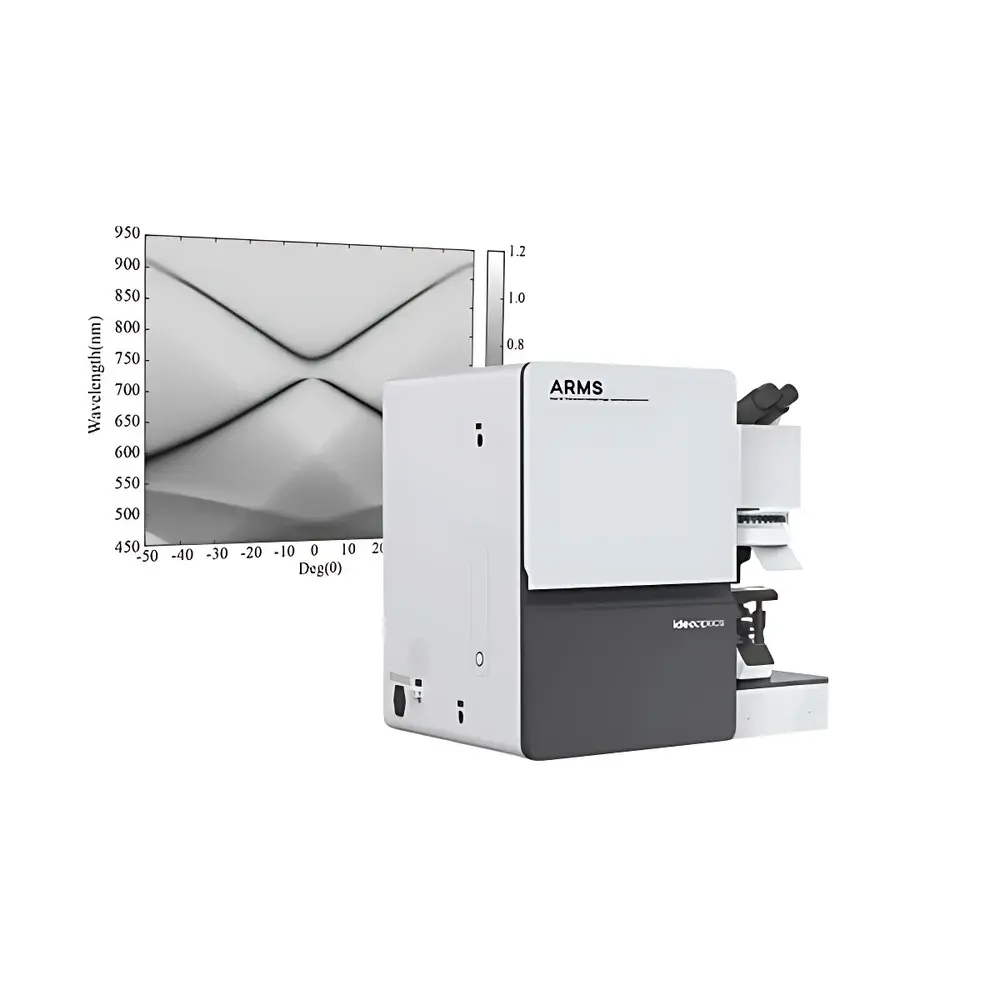
IdeaOptics ARMS Microscopic Angle-Resolved Spectrometer
| Brand | IdeaOptics |
|---|---|
| Origin | Shanghai, China |
| Manufacturer Type | Original Equipment Manufacturer (OEM) |
| Product Origin | Domestic (China) |
| Model | ARMS |
| Pricing | Upon Request |
Overview
The IdeaOptics ARMS Microscopic Angle-Resolved Spectrometer is an advanced optical characterization platform engineered for high-fidelity, spatially localized angle-resolved spectroscopy across the ultraviolet–visible–near-infrared (UV-VIS-NIR) spectrum. Based on the fundamental principle of momentum-resolved optical spectroscopy, the ARMS system measures spectral response as a function of in-plane wavevector (k∥) by precisely controlling and resolving incident or emitted light angles with sub-degree accuracy. This enables direct mapping of photonic dispersion relations—critical for studying band structures in photonic crystals, polaritonic modes in strong light–matter coupling regimes, topological edge states, and momentum-space signatures in metasurfaces and 2D materials. Integrated into a motorized upright microscope architecture, the ARMS delivers micron-scale spatial resolution while maintaining angular fidelity from ±30° to ±60° relative to surface normal—making it uniquely suited for microcavity photonics, plasmonic nanostructures, and heterogeneous nanophotonic devices.
Key Features
- Sub-degree angular resolution: Optimized achromatic and anastigmatic optical design achieves ≤0.5° angular resolution across 400–1700 nm, enabling precise reconstruction of k-space dispersion contours.
- Extended spectral coverage: Dual-band calibrated performance from 400 nm to 1650 nm, with dedicated NIR-optimized alignment and calibration protocols for 900–1650 nm operation—supporting telecom-band photonic device characterization.
- Multi-modal spectral acquisition: Supports nine standardized measurement geometries—including transmission, reflection, photoluminescence, cathodoluminescence, and thermal radiation—via software-selectable optical path routing and polarization management.
- 5D spatial selectivity: Motorized variable aperture with independent X/Y translation, aperture width control (1–200 µm), and in-plane rotational adjustment (±180°, 0.1° step) enables targeted interrogation of morphologically complex microstructures.
- Cryogenic & magnetic field compatibility: Designed for integration with closed-cycle cryostats (down to 2.7 K) and superconducting magnets (up to 5 T), preserving angular and spectral fidelity under extreme environmental conditions.
- Modular instrumentation interface: Standard SMA905 and FC/PC fiber ports, plus direct C-mount and kinematic mount options, allow seamless coupling to external pulsed lasers, time-correlated single-photon counting (TCSPC) modules, or Princeton Instruments spectrographs for transient, coherence, or hyperspectral extensions.
Sample Compatibility & Compliance
The ARMS platform accommodates planar and quasi-planar micro- and nanostructured samples—including lithographically patterned photonic crystals, van der Waals heterostructures, epitaxial quantum wells, plasmonic antenna arrays, and dielectric metasurfaces—on standard 25 mm diameter substrates or custom wafer carriers. All optical components comply with ISO 10110 surface quality standards; spectral calibration traceability follows NIST-traceable reference sources (e.g., tungsten-halogen and deuterium lamps) and is documented per ISO/IEC 17025 guidelines. The system supports GLP-compliant audit trails when operated with validated instrument control software, and data export formats (HDF5, CSV, SPE) are compatible with ASTM E2937-22 metadata conventions for spectral data interchange.
Software & Data Management
Control and analysis are performed via ARMS Studio, a Python-based application framework compliant with FDA 21 CFR Part 11 requirements for electronic records and signatures (with optional audit trail and user role management). The software provides real-time k–ω–λ hyperspectral cube acquisition, dispersion fitting using Levenberg–Marquardt minimization, bandgap extraction, group velocity calculation, and export to third-party platforms including MATLAB, OriginLab, and Python’s SciPy ecosystem. Raw data files include embedded metadata: instrument configuration, calibration timestamps, environmental sensor logs (temperature, humidity), and user-defined experimental annotations—ensuring full reproducibility and FAIR (Findable, Accessible, Interoperable, Reusable) data principles.
Applications
- Photonic band structure mapping of silicon-based and III–V photonic crystals
- Momentum-resolved exciton-polariton condensation studies in TMDC heterobilayers
- Azimuthally resolved scattering analysis of chiral metasurfaces and topological photonic lattices
- Angle-dependent quantum efficiency characterization of micro-LEDs and VCSEL arrays
- Dispersion engineering validation for integrated LiDAR transceivers operating at 1310 nm and 1550 nm
- In-situ magneto-optical Kerr effect (MOKE) measurements under high-field cryogenic conditions
FAQ
What is the minimum resolvable angular increment?
The ARMS achieves ≤0.5° mechanical angular step size with interpolation-enabled resolution down to 0.1° in post-processing, subject to optical throughput and signal-to-noise constraints.
Can the system be used for time-resolved angle-resolved measurements?
Yes—via external synchronization triggers (TTL input/output), the ARMS can coordinate with picosecond laser systems and gated ICCD or SPAD detectors for pump–probe or time-gated k-space dynamics.
Is vacuum-compatible operation supported?
The base configuration is air-operated; however, a UHV-compatible variant with all-metal seals and bake-out rated optics is available upon request (custom lead time applies).
How is spectral calibration maintained across the full 400–1650 nm range?
Calibration uses multi-point NIST-traceable sources and a dual-grating monochromator reference path; automated recalibration routines run before each measurement session and are logged with timestamp and uncertainty estimates.
Does the system support polarization-resolved measurements?
Yes—integrated motorized rotating half-wave and quarter-wave plates enable full Stokes parameter acquisition at each angle and wavelength, with software-assisted Mueller matrix reconstruction.




