
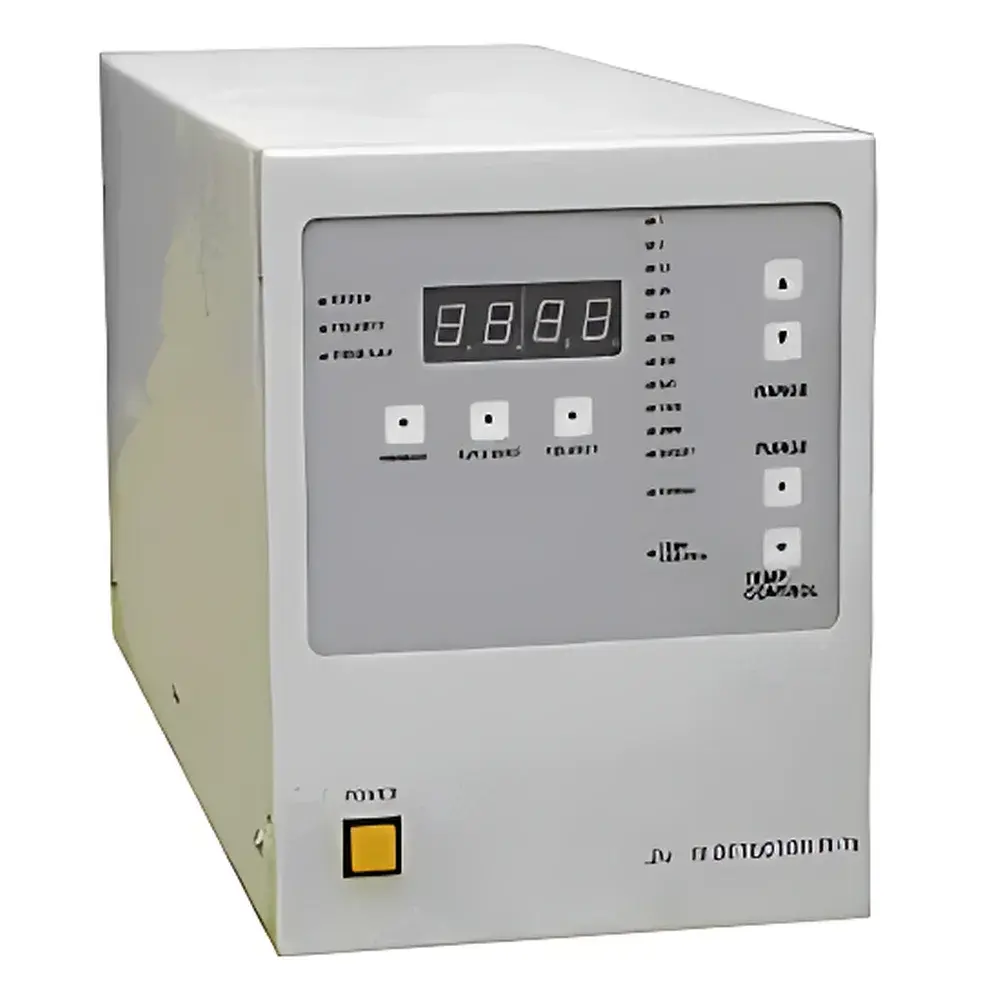
JAI RI-7s Differential Refractometer Detector
| Brand | JAI |
|---|---|
| Origin | Japan |
| Model | RI-7s |
| Detector Type | Differential Refractometer (RID) |
| Flow Cell Volume | 8 µL |
| Refractive Index Range | 1.00–1.75 |
| Attenuation Settings | 1–2000 and ∞ (12-step) |
| Temperature Control | Fixed at 34 °C, max 50 °C |
| Reference Cell Cleaning | Solenoid-valve actuated |
| Integrator Output | 1 V |
| Recorder Output | 100 mV / 10 mV |
| Zero Adjustment | Automatic |
| Dimensions (W×H×D) | 160 × 210 × 400 mm |
| Power Supply | AC 85–135 V, 50/60 Hz, 200 VA |
| Weight | 12 kg |
Overview
The JAI RI-7s Differential Refractometer Detector is a precision optical detector engineered for universal solute detection in liquid chromatography systems, particularly HPLC and preparative LC applications where analytes lack chromophores or UV absorbance. It operates on the principle of differential refractometry—measuring minute changes in the refractive index between a sample stream and a reference solvent stream passing through matched optical cells. This label-free, non-destructive detection method provides consistent response across a broad range of organic and inorganic compounds—including sugars, polymers, lipids, surfactants, and small-molecule APIs—regardless of their UV activity. The RI-7s integrates into standard chromatographic workflows as a complementary or primary detector, delivering quantitative data with high baseline stability and low thermal drift, essential for reproducible method development and routine QC analysis.
Key Features
- Optically balanced dual-cell design ensures high sensitivity to refractive index differentials while minimizing environmental noise and solvent composition drift.
- Fixed-temperature thermostatic chamber (set at 34 °C, adjustable up to 50 °C) maintains thermal equilibrium across flow and reference paths, critical for minimizing RI fluctuations caused by temperature gradients.
- Compact 8 µL flow cell volume supports low-dead-volume integration with microbore and narrow-bore columns, preserving chromatographic resolution and reducing band broadening.
- 12-step attenuation range (1–2000 + ∞) enables dynamic signal scaling across diverse concentration regimes—from trace-level excipients to concentrated polymer solutions—without manual gain adjustment during gradient runs.
- Automated zero calibration eliminates manual offset correction; system self-adjusts baseline prior to each injection or at user-defined intervals, ensuring long-term signal fidelity.
- Solenoid-controlled reference cell flush mechanism enables programmable cleaning cycles, preventing carryover and maintaining optical path integrity during extended unattended operation.
- Dual analog outputs (1 V integrator signal and switchable 100 mV / 10 mV recorder outputs) support seamless interfacing with legacy integrators, modern CDS platforms, and custom DAQ systems.
Sample Compatibility & Compliance
The RI-7s exhibits broad compatibility with common HPLC mobile phases—including aqueous buffers, alcohols, acetonitrile, THF, and chlorinated solvents—provided refractive index differences between eluent and analyte are sufficient (>10−5 RIU). It is routinely deployed in compliance-critical environments: its stable analog output architecture supports audit-ready data acquisition when paired with 21 CFR Part 11–compliant chromatography data systems. While the detector itself does not perform digital logging, its analog signal integrity and repeatable zeroing behavior align with GLP and GMP documentation requirements for method validation (e.g., ICH Q2(R2), USP ). No internal software or firmware requires qualification; however, system-level validation must include temperature stability verification, linearity assessment over defined RI ranges (1.33–1.52 typical for aqueous/organic mixtures), and attenuation accuracy per ASTM D1218 and ISO 1628-1 protocols.
Software & Data Management
As an analog-output-only detector, the RI-7s relies on external data acquisition hardware and chromatography data systems (CDS) for digitization, peak integration, and report generation. It interfaces directly with industry-standard integrators (e.g., Shimadzu CLASS-VP, Waters Empower, Agilent OpenLab CDS) via its 1 V full-scale integrator output. The 10 mV/100 mV recorder outputs allow simultaneous connection to strip-chart recorders or secondary monitoring systems for real-time visual verification. For regulated labs, raw voltage signals should be acquired at ≥10 Hz sampling rate to preserve peak shape fidelity. Metadata such as instrument ID, date/time stamp, and attenuation setting must be manually logged or embedded via CDS annotation tools, as the RI-7s lacks onboard memory or digital communication ports (e.g., RS-232, USB, or Ethernet).
Applications
- Carbohydrate analysis in food, beverage, and biofuel feedstocks—especially sucrose, glucose, fructose, and oligosaccharides in HILIC or amino-column separations.
- Quantification of non-UV-absorbing synthetic polymers (e.g., PEG, PVP) in pharmaceutical formulations and excipient release studies.
- Quality control of surfactant blends and emulsifiers in personal care and agrochemical products.
- Process monitoring of fermentation broths and bioreactor effluents where UV-active impurities dominate but target metabolites (e.g., glycerol, ethanol, organic acids) require orthogonal detection.
- Method transfer support in regulatory submissions, serving as a stability-indicating detector for forced degradation studies involving hydrolysis or oxidation products lacking chromophores.
FAQ
Does the RI-7s support temperature ramping or programmable thermal gradients?
No—the RI-7s features fixed-point temperature control. The setpoint is factory-configured at 34 °C and can be manually adjusted up to 50 °C, but it does not support dynamic temperature programming.
Can the RI-7s be used with UHPLC systems operating above 1000 bar?
Yes, provided appropriate pressure-rated flow cells and tubing are installed upstream; the detector’s optical block is rated for ≤40 MPa (400 bar), so external pressure management (e.g., back-pressure regulators) is required for full UHPLC compatibility.
Is the 8 µL flow cell compatible with 2.1 mm ID columns?
Yes—its low internal volume minimizes extra-column dispersion and maintains efficiency when coupled with narrow-bore and microbore columns, though optimal performance requires matching dwell volume and detector response time to system bandwidth.
How often must the reference cell be cleaned?
Cleaning frequency depends on mobile phase composition and sample load; under typical reversed-phase conditions, solenoid-actuated flushing every 5–10 injections is recommended to prevent refractive index baseline drift.
Does JAI provide NIST-traceable calibration standards for the RI-7s?
JAI supplies certified sucrose/water standard solutions for initial setup and periodic verification; users are responsible for maintaining traceability per ISO/IEC 17025 requirements using accredited reference materials.




