
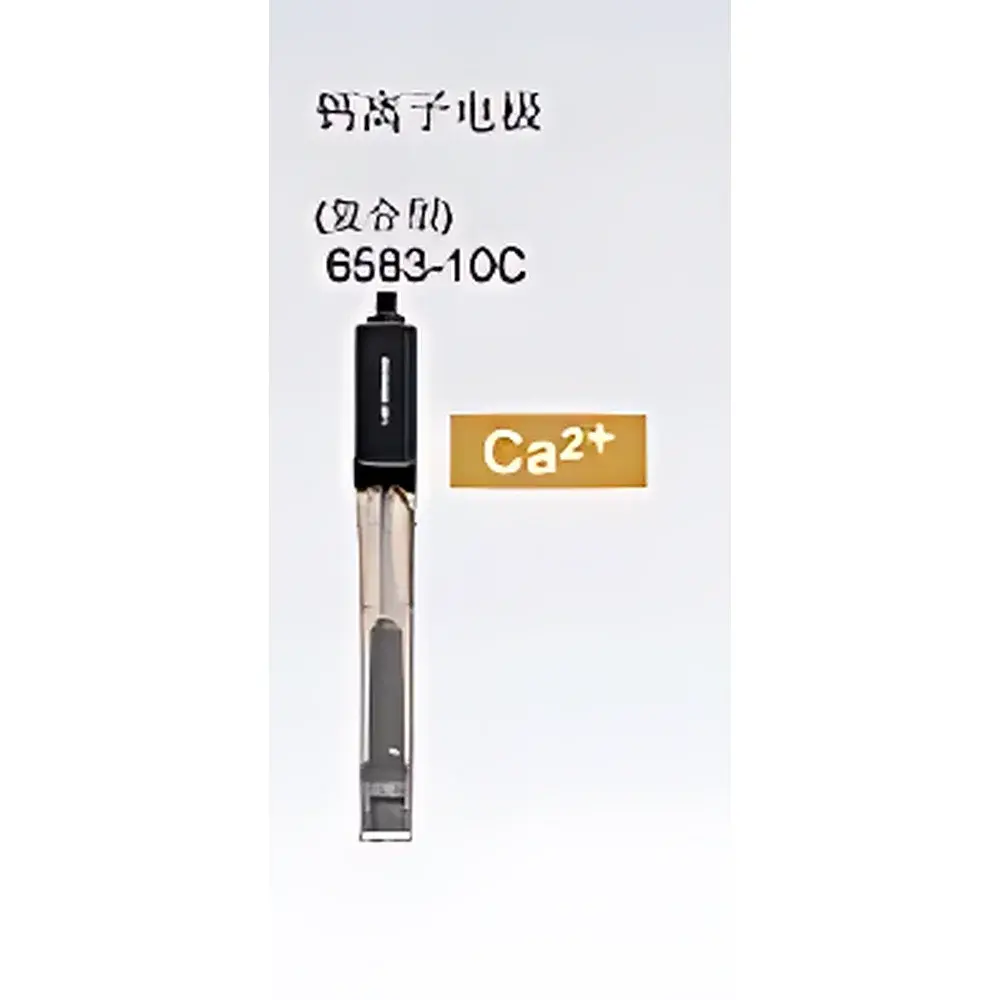
HORIBA 6583-10C Calcium Ion-Selective Electrode (Composite Type)
| Brand | HORIBA |
|---|---|
| Origin | Japan |
| Model | 6583-10C |
| Measuring Range | 0.4–40,080 ppm Ca²⁺ |
| Electrode Type | Composite ISE (Integrated Reference) |
| Compatible Instruments | F-72, F-73, F-74, F-74BW (benchtop) |
| Catalog No. | 3014093434 (9003014900) |
| Interference Consideration | pH range and coexisting ions affect measurement accuracy |
Overview
The HORIBA 6583-10C is a composite-type calcium ion-selective electrode (ISE) engineered for direct potentiometric measurement of free Ca²⁺ activity in aqueous solutions. It operates on the principle of membrane potential development across a polymeric ionophore-doped sensing membrane—specifically formulated for high selectivity toward calcium ions over common interferents such as Na⁺, K⁺, Mg²⁺, and H⁺ within defined operational constraints. Unlike conventional two-electrode setups requiring separate reference and indicator electrodes, the 6583-10C integrates a stable internal reference system, eliminating liquid junction potential drift and simplifying calibration and field deployment. Its design complies with standard electrochemical ISE theory per ISO 10523 and ASTM D1293, supporting trace-to-macro level quantification across environmental, industrial effluent, drinking water, and wastewater matrices.
Key Features
- Composite construction with built-in double-junction reference system ensures long-term stability and minimizes contamination risk during repeated immersion.
- Wide dynamic detection range: 0.4–40,080 ppm Ca²⁺ (equivalent to ~1×10⁻⁵ M to ~1×10⁻² M), enabling use from ultra-low hardness waters to concentrated brines and process streams.
- Optimized PVC-based ion-selective membrane with calcium ionophore X (ETH 1001 analog) provides Nernstian response slope of −27.5 ± 1.5 mV/decade at 25 °C, verified per IUPAC guidelines.
- Robust epoxy body with integrated temperature sensor (NTC 10 kΩ) supports automatic temperature compensation (ATC) when paired with compatible HORIBA meters (F-series, D-53).
- Chemically resistant O-ring seals and IP67-rated housing ensure reliable operation in humid or splash-prone laboratory and field environments.
- No external filling solution required—maintenance-free operation reduces downtime and eliminates electrolyte leakage concerns typical of conventional calomel or Ag/AgCl reference electrodes.
Sample Compatibility & Compliance
The 6583-10C is validated for use in natural waters (rivers, lakes, groundwater), municipal and industrial wastewater, boiler feedwater, desalination brines, and nutrient solutions. Sample pH must be maintained between 4.0 and 11.0; outside this range, hydrolysis or carbonate precipitation may suppress free Ca²⁺ activity and bias readings. High concentrations of fluoride, phosphate, or oxalate require pretreatment (e.g., acidification + complex masking with EGTA or La³⁺) to avoid interference. The electrode meets essential requirements for GLP-compliant water quality testing under ISO/IEC 17025:2017 and supports audit-ready documentation when used with HORIBA instruments featuring 21 CFR Part 11–compliant software modules (e.g., F-74BW with optional data logging firmware).
Software & Data Management
When connected to HORIBA’s F-series benchtop analyzers or D-53 portable meter, the 6583-10C leverages embedded calibration algorithms supporting one-point, two-point, or multi-point standard addition protocols. All measurements are timestamped, temperature-corrected, and stored with metadata including electrode ID, calibration history, and operator input. Export formats include CSV and PDF reports compliant with EPA Method 300.1 and ISO 10304-1 for anion/cation analysis. Optional HORIBA LabManager™ software enables centralized fleet management, firmware updates, and traceability logs aligned with GMP documentation standards.
Applications
- Regulatory monitoring of calcium hardness in drinking water per WHO Guidelines and EU Directive 98/83/EC.
- Process control in water softening plants, reverse osmosis systems, and cooling tower management.
- Ecotoxicological assessment of Ca²⁺ bioavailability in freshwater ecosystems (e.g., chronic exposure studies per OECD 202).
- Quality assurance in pharmaceutical excipient testing (e.g., calcium carbonate content verification per USP ).
- Research applications in soil leachate analysis, hydroponic nutrient profiling, and cement pore solution characterization.
FAQ
What is the recommended storage condition for the 6583-10C electrode?
Store upright in 0.01 M CaCl₂ solution or dedicated ISE storage solution; never in deionized water or dry conditions.
Can the 6583-10C be used with non-HORIBA meters?
Yes—any pH/mV meter with BNC input and millivolt readout capability can interface it, though full ATC, auto-calibration, and compliance reporting require HORIBA hardware/software integration.
How often should calibration be performed?
Daily calibration is recommended for routine QC; for high-precision work or regulatory submissions, calibrate before each analytical batch using certified reference standards traceable to NIST SRM 3109a.
Does this electrode require conditioning before first use?
Yes—soak in 100 ppm Ca²⁺ standard for ≥2 hours prior to initial calibration to stabilize membrane potential and achieve optimal slope response.
Is the 6583-10C suitable for seawater analysis?
It can measure total dissolved Ca²⁺ in seawater (~400 ppm), but matrix effects from high ionic strength and Mg²⁺ require sample dilution and ionic strength adjustment (e.g., with 0.1 M KNO₃) to maintain accuracy.







