
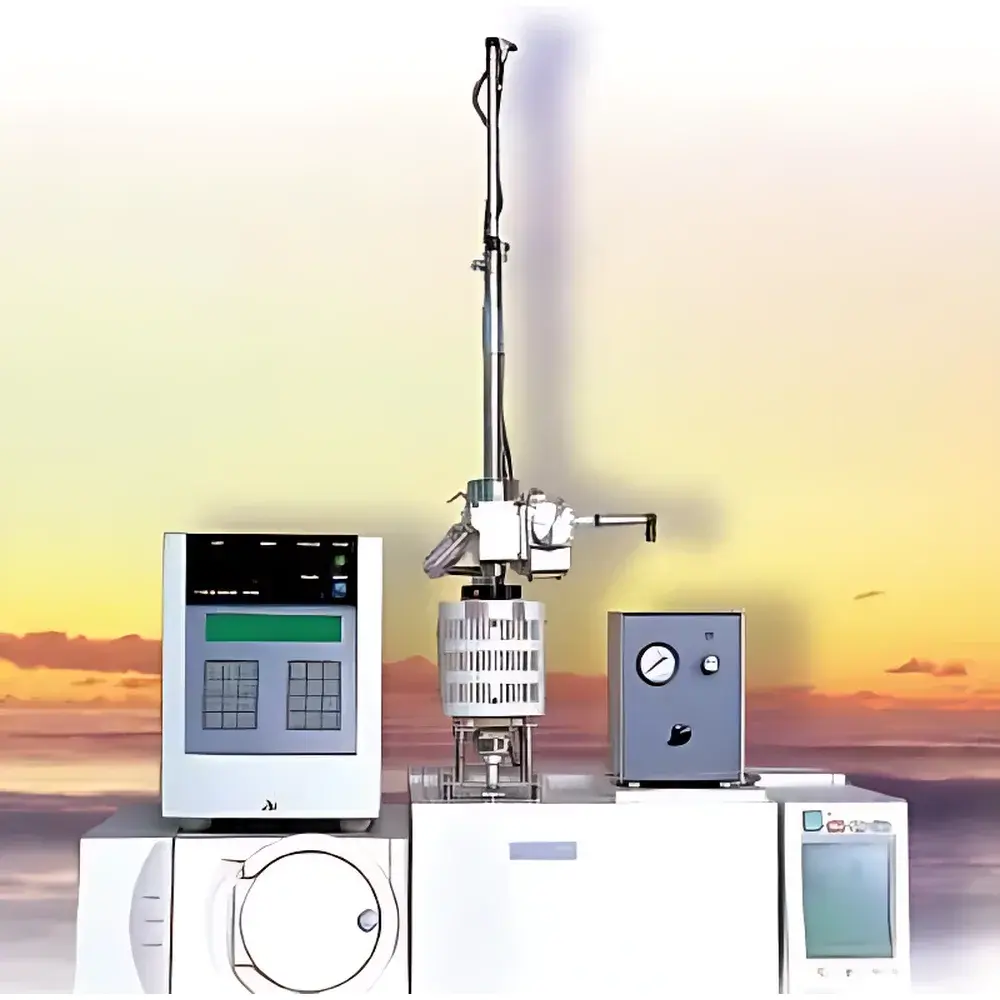
JPS-700 Automated Curie-Point Pyrolyzer
| Origin | Japan |
|---|---|
| Manufacturer Type | Authorized Distributor |
| Origin Category | Imported |
| Model | JPS-700 |
| Instrument Type | Curie-Point Pyrolyzer |
| Maximum Sample Capacity | 40 samples |
| Pyrolysis Temperature Range | Up to 400 °C (typical operating range ≤300 °C) |
| Heating Method | High-Frequency Induction |
| RF Frequency | 600 kHz |
| RF Power Output | 48 W |
| Pyrolysis Duration Control | 1–9,999 s |
| Inter-Analysis Interval | 0.01–999.99 min |
| Carrier Gas Purge | Dual-point dry air purge (pressure ≥0.4 MPa) |
| GC Interface | Universal GC-mount adapter |
| Compliance | Compatible with ASTM D7250, ISO 11348, and USP <621> chromatographic system integration requirements |
Overview
The JPS-700 Automated Curie-Point Pyrolyzer is a precision-engineered thermal desorption instrument designed for reproducible, high-throughput pyrolysis-gas chromatography/mass spectrometry (Py-GC/MS) analysis of thermally labile and non-volatile organic materials. Unlike furnace-based or filament-type pyrolyzers, the JPS-700 employs Curie-point induction heating—where ferromagnetic alloy foils (e.g., Ni–Fe or Fe–Co) are heated rapidly and precisely to their material-specific Curie temperature via high-frequency electromagnetic fields. This principle ensures isothermal, instantaneous, and highly repeatable thermal decomposition at user-defined temperatures (up to 400 °C), eliminating thermal lag and gradient-related artifacts. The system integrates seamlessly with standard GC and GC/MS platforms as a front-end sample introduction module, enabling automated, unattended analysis of up to 40 pre-packaged samples per run—ideal for QC laboratories, polymer characterization labs, forensic chemistry units, and geological sample screening workflows requiring strict traceability and inter-laboratory comparability.
Key Features
- Automated 40-position foil magazine with sequential, CPU-controlled sample loading and ejection—eliminating manual handling and reducing operator-induced variability.
- Curie-point induction heating at 600 kHz with precise dwell-time control (1–9,999 s), delivering consistent thermal energy input independent of sample mass or matrix effects.
- Dual-point dry air purge system (≥0.4 MPa) with integrated flow controller (FWC-33B) to ensure carrier gas stability, minimize memory effects, and support both standalone pyrolysis and direct Py-GC coupling modes.
- Magnetic foil retrieval mechanism: after pyrolysis, a pneumatically actuated magnetic rod extracts the spent foil and deposits it into a dedicated waste canister—verified in real time by optical sensors for process integrity.
- Universal GC adapter compatible with all major gas chromatograph models (Agilent, Thermo Fisher, Shimadzu, PerkinElmer), supporting both split/splitless and cold-on-column injection configurations.
- No regulatory filing required for high-frequency operation: the 48 W, 600 kHz RF generator complies with IEC 61000-6-3 emission limits and does not necessitate local radiofrequency equipment licensing.
Sample Compatibility & Compliance
The JPS-700 demonstrates broad applicability across heterogeneous solid matrices without prior solvent dissolution or derivatization. Validated use cases include vulcanized rubber (SBR, NR, EPDM), engineering thermoplastics (PA6, PA66, POM), synthetic fibers (nylon, polyester), coal and kerogen-rich geological specimens, and aged polymeric packaging residues. Sample masses (typically 0.1–2.0 mg) are weighed gravimetrically onto standardized Curie-point foils—enabling quantitative calibration against certified reference materials (CRMs) per ISO/IEC 17025 requirements. The system supports audit-ready data acquisition when paired with GLP/GMP-compliant GC/MS software; all pyrolysis trigger events, temperature profiles, and inter-sample intervals are timestamped and logged with metadata (operator ID, method name, sample ID), satisfying FDA 21 CFR Part 11 electronic record integrity criteria.
Software & Data Management
Operation is governed by an embedded 32-bit CPU with a monochrome LCD interface for local parameter entry (sample count, dwell time, interval delay, GC trigger mode). For full traceability, the JPS-700 outputs TTL-compatible pyrolysis start/stop signals to synchronize with GC autosampler clocks or MS acquisition software (e.g., Agilent MassHunter, Thermo Xcalibur). All timing parameters—including foil ejection confirmation pulses—are recorded in ASCII-formatted log files exportable via USB port. When integrated into LIMS environments, these logs link directly to sample IDs and analytical batches, supporting automated report generation and deviation investigation workflows. Firmware updates are performed via secure USB flash drive, with version rollback capability retained for method validation continuity.
Applications
- Quantitative polymer composition analysis (e.g., copolymer ratio determination in ABS or SAN resins via characteristic fragment ion ratios).
- Forensic identification of unknown adhesives, sealants, and automotive under-hood materials using pyrolyzate fingerprint libraries (NIST 2023 Pyrolysis Library, Wiley Polymer Fragmentation Database).
- Thermal stability assessment of flame-retardant additives in electronics-grade plastics per UL 94 and IEC 60695 test protocols.
- Routine QC screening of recycled plastic feedstocks for contaminant detection (e.g., PVC in PET streams via chlorobenzene markers).
- Paleoenvironmental reconstruction through biomarker pyrolysis of sedimentary organic matter, aligned with ASTM D7250-22 guidelines for kerogen typing.
FAQ
What Curie-point foil alloys are supported, and how are temperature calibrations performed?
The JPS-700 is compatible with commercially available Ni–Fe (e.g., 350 °C), Fe–Co (e.g., 420 °C), and Ni–Co (e.g., 310 °C) foils. Calibration is verified using NIST-traceable thermocouple probes inserted into dummy foils during commissioning; no routine recalibration is required due to inherent alloy-specific Curie temperature stability.
Can the JPS-700 be used with cryo-focused GC injectors?
Yes—the GC adapter maintains mechanical compatibility with liquid nitrogen or CO₂ cryo-trapping modules. The 350 °C maximum needle temperature ensures efficient volatilization of heavy pyrolyzates prior to cold trapping.
Is remote start/stop functionality available for integration into automated lab workflows?
The unit accepts external TTL triggers from GC systems or central lab automation controllers (e.g., Hamilton STAR, Tecan Fluent). Two isolated digital I/O lines support independent pyrolysis initiation and completion signaling.
How is carryover minimized between samples?
Carryover mitigation is achieved through dual air purge zones (pre- and post-pyrolysis), real-time foil removal verification, and programmable purge duration (0.1–5.0 min) configurable per sample batch.
Does the system comply with ISO/IEC 17025 method validation requirements?
Yes—its deterministic heating profile, sensor-confirmed foil handling, and timestamped event logging meet ISO/IEC 17025:2017 clauses 7.2.2 (method validation) and 7.7 (result reporting), particularly when combined with certified CRMs and documented uncertainty budgets.





