
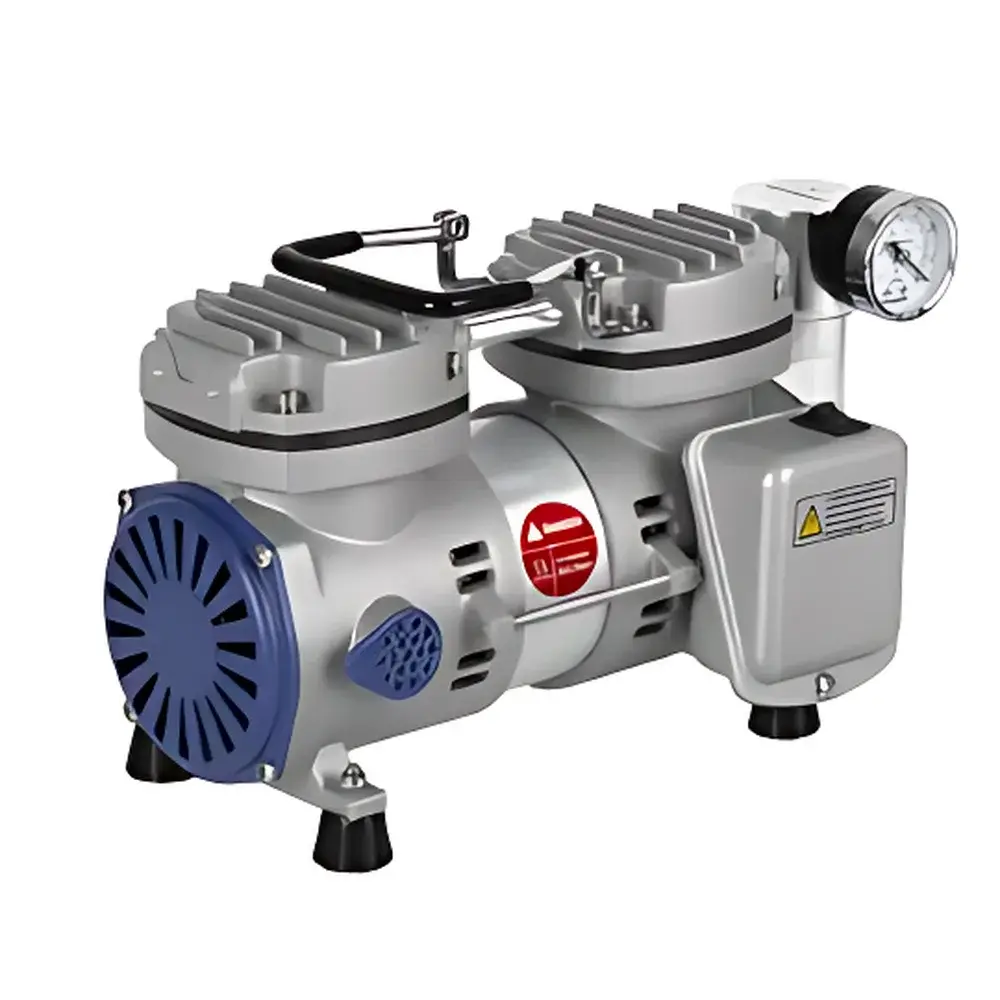
WIGGENS V810 Oil-Free Vacuum Pump
| Brand | WIGGENS |
|---|---|
| Origin | Germany |
| Model | V810 |
| Pump Type | Oil-Free Piston Vacuum Pump |
| Ultimate Vacuum | 30 mbar |
| Pumping Speed | 50 L/min |
| Motor Power | 220 W |
| Dimensions (W×D×H) | 350 × 170 × 195 mm |
| Weight | 8.6 kg |
| Noise Level | 52 dB(A) |
| Input Voltage | 220–240 V / 50 Hz |
| Motor Speed | 1450 rpm |
| Inlet Port Diameter | 9 mm |
| Thermal Overload Protection | Integrated |
| Inlet Filter | Standard Sintered Filter Cartridge |
| Compliance | CE, RoHS |
Overview
The WIGGENS V810 Oil-Free Vacuum Pump is a precision-engineered, single-stage piston vacuum pump designed for reliable, contamination-free operation in analytical, biological, and quality control laboratories. Operating on the principle of reciprocating piston displacement, the V810 generates vacuum without lubricating oil—eliminating oil vapor backstreaming, hydrocarbon contamination, and associated maintenance requirements. Its ultimate vacuum of 30 mbar and stable pumping speed of 50 L/min at atmospheric pressure make it suitable for routine vacuum applications requiring moderate vacuum levels and consistent flow performance. The pump’s compact footprint (350 × 170 × 195 mm), low operational noise (52 dB(A)), and robust thermal management system support integration into shared lab environments where acoustic comfort and space efficiency are critical.
Key Features
- Oil-free piston technology ensures zero oil carryover—critical for applications sensitive to hydrocarbon contamination, including microbiological filtration, food sample preparation, and solvent-free vacuum drying.
- Integrated thermal overload protection automatically interrupts motor operation when internal temperature exceeds safe thresholds; automatic restart occurs after passive cooling, enhancing equipment longevity and unattended operation safety.
- Standard sintered inlet filter cartridge captures particulates and moisture from intake air, protecting the cylinder and piston seal integrity and extending service intervals between inspections.
- Low-noise design (52 dB(A) at 1 m) achieved through precision-balanced crankshaft assembly, vibration-damping housing, and optimized airflow paths—meets ISO 7779 and IEC 60034-9 acoustic standards for laboratory-grade equipment.
- Universal port configuration (9 mm BSP inlet) enables rapid integration with common vacuum manifolds, filter flasks, and vacuum ovens; optional pressure conversion kits allow reversible operation as a positive-pressure source (up to 0.2 bar gauge), supporting dual-mode utility in resource-constrained labs.
Sample Compatibility & Compliance
The V810 is validated for use with non-corrosive, non-condensable gases and vapors only. It is not rated for solvents with high vapor pressure (e.g., acetone, chloroform), acidic or alkaline gases, or abrasive particulates beyond the capacity of its standard sintered filter. As an electrical appliance conforming to EN 61000-6-3 (EMC emission) and EN 61000-6-1 (immunity), the pump carries CE marking and complies with RoHS Directive 2011/65/EU. While not intrinsically safe, its construction meets general-purpose laboratory safety requirements under EN 61010-1:2010 for measurement, control, and laboratory equipment. For GLP/GMP-regulated workflows, audit trails for pump usage are maintained externally via compatible data loggers or LIMS interfaces.
Software & Data Management
The V810 operates as a standalone analog device with no embedded firmware, touchscreen, or digital communication interface (e.g., RS-232, USB, or Ethernet). This architecture minimizes failure points and eliminates software validation burdens in regulated environments. Operational status is indicated solely by mechanical power switch and LED illumination. For traceable vacuum process documentation, users may integrate third-party pressure transducers (e.g., capacitive or piezoresistive sensors) with data acquisition systems compliant with FDA 21 CFR Part 11—provided electronic records include operator identification, timestamping, and change history logging. WIGGENS provides calibration guidance and recommended maintenance intervals (every 12 months or 2,000 operating hours) in accordance with ISO/IEC 17025:2017 Annex A.3.
Applications
- Microbiological membrane filtration (ASTM D5157, ISO 9308-1) for coliform and E. coli enumeration in water and beverage testing.
- Vacuum-assisted liquid filtration using Büchner or Hirsch funnels with glass or polypropylene filter holders.
- Deaeration and degassing of reagents prior to HPLC mobile phase preparation or cell culture media sterilization.
- Operation of vacuum desiccators and benchtop vacuum ovens (e.g., drying lyophilized samples at ≤40 °C).
- Air sampling for particulate matter (PM₁₀, PM₂.₅) collection onto PVC or polycarbonate filters per EPA Method IO-2.2.
- Controlled aeration of fermentation broths or activated sludge samples in environmental microbiology studies.
FAQ
Can the V810 be used with corrosive or solvent-laden vapors?
No. The pump is strictly intended for clean, dry, non-corrosive gases. Exposure to halogenated solvents, acids, or condensable vapors will degrade piston seals and void warranty.
Is routine oil replacement required?
None—this is an oil-free design. No lubrication is needed during normal operation. Only periodic inspection and replacement of the inlet filter cartridge (recommended every 6 months under continuous use) are required.
What is the expected service life under typical lab usage?
With proper inlet filtration and ambient operating temperatures (15–30 °C), the motor and piston assembly are rated for ≥10,000 hours of operation, corresponding to approximately 5–7 years of standard 8-hr/day lab shifts.
Does the pump meet regulatory requirements for pharmaceutical QC labs?
It satisfies general electrical safety and EMC requirements (CE, RoHS) but lacks built-in audit trail or electronic signature capabilities. Integration with validated external monitoring systems is necessary to fulfill FDA 21 CFR Part 11 or EU Annex 11 compliance.
Can the V810 be mounted vertically or inverted?
No. It must be operated in the supplied orientation only—horizontal base contact with stable, level surface—to ensure proper heat dissipation and piston alignment.



