
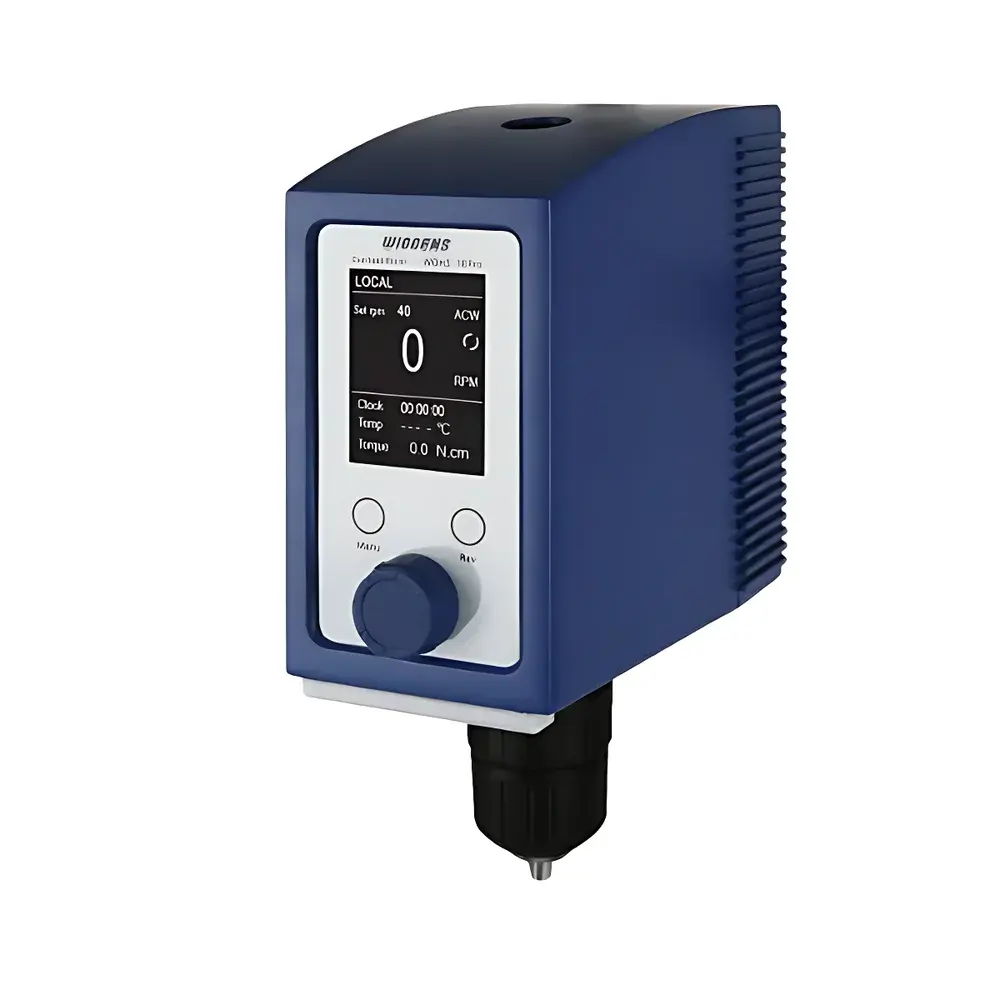
WIGGENS WOHS-18 Pro Overhead Stirrer
| Brand | WIGGENS |
|---|---|
| Origin | Germany |
| Model | WOHS-18 Pro |
| Maximum Stirring Volume | ≤50 L (H₂O) |
| Speed Range | 40–2000 rpm |
| Speed Resolution | ≥1 rpm |
| Speed Accuracy | ≤±3% (at n > 300 rpm) |
| Temperature Measurement Range | −10 to 350 °C |
| Temperature Resolution | 0.1 °C |
| Max. Viscosity Handling | ≤50,000 mPa·s |
| Max. Torque | ≤70 N·cm |
| Motor Type | Brushless DC Motor |
| Chuck Type | Self-locking, tool-free drill chuck |
| Shaft Clamp Diameter | 0.5–10 mm |
| Hollow Shaft Inner Diameter | 10.2 mm |
| Dimensions (W×D×H, without support rod) | 101×191×251 mm |
| Support Rod Specification | 13×150 mm |
| IP Rating | IP42 |
| Power Supply | 100–240 V AC, 50/60 Hz |
| Input/Output Power | 115 / 70 W |
| Display | High-brightness TFT LCD |
| Direction Control | Clockwise & Counterclockwise |
| Timer Range | 0–99 h 59 min 59 sec |
| Status Indicators | Standby (blue), Running (green), Alarm (red) |
Overview
The WIGGENS WOHS-18 Pro Overhead Stirrer is an engineered solution for high-demand laboratory mixing, homogenization, and dispersion tasks requiring precise speed control, thermal monitoring, and mechanical robustness. Unlike magnetic stirrers, this overhead design employs a direct-drive brushless DC motor coupled with a self-locking chuck system—eliminating coupling losses and enabling stable torque transmission across wide viscosity ranges (up to 50,000 mPa·s). Its modular architecture supports scalable agitation in vessels from small beakers to 50 L reactors, while the integrated temperature sensor (−10 to 350 °C) allows real-time thermal feedback during exothermic or endothermic processes. Designed and assembled in Germany, the unit complies with IEC 61000-6-3 (EMC) and IEC 61010-1 (safety for laboratory equipment), ensuring operational integrity in regulated environments including GLP-compliant QC labs and pilot-scale R&D facilities.
Key Features
- Brushless DC motor: Delivers consistent torque output, low electromagnetic interference, and extended service life—critical for uninterrupted long-duration experiments (e.g., polymerization kinetics or crystallization studies).
- Self-locking, tool-free chuck: Accepts stirring rods with diameters from 0.5 to 10 mm; hollow shaft (10.2 mm inner diameter) accommodates thermocouples or pH probes without compromising rotational stability.
- High-resolution TFT display: Shows real-time speed (40–2000 rpm, 1-rpm increments), temperature (0.1 °C resolution), torque trend (derived from motor current), and elapsed time—enabling traceable parameter logging.
- Bidirectional rotation control: Programmable clockwise/counter-clockwise switching supports specialized protocols such as deagglomeration of shear-sensitive suspensions or controlled flocculation.
- IP42-rated enclosure: Protects internal electronics against splashing water and solid objects ≥1 mm—suitable for fume hood or wet-lab deployment.
- Wide thermal operating range: Integrated Pt100-compatible temperature sensing enables closed-loop monitoring—not control—of reaction mass, supporting ASTM E2913-22 (standard practice for temperature measurement in mixing applications).
Sample Compatibility & Compliance
The WOHS-18 Pro handles aqueous, organic, and viscous non-Newtonian media—including polymer melts, ceramic slurries, and pharmaceutical suspensions—within its 50 L capacity limit (water-equivalent). Its torque delivery (≤70 N·cm) and speed stability (<±3% deviation above 300 rpm) meet ISO 4787:2021 requirements for volumetric apparatus calibration support. The device does not include active heating/cooling but interfaces seamlessly with external circulators via standard mounting fixtures. All electrical components conform to CE marking directives (2014/30/EU EMC, 2014/35/EU LVD) and RoHS 2011/65/EU material restrictions. For FDA-regulated environments, audit trails can be generated via optional RS232/USB data export compliant with 21 CFR Part 11 when paired with validated third-party software.
Software & Data Management
While the WOHS-18 Pro operates autonomously via front-panel controls, it supports ASCII-based serial communication (RS232) and USB virtual COM port output for integration into LabVIEW, Python-based acquisition systems, or ELN platforms. Timestamped logs include speed setpoint, actual rpm, measured temperature, torque index, direction status, and alarm flags (e.g., overtemperature, overload, timeout). Exported .csv files retain full metrological traceability per ISO/IEC 17025:2017 clause 7.7.2. No proprietary software is required; raw data streams are compatible with open-source analysis tools such as Pandas or OriginLab for post-hoc correlation of shear rate vs. viscosity profiles.
Applications
- Scale-up mixing validation in API synthesis (batch consistency per ICH Q5A)
- Rheological preconditioning of battery electrode slurries prior to coating
- Homogenization of nanocomposite dispersions under inert atmosphere (via sealed reactor coupling)
- Controlled dissolution testing per USP , where mechanical agitation must replicate in vivo hydrodynamics
- Long-term stability studies of emulsions and colloidal suspensions (≥72 h continuous operation)
- Preparation of calibration standards for viscometers and particle size analyzers
FAQ
Does the WOHS-18 Pro provide active temperature control?
No—it features integrated temperature *monitoring* only. External heating mantles, cooling jackets, or recirculating chillers must be used for thermal regulation.
Can it be mounted on custom reactor frames?
Yes. The 13 mm diameter support rod (150 mm length) is compatible with standard lab clamps (e.g., Thorlabs, Fischer Scientific) and OEM reactor flanges with M12 or ½″ NPT threading adapters.
Is torque measurement calibrated and traceable?
Torque values are derived from motor current and displayed as a relative trend indicator—not a metrologically certified measurement. For quantitative rheology, pairing with a dedicated rotational rheometer (e.g., Anton Paar MCR series) is recommended.
What maintenance is required for long-term reliability?
Annual inspection of chuck jaw integrity and bearing preload is advised. Brushless motor design eliminates carbon brush replacement; no scheduled lubrication is needed for the geartrain.
How is overload protection implemented?
The system monitors motor current in real time. If sustained current exceeds safe thresholds (indicating stalled impeller or excessive viscosity), it triggers red LED alarm and halts rotation after 2 s—preventing thermal damage per IEC 60034-1 insulation class F limits.



