
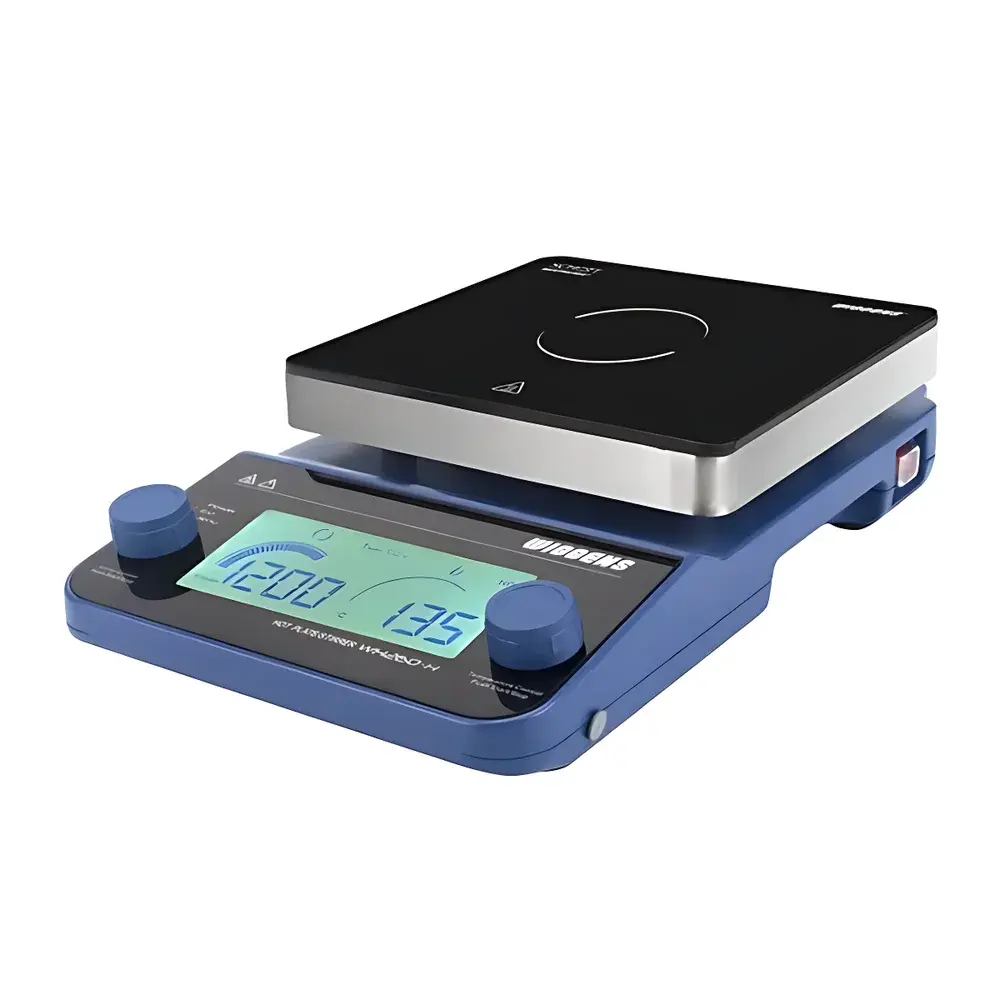
WIGGENS WH260-H Heated Magnetic Stirrer
| Brand | WIGGENS |
|---|---|
| Origin | Germany |
| Model | WH260-H |
| Maximum Stirring Volume | 20 L |
| Speed Range | 100–1500 rpm |
| Heating Plate Temperature | ≤450 °C |
| Sample Temperature Control Range (with Pt100) | ≤300 °C |
| Safety Cut-off Temperature Range | 50–500 °C (adjustable) |
| Over-Temperature Delta Protection (ΔT) | 10–50 °C (adjustable) |
| Temperature Stability (with Pt100) | ±1 °C |
| Heating Power | 800 W |
| Display | LCD |
| Control Interface | Rotary Knob + Menu Navigation |
| Timer Function | 1–1999 min or Continuous |
| External Temperature Sensor | Pt100 |
| PID Control | Triple Preset PID Algorithms (PID1–PID3) |
| Plate Material | Enamel-Coated Glass |
| Plate Dimensions | 180 × 180 mm |
| Dimensions (W×D×H) | 187 × 315 × 95 mm |
| Weight | 3.2 kg |
| Power Supply | 220 V / 50 Hz |
| USB-A Interface | Yes |
Overview
The WIGGENS WH260-H Heated Magnetic Stirrer is an engineered solution for laboratories requiring simultaneous, precise thermal control and mechanical agitation of liquid samples. Based on the principle of magnetic coupling—where a rotating permanent magnet beneath the heated plate induces rotation in a magnetic stir bar immersed in the sample—the WH260-H integrates a high-efficiency infrared-enhanced heating system with microprocessor-based PID temperature regulation. Unlike conventional resistive hotplates, its optimized thermal architecture delivers rapid heat transfer and exceptional uniformity across the enamel-coated glass plate surface (180 × 180 mm), enabling stable setpoint maintenance within ±1 °C when used with an external Pt100 probe. Designed for reproducible operation in regulated environments, the unit supports both open-loop speed control and closed-loop temperature feedback, making it suitable for applications ranging from gentle homogenization of sensitive biological buffers to vigorous mixing of viscous organic reaction mixtures at elevated temperatures up to 300 °C (sample) and 450 °C (plate).
Key Features
- Triple-configurable PID algorithms (PID1–PID3) optimized for distinct thermal load profiles: PID1 for low-thermal-mass samples (e.g., <50 mL aqueous solutions), PID3 for high-volume, high-heat-capacity media (e.g., ≥10 L solvent systems)
- Integrated Pt100 sensor input enabling real-time, closed-loop sample temperature monitoring and regulation—critical for kinetic studies, crystallization protocols, and exothermic reaction control
- Corrosion-resistant spill containment groove surrounding the control panel prevents electrolyte or acid splashes from compromising electronics or user interface integrity
- Sealed enclosure design isolates motor, electronics, and heating elements from ambient particulates and humidity—enhancing long-term reliability in ISO 17025-accredited labs
- Adjustable overtemperature protection (ΔT = 10–50 °C above setpoint) combined with independent safety cut-off (50–500 °C range) meets IEC 61010-1 requirements for laboratory electrical equipment
- USB-A port enables firmware updates and optional data logging via compatible PC software—supporting traceability under GLP/GMP frameworks
Sample Compatibility & Compliance
The WH260-H accommodates vessels from 10 mL vials to 20 L carboys (water-equivalent capacity), provided appropriate stir bar geometry and magnetic coupling strength are selected. Its enamel-glass plate resists chemical attack from common solvents (e.g., acetone, ethanol, dilute acids/bases) and withstands thermal shock during rapid cooldown. The device complies with EN 61326-1 (EMC for laboratory equipment) and EN 61010-1 (safety requirements for electrical equipment for measurement, control, and laboratory use). When operated with validated Pt100 probes and documented calibration records, it supports temperature-critical workflows aligned with ASTM E2877 (standard guide for validation of thermal analysis instruments) and USP (analytical instrument qualification).
Software & Data Management
While standalone operation requires no software, the embedded USB-A interface permits connection to Windows-based configuration utilities for parameter backup, firmware revision tracking, and audit trail generation. All user-defined settings—including speed, temperature setpoint, timer duration, PID selection, and ΔT threshold—are retained in non-volatile memory after power cycling, satisfying FDA 21 CFR Part 11 requirements for electronic record integrity when paired with compliant lab information management systems (LIMS). Optional time-stamped event logs (e.g., “Temp set to 75.0 °C”, “Overtemp alarm triggered at 14:22:08”) can be exported for quality review or regulatory submission.
Applications
- Kinetic reaction monitoring in synthetic organic chemistry, where consistent temperature ramping and mixing intensity directly impact yield and selectivity
- Dissolution testing per USP , particularly for poorly soluble APIs requiring sustained heating and agitation at 37 °C ± 0.5 °C
- Preparation of homogeneous nanoparticle dispersions in aqueous or polar aprotic media, minimizing agglomeration through controlled shear input
- Standardization of buffer solutions and calibration standards under ISO/IEC 17025 clause 7.7 (ensuring measurement traceability)
- Cell culture media pre-warming with strict avoidance of localized overheating that could degrade growth factors or antibiotics
FAQ
Does the WH260-H support external temperature feedback without a Pt100 probe?
No. Closed-loop temperature regulation requires a certified Pt100 sensor connected via the designated analog input port. Open-loop operation (plate-only heating) is possible but lacks sample temperature verification.
Can the WH260-H be integrated into a networked lab automation system?
Not natively. It lacks Ethernet, RS-232, or Modbus interfaces. However, third-party USB-to-serial gateways may enable limited SCADA integration with custom driver development.
What is the recommended calibration frequency for the Pt100 input channel?
Per ISO/IEC 17025, calibration should occur before first use, after any physical impact, and at intervals defined by risk assessment—typically every 6–12 months for routine QC applications.
Is the enamel-glass plate resistant to hydrofluoric acid (HF)?
No. HF etches glass-based coatings. Use only with HF-compatible alternatives (e.g., PTFE-coated hotplates) when handling fluorinated reagents.
How does the WH260-H differ from the WH260-R model?
The WH260-R features a smaller 135 mm diameter plate and reduced weight (2.7 kg), optimized for benchtop space constraints; the WH260-H retains the full 180 × 180 mm plate and higher thermal inertia for large-volume stability.



