
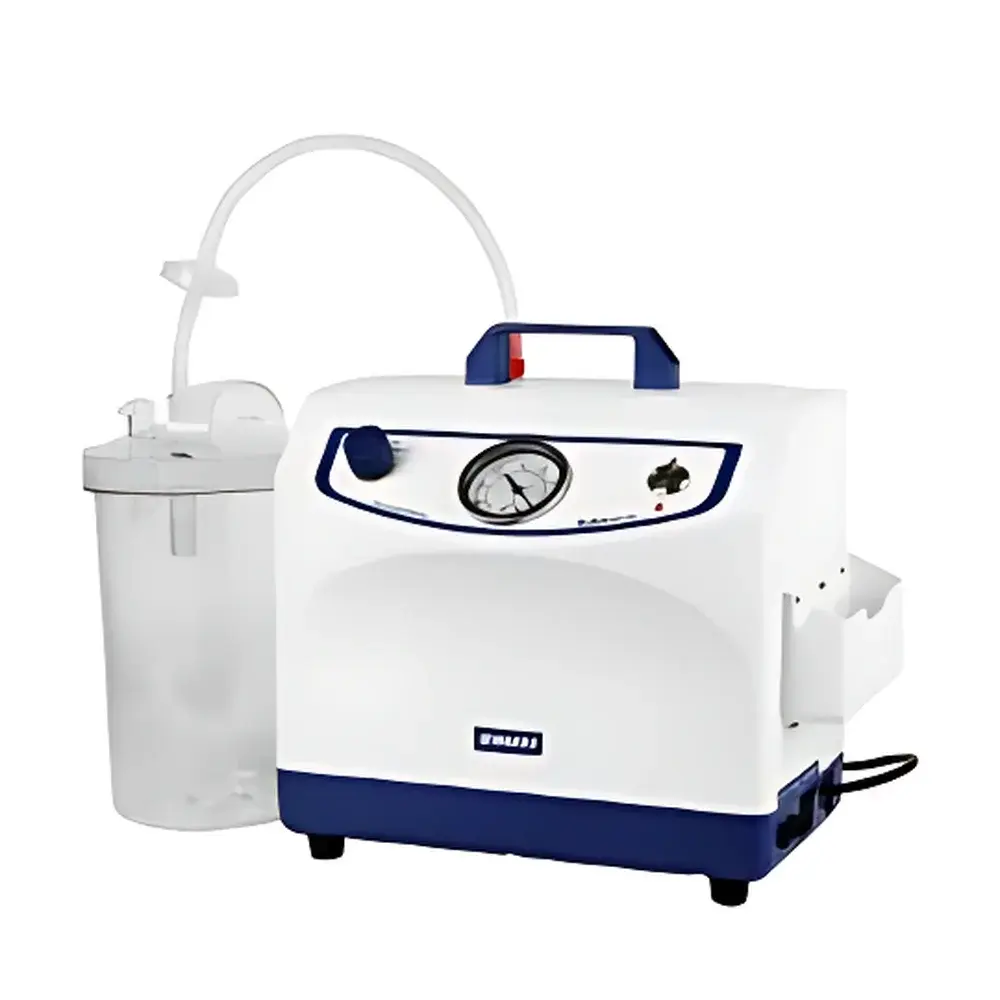
WIGGENS BioVac 240 PLUS Portable Vacuum Liquid Aspiration System
| Brand | WIGGENS |
|---|---|
| Origin | Germany |
| Model | BioVac 240 PLUS |
| Ultimate Vacuum | 100 mbar |
| Maximum Flow Rate | 34 L/min |
| Dimensions | 54 × 26 × 35 cm |
| Weight | 12 kg |
| Waste Bottle Capacity | 3000 mL |
| Filtration | 0.2 µm PTFE disc filter |
| Sterilization Compatibility | Autoclavable (121 °C, 20 min) |
| Foot Switch | Included |
| Standard Accessories | Single-claw stainless steel aspirator tip, eight-claw retractable plastic tip, handheld controller |
Overview
The WIGGENS BioVac 240 PLUS Portable Vacuum Liquid Aspiration System is an engineered solution for sterile, controlled liquid removal in biosafety cabinets, laminar flow hoods, and cell culture laboratories. Designed around a maintenance-free, oil-free diaphragm vacuum pump, the system operates on the principle of regulated negative pressure generation to enable precise aspiration of supernatants, media, wash buffers, and spent reagents—without risk of oil contamination or microbial carryover. Its compact footprint (54 × 26 × 35 cm) and 12 kg mass support benchtop portability across shared lab spaces, while its 100 mbar ultimate vacuum and 34 L/min maximum flow rate provide sufficient suction head for rapid, low-turbulence aspiration of viscous or foaming biological liquids. The system meets core operational requirements for aseptic technique compliance and is routinely deployed during passaging, transfection cleanup, ELISA plate washing, and post-centrifugation supernatant decanting.
Key Features
- Oil-free diaphragm vacuum pump: Eliminates lubricant degradation, hydrocarbon outgassing, and scheduled oil changes—ensuring long-term stability and ISO Class 5 cleanroom compatibility.
- Dual-stage overflow protection: Integrated float valve in the 3000 mL polycarbonate waste bottle prevents overfilling; a secondary 0.2 µm hydrophobic PTFE disc filter placed between bottle and pump blocks aerosol and liquid ingress into the pump chamber.
- Autoclavable components: Both the waste bottle and PTFE filter disc are rated for repeated steam sterilization at 121 °C for 20 minutes (EN 285), supporting GLP-aligned decontamination protocols between experiments.
- Ergonomic control interface: Includes a hands-free foot switch for momentary activation and a handheld controller with tactile feedback—enabling seamless operation inside biosafety cabinets without compromising glove integrity or airflow integrity.
- Modular aspiration tips: Supplied with a single-claw stainless steel tip for robust, high-precision aspiration and an eight-claw retractable plastic tip optimized for multiwell plate aspiration (e.g., 96-well plates), minimizing cross-contamination risk.
Sample Compatibility & Compliance
The BioVac 240 PLUS accommodates aqueous, buffered, and mildly corrosive biological liquids—including PBS, DMEM, FBS-supplemented media, trypsin-EDTA solutions, and fixation reagents (e.g., 4% paraformaldehyde). It is not intended for organic solvents, strong acids/bases, or highly viscous polymer solutions (>100 mPa·s). All wetted parts (bottle, tubing, tips, filter housing) are chemically resistant to standard cell culture reagents and compatible with common disinfectants (70% ethanol, 0.5% sodium hypochlorite). The system conforms to IEC 61000-6-3 (EMC emission limits) and IEC 61000-6-2 (immunity standards); CE marking indicates compliance with EU Machinery Directive 2006/42/EC and Low Voltage Directive 2014/35/EU.
Software & Data Management
As a standalone hardware-only aspiration platform, the BioVac 240 PLUS does not incorporate embedded software, firmware-based logging, or digital connectivity. This architecture ensures electromagnetic compatibility within sensitive instrumentation environments (e.g., adjacent to microscopes or electrophysiology rigs) and eliminates cybersecurity or validation overhead associated with computerized systems. For labs operating under FDA 21 CFR Part 11 or EU Annex 11 requirements, manual usage logs—including date, operator ID, application type, and sterilization cycle records—can be maintained in paper or LIMS-integrated electronic formats. The absence of programmable logic simplifies IQ/OQ documentation and reduces qualification scope for GMP-regulated QC laboratories.
Applications
- Cell culture maintenance: Rapid removal of spent medium during subculturing of adherent and suspension cell lines.
- Microbiology workflows: Aspiration of broth cultures prior to centrifugation or plating; clearing agar plate washes.
- Molecular biology: Removal of ethanol washes after nucleic acid precipitation; aspiration from spin columns and gel excision trays.
- Histology & pathology: Drainage of staining solutions from tissue sections mounted on slides or in staining racks.
- Quality control testing: Controlled aspiration of rinse water or extraction solvents in raw material or finished product testing per USP Analytical Instrument Qualification guidelines.
FAQ
Is the BioVac 240 PLUS suitable for use inside a Class II biosafety cabinet?
Yes—the system’s low noise emission (<52 dB(A)) and zero oil vapor output prevent airflow disruption and maintain cabinet certification integrity.
Can the PTFE filter disc be replaced with a different pore size?
No—the 0.2 µm hydrophobic PTFE disc is factory-integrated and validated for bacterial retention (per ISO 8573-1:2010); substitution voids safety compliance and warranty.
What is the recommended service interval for the diaphragm pump?
None—the oil-free design requires no scheduled maintenance; lifetime expectancy exceeds 10,000 hours under typical intermittent lab usage.
Does the system support continuous operation?
It is rated for duty cycles up to 30 minutes ON / 10 minutes OFF to ensure thermal stability of the motor and diaphragm assembly.
Are replacement waste bottles available with graduations or RFID tags?
Standard polycarbonate bottles include molded volume markings (500–3000 mL); RFID-enabled variants are not offered—custom integration requires third-party hardware modification.



